
Iveron Icon of the Mother of God
Kept 12 February — Commemoration of the icon and its history (Russian usage), 13 October — Arrival of the Moscow copy of the icon, 1648
The Iveron Icon — in Greek the Portaitissa, "the Keeper of the Gate" — is the great wonderworking icon of the Iviron Monastery on Mount Athos, and among the most celebrated icons of the Mother of God in the whole Orthodox world. The tradition tells of a widow of Nicaea who, in the iconoclast persecution under the emperor Theophilus, hid the icon; when a soldier struck it with his spear, blood flowed from the wounded face, and the widow, to save it, set it upright upon the sea. Years later it appeared as a pillar of fire on the waves off Athos, and was received by the Georgian monk Gabriel, who at the Mother of God's word walked upon the water to bring it ashore. Set again and again in the sanctuary, the icon each time removed itself to the monastery gate, until the Mother of God made known that she had come not to be guarded but to guard — whence her title, Portaitissa. Its several commemorations (Bright Tuesday on Athos, February 12, October 13, and the Georgian remembrances) are kept across the Orthodox world.

The widow of Nicaea, and the blood from the icon
The history of the Portaitissa opens in the second and fiercer iconoclasm, under the emperor Theophilus (829–842), when the imperial agents went through the provinces destroying the holy images and punishing those who kept them. Near Nicaea a devout widow possessed a revered icon of the Mother of God, which she kept and honoured in a shrine by her house. When the soldiers of the emperor found it, one of them struck the image with his spear — and from the wounded face, at the right cheek, blood flowed as from a living wound. The soldiers fled in terror; and the widow, fearing the icon would yet be seized and burned, took counsel with her son and by night carried it to the sea. Standing on the shore, she prayed, and committed the icon to the deep — and it did not sink or lie flat upon the water, but stood upright upon the waves and moved out to sea, borne westward by an unseen hand. (The widow's son, the tradition adds, made his way to Thessalonica and thence to Athos, and became a monk; from him the fathers of the Holy Mountain first learned the story of the icon that would one day come to them.)
The pillar of fire, and Gabriel the Georgian
Many years afterward — the Athonite tradition sets it about the year 1004 — the monks of the Iviron monastery, the great Georgian house of the Holy Mountain (its name, Iviron, means "of the Iberians," that is, the Georgians), saw upon the sea a pillar of fire reaching up to heaven, standing over an icon of the Mother of God that floated upon the waves. For several days the wonder continued; when the monks went down in a boat to take the icon, it withdrew from them the nearer they came, and could not be reached. Then the Mother of God appeared to a holy elder of the monastery, the Georgian Gabriel (commemorated May 13) — a monk of great simplicity and prayer, who kept the ascetic life on the heights above — and told him that she wished to give her icon to the monastery for its protection, and that he was to go down to the sea and walk upon the waves with faith to receive her. Gabriel obeyed: he walked upon the water as though upon dry land, took up the holy icon in his arms, and bore it back to the shore, where the fathers received it with lamps and censers and hymns, and kept three days of prayer and joy on the sands.
The Keeper of the Gate
The monks carried the icon into the church and set it in the sanctuary with all honour. But the next morning it was found not in the sanctuary but over the gate of the monastery; they returned it to its place, and again it removed itself to the gate; and this happened many times. At last the Mother of God appeared again to Gabriel and made her will plain: "I have not come that you should guard me, but that I should be your guardian, in this life and in that which is to come. As long as you see my icon in the monastery, the grace and mercy of my Son toward you shall not fail." So the fathers built a church at the gate to house the icon, and there it has remained; and from her post at the entrance she is called Portaitissa, the Keeper (or Gate-keeper) of the Gate — the sentinel of the Holy Mountain. The wound in her cheek, and the trace of blood, are shown upon the icon to this day.
The Portaitissa has been the sign and safeguard of Iviron through the centuries — the fathers recount her warnings of pirate raids and of famine, her feeding of the monastery in dearth, and the ancient promise that her departure from the gate would be the sign of coming judgment upon the Mountain, for which reason the monks watch over the icon as over their own life.
The Moscow copy
In 1648, at the request of the Russian archimandrite (and future patriarch) Nikon, the fathers of Iviron made a faithful copy of the Portaitissa — the iconographer keeping a strict rule of fasting and prayer, and mixing into the paints water with which the original had been washed — and sent it to Moscow, where it was received with immense solemnity at the city gate on October 13, 1648. The Moscow Iveron icon was set in a chapel by the Resurrection (Iveron) Gate of the Kitay-gorod wall, and became one of the most venerated icons of the Russian capital, carried in procession to the sick and to the houses of the city; its chapel stood until the Soviet demolition of the gate, and was rebuilt in the 1990s. This is the origin of the October 13 commemoration and of the icon's great Russian fame, under the name Iverskaya.
Feast and commemoration
The Iveron Icon has several commemorations, and the calendars differ in which they emphasise:
- Bright (Renewal) Tuesday — the Tuesday of Renewal Week, two days after Pascha — is the principal Athonite feast of the Portaitissa, kept at Iviron with a great procession; being movable, it has no fixed date.
- February 12 (church date; Old Calendar civil February 25) — kept in Russian usage as a commemoration of the icon and the history of its coming, and the day on which it is authored here.
- October 13 (Old Calendar civil October 26) — the arrival of the Moscow copy in 1648.
- The Georgian and Athonite tradition also keeps memorials tied to the icon's reception on the Holy Mountain.
The feast is a day of the Mother of God, kept in Russian usage with the blue vestments there appointed for her feasts.
Hymns
Troparion — Tone 1
The insolence of them that hate the image of the Lord, and the power of the ungodly, came godlessly upon Nicaea, and those sent thither cruelly tormented a widow who piously honoured the icon of the Mother of God; but she by night, together with her son, sent the icon forth upon the sea, crying aloud: Glory to Thee, O Pure One, for the untrodden sea hath lent Thee its shoulders; glory to Thy straight voyaging, O only Incorrupt One.
Original translation from the Slavonic
Kontakion — Tone 8
Though thy holy icon was cast into the sea, O Theotokos, by a widow who could not save it from the enemies, yet hast thou been shown forth as the Guardian of Athos and the Keeper of the Gate of the Iveron monastery, striking terror into the foes, and delivering from all afflictions and calamities, in the Orthodox land of Russia, them that honour thee.
Original translation from the Slavonic
Appointed readings
Epistle — Philippians 2:5–11
5Let this mind be in you, which was also in Christ Jesus: 6Who, being in the form of God, thought it not robbery to be equal with God: 7But made himself of no reputation, and took upon him the form of a servant, and was made in the likeness of men: 8And being found in fashion as a man, he humbled himself, and became obedient unto death, even the death of the cross. 9Wherefore God also hath highly exalted him, and given him a name which is above every name: 10That at the name of Jesus every knee should bow, of things in heaven, and things in earth, and things under the earth; 11And that every tongue should confess that Jesus Christ is Lord, to the glory of God the Father.
Gospel — Luke 10:38–42; 11:27–28
38Now it came to pass, as they went, that he entered into a certain village: and a certain woman named Martha received him into her house. 39And she had a sister called Mary, which also sat at Jesus’ feet, and heard his word. 40But Martha was cumbered about much serving, and came to him, and said, Lord, dost thou not care that my sister hath left me to serve alone? bid her therefore that she help me. 41And Jesus answered and said unto her, Martha, Martha, thou art careful and troubled about many things: 42But one thing is needful: and Mary hath chosen that good part, which shall not be taken away from her. 27And it came to pass, as he spake these things, a certain woman of the company lifted up her voice, and said unto him, Blessed is the womb that bare thee, and the paps which thou hast sucked. 28But he said, Yea rather, blessed are they that hear the word of God, and keep it.
Iconography
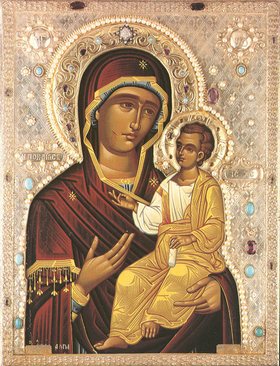
The Portaitissa is of the Hodegetria type, the "She who shows the Way": the Mother of God bearing the Christ Child on her left arm and gesturing toward him with her right hand, the Child raising his hand in blessing and holding a scroll. Its one unmistakable feature — the mark by which every copy of the Iveron type is known — is the wound on the Mother of God's right cheek, with a drop or trickle of blood, recalling the blow of the iconoclast's spear from which blood flowed. The venerated original at Iviron is dark with age and almost wholly covered by a jewelled riza that leaves visible the faces and the wounded cheek. The stored image is a reproduction of the Iveron (Portaitissa) type, showing the characteristic composition (source, public domain, pd-old-work).