
Gabriel the Iberian
Our Venerable Father Gabriel the Iberian, who received the Portaitissa icon from the sea
Venerable · d. 11th century, on Mount Athos
Commemorated 13 May — Commemoration with the Georgian fathers of Iviron
Gabriel was a Georgian ascetic of Mount Athos, a monk of great simplicity who lived in a cave in the high ground above the boundary between Xeropotamou and the monastery of Saint Panteleimon. At the word of a divine voice he came down to the shore and, walking upon the sea, received from the waves the icon of the Mother of God afterwards called Portaitissa, the "Keeper of the Gate" — the Iveron icon, which of its own will took its place over the monastery gate and has remained the great treasure and the guardian of Iviron ever since. The Church honours him with the other Georgian fathers of the Holy Mountain on May 13. Almost nothing else of his life is recorded: he is known by one act, and it is one of the most famous acts in the history of Athos.
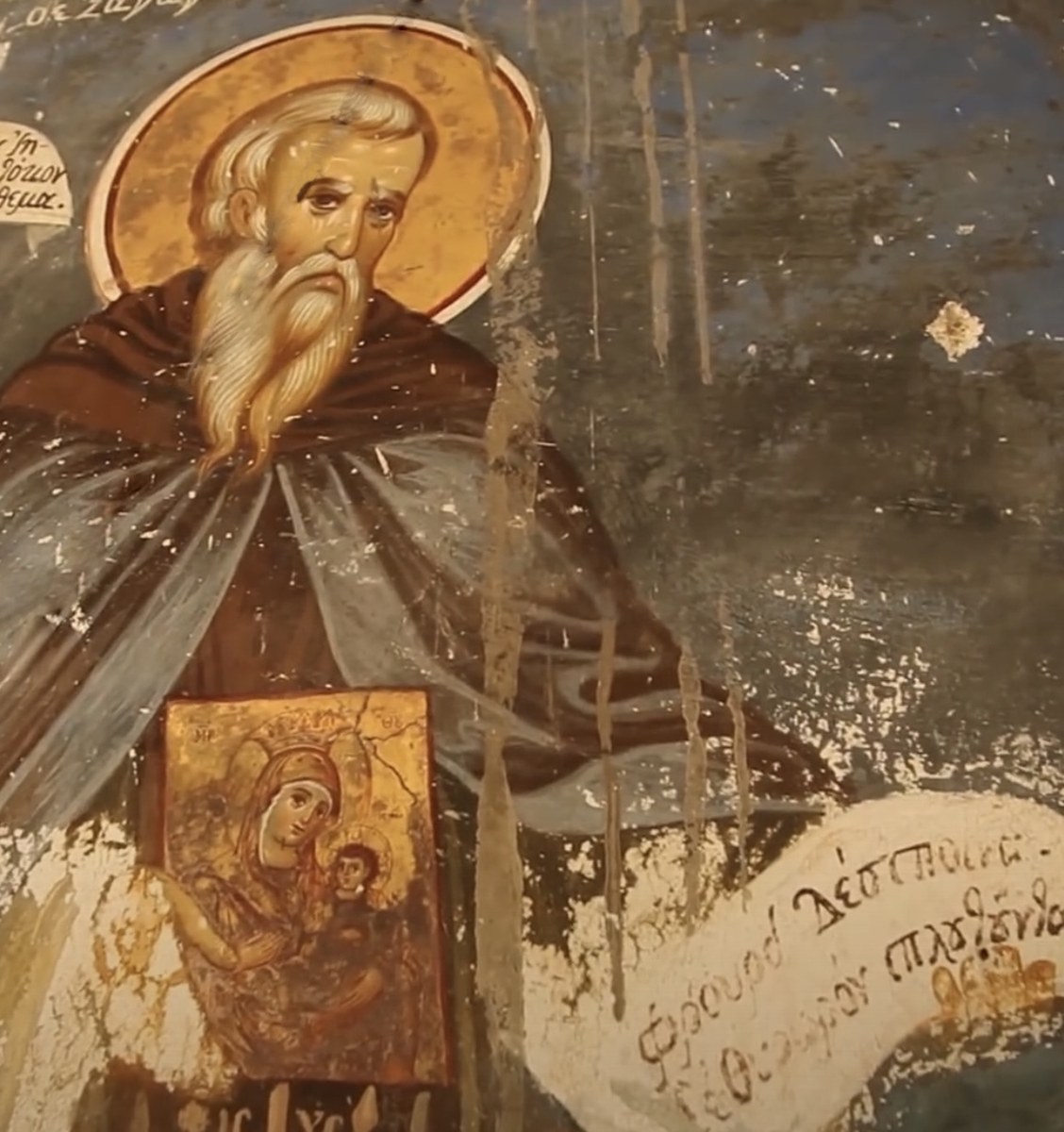

The ascetic of the cave
The Greek synaxaristes says that Gabriel was of Iberia — a Georgian — and that he lived as a hermit in a cave in the hills above the frontier of the monasteries of Xeropotamou and of Saint Panteleimon, on the western side of the Athonite peninsula. He was, in the Athonite tradition, a monk of the simplest kind: unlearned, of unbroken prayer and childlike obedience, one of those whom the Mountain has always regarded as its true aristocracy. He belonged, or was attached, to the Georgian community of Iviron, and it is with Iviron that his memory is bound.
The icon on the waves
The tradition, told at length in this collection's entry on the Iveron icon of the Mother of God, begins with a widow of Nicaea in the iconoclast persecution, whose icon of the Theotokos, struck by a soldier's spear, bled from the wounded face, and which she set upright upon the sea rather than let it be burned. The image did not sink but stood on the waves and moved westward.
Years afterward — the Athonite reckoning sets it about the year 1004 — the monks of Iviron saw upon the sea a pillar of fire standing over the water, and drawing near found beneath it the icon; but it withdrew from them as they came, and could not be taken. That night the Mother of God appeared to Gabriel in his cave and told him that she wished to give the monastery her icon for its protection, and that he was to go down to the sea and walk upon the waves with faith to receive her. Gabriel obeyed. He walked upon the water as upon dry land, took the icon in his arms and carried it ashore, where the brotherhood met it with lamps and chanting and bore it into the katholikon.
The next morning the icon was not in the sanctuary but over the gate of the monastery. It was brought back, and again returned to the gate; and the Mother of God appeared once more to Gabriel and made her intention plain — that she had not come to be guarded by the monks but to guard them. From that word the icon has its name, Portaitissa, the Keeper of the Gate, and the gate-chapel that houses it. The Athonites have kept ever since the tradition that the icon's departure from the Mountain will be the sign of the end of Athos.
Repose
Nothing is transmitted of Gabriel's death; the notices say only that he ended his days on the Holy Mountain. He is honoured on May 13 with the Georgian fathers of Iviron, and his memory is inseparable from that of the icon he received.
Feast and commemoration
May 13 (church date; New Calendar civil May 13, Old Calendar civil May 26), with the Georgian fathers of the Holy Mountain — John, Euthymius and George — and with the Iberite venerable-martyrs. Gabriel's other and larger commemoration is not his own but the icon's: the Iveron icon of the Mother of God is kept on February 12 and October 13 in the Russian usage, and on Bright Tuesday — the movable day of the finding — on Athos and in the Greek books, where the monastery keeps its great annual procession. Because the date of Pascha moves, May 13 falls in some years within the Paschal season and in others after Pentecost, and no fixed seasonal note belongs to the day.
Hymns
Troparion — Tone 8 (common of a venerable father)
In thee, O Father, that which is according to the image was preserved exactly: for taking up the cross, thou didst follow Christ, and by thy deeds didst teach us to despise the flesh, for it passeth away, but to care for the soul, a thing immortal; wherefore thy spirit rejoiceth with the angels, O venerable Gabriel.
Original translation from the Greek
Kontakion — Tone 2
Simple in heart and rich in faith, thou didst tread the waves as dry land at the word of the Mother of God, O Gabriel, and didst receive her holy image into thine arms; wherefore the Gate she keeps is thy crown, and the Holy Mountain calls thee blessed.
Iconography
Gabriel's iconography is entirely that of the miracle. He is shown as a monastic of middle age or older in the mantle and analavos of the great schema, standing or walking upon the waves with the icon of the Theotokos held in both arms against his breast, the monastery of Iviron and the brethren with lamps on the shore behind him, and often the pillar of fire above the water; where the scene is compressed he simply holds the Portaitissa, and the sea is indicated at his feet. This composition appears wherever the history of the Iveron icon is painted — on Athos, in Georgia, and in the Russian churches of the Iverskaya — and it is a narrative type rather than a portrait type: he is almost never painted alone. In the groups of the Georgian Athonite fathers he stands with John, Euthymius and George. His feast being in May, the Menologion of Basil II (September–February) is no source for him. The stored image is securely his by its attribute: the Iviron fresco of the elder hermit holding the Portaitissa icon itself in his arms — the act that is his alone in the whole calendar, the receiving of the icon from the sea — with the scroll of his obedience unrolling beside him. (The Commons source dates the subject to the 10th century; the visible paint layer is post-Byzantine.)
Disputed questions
- The date: 829 or c. 1004? The Greek Great Synaxaristes places Gabriel in the ninth century and dates his reception of the icon to Bright Tuesday of the year 829. The Athonite and Iveron tradition — followed in this collection's entry on the Iveron icon — sets the finding about the year 1004, "many years" after the widow of Nicaea sent the image out upon the sea. The later date is the one the story requires: the monastery of Iviron did not exist in 829, having been founded only at the end of the tenth century by John, Tornike and Euthymius, and it is Iviron's monks who see the pillar of fire and Iviron's gate on which the icon settles. What the ninth-century date does correctly preserve is the iconoclast setting of the icon's origin — the persecution under Theophilus, in which the widow of Nicaea suffered — and it appears that the two ends of the tradition, the casting-out and the finding, have been compressed into one date in transmission. This entry follows the Athonite chronology and indexes Gabriel in the eleventh century, while recording the ninth-century notice.
- A hermit of Iviron, of Xeropotamou, or of neither? The Greek notice locates his cave above the boundary of Xeropotamou and Saint Panteleimon, which is on the far side of the peninsula from Iviron; the Iveron tradition treats him as one of its own. Both may be true of a hermit attached to a community but living apart, and the Mountain's boundaries in the eleventh century were not those of today. The notice also places the icon "today" in the church of the Dormition of the Theotokos, near the monastery and to the east of it, which reflects a stage in the icon's housing before its present gate-chapel.
- Not to be confused with the Archangel Gabriel, whose synaxes are kept on March 26, July 13 and November 8, nor with the other monastic Gabriels of the calendar; nor with the "Monastic Martyr Gabriel of the Iveron Monastery" of the Orthodox Church in America's May 13 list — that heading names this same Gabriel, but classes him with the Iberite venerable-martyrs, whereas the Greek synaxaria call him Ὅσιος, venerable, and know no tradition of his martyrdom.