
"Joy of All Who Sorrow" Icon of the Mother of God
The "Joy of All Who Sorrow" (Vsekh Skorbyashchikh Radost) is one of the most beloved Russian icons of the Mother of God, its very name a confession of the Theotokos as the consolation of the afflicted. The icon shows her full-length in glory, encircled by the suffering of the world — the hungry, the naked, the sick, the grieving — with angels ministering to them at her word. The feast on October 24 keeps the healing at Moscow in 1688 of Euphemia, sister of Patriarch Joachim, who was raised from her deathbed before the icon in the church of the Transfiguration on the Ordynka; from that miracle the image's veneration spread through all Russia, and copies of it, some themselves wonderworking, multiplied without number.
.jpg)
The image and its name
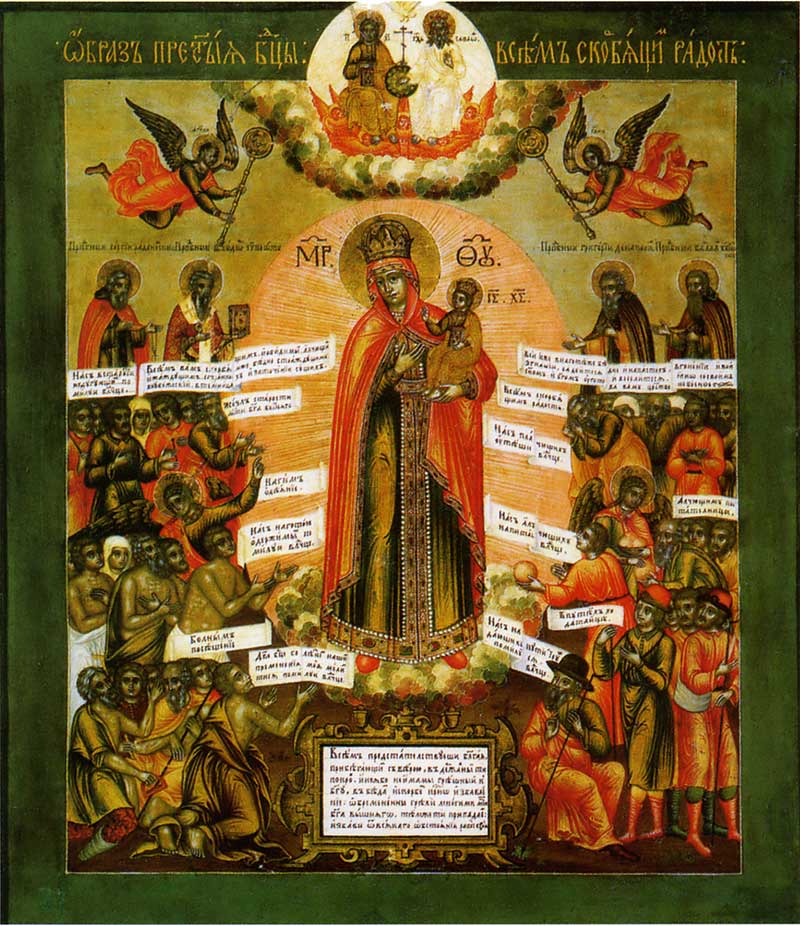
The icon belongs to the Russian devotional imagination of the later seventeenth century, when the older Byzantine Marian types were joined by new compositions built around a theme or a text. Its theme is given by its name — drawn from the opening of a much-loved hymn to the Theotokos, "O Joy of all who sorrow" — and its composition sets that name before the eye. The Mother of God stands full-length at the centre, often crowned and holding the Child or a sceptre, robed in glory; and around her, instead of the usual ranks of saints, are gathered the suffering members of Christ's body: the hungry and the naked, the sick on their beds, the wanderers and the sorrowful, each with an angel bending toward them to bring the Mother's mercy. Scrolls name their afflictions and her help — "to the naked, clothing; to the sick, healing" — so that the panel preaches the works of mercy even as it is venerated. It is an icon not of a historical event but of a standing truth: that the Theotokos is the refuge of all who have nowhere else to turn.
The healing of Euphemia, 1688
The feast keeps a particular wonder. In Moscow in 1688 Euphemia (Evfimia) Papina, sister of Joachim, Patriarch of Moscow, lay grievously ill, an open and festering wound in her side, given up by those about her and near to death. In her extremity she gave herself to prayer to the Mother of God, and — the account relates — heard a voice bidding her send to the church of the Transfiguration of the Saviour on the Ordynka (in the Zamoskvorechye quarter across the river), where the icon called "Joy of All Who Sorrow" was kept, and have it brought to her house and a moleben with the blessing of water served before it. She did so; and when the icon was brought and the prayers offered, she was healed. The day of her recovery, October 24, became the feast of the icon, and the panel before which she was healed became the first and most famous of the wonderworking copies, drawing pilgrims to the Ordynka church, which took its popular name from the icon.
Diffusion and the Petersburg variant
From the Moscow miracle the veneration spread swiftly, and copies of the "Joy of All Who Sorrow" were set up across Russia, a number of them becoming celebrated for their own wonders. The most famous of these is the Saint Petersburg icon "with the coins" (s groshikami): in 1888 lightning struck a chapel near the Neva glassworks and, sparing the icon, scorched the wall about it, while twelve copper coins from a shattered alms-box were found fixed to its surface. That icon is kept with its own commemoration on July 23; the present feast, October 24, is that of the original Moscow image and its type.
Feast and commemoration
October 24 (church date; Old Calendar civil November 6), kept in the Russian Church and the churches of the Slavic tradition, and by the Orthodox Church in America, as the feast of the "Joy of All Who Sorrow" icon, joined on the day to the martyrs of Najran and the hierarch Athanasius of Constantinople. The Petersburg icon "with the coins" has a separate feast on July 23. The commemoration is one of icon and hymn together: the day's services draw on the same theme of the Mother of God as the consolation of the sorrowing that gives the image its name.
Hymns
Troparion — Tone 4
To the Theotokos let us sinners and lowly ones now diligently hasten, and let us fall down in repentance, crying from the depths of our soul: O Lady, help us, take pity upon us; make haste, for we perish under the multitude of our transgressions; turn not thy servants away empty, for thee alone do we have as our hope.
Original translation from the Slavonic
Kontakion — Tone 6
We have no other help, we have no other hope, but thee, O Lady. Do thou help us: in thee we hope, and of thee we make our boast, for we are thy servants; let us not be put to shame.
Original translation from the Slavonic
Appointed readings
Epistle — Philippians 2:5–11
5Let this mind be in you, which was also in Christ Jesus: 6Who, being in the form of God, thought it not robbery to be equal with God: 7But made himself of no reputation, and took upon him the form of a servant, and was made in the likeness of men: 8And being found in fashion as a man, he humbled himself, and became obedient unto death, even the death of the cross. 9Wherefore God also hath highly exalted him, and given him a name which is above every name: 10That at the name of Jesus every knee should bow, of things in heaven, and things in earth, and things under the earth; 11And that every tongue should confess that Jesus Christ is Lord, to the glory of God the Father.
Gospel — Luke 10:38–42; 11:27–28
38Now it came to pass, as they went, that he entered into a certain village: and a certain woman named Martha received him into her house. 39And she had a sister called Mary, which also sat at Jesus’ feet, and heard his word. 40But Martha was cumbered about much serving, and came to him, and said, Lord, dost thou not care that my sister hath left me to serve alone? bid her therefore that she help me. 41And Jesus answered and said unto her, Martha, Martha, thou art careful and troubled about many things: 42But one thing is needful: and Mary hath chosen that good part, which shall not be taken away from her. 27And it came to pass, as he spake these things, a certain woman of the company lifted up her voice, and said unto him, Blessed is the womb that bare thee, and the paps which thou hast sucked. 28But he said, Yea rather, blessed are they that hear the word of God, and keep it.
Iconography
The type is distinguished from all other Marian icons by its subject: not the Mother and Child alone, nor the Theotokos among saints, but the Theotokos amid the suffering of the world. She stands in the centre, usually crowned and in royal robes, sometimes bearing the Child on her arm, sometimes holding a sceptre or a scroll; radiance and clouds surround her, and Christ or the Lord of Sabaoth may appear above. To either side, in registers, are the afflicted — the sick, the hungry, the naked, the imprisoned, the grieving — with angels who turn from the Mother of God to them, carrying her mercy; inscribed scrolls name each affliction and its relief. Later copies vary the details freely, and the Petersburg recension adds the coins fixed to the icon's lower edge. The stored image is a Russian icon of 1710 of the type: the Mother of God standing in glory among the suffering, encircled by angels, an early witness to the composition that spread from the Moscow miracle of 1688.