
Kazan Icon of the Mother of God
Kept 8 July — The finding of the icon at Kazan, 1579, 22 October — The deliverance of Moscow from the Poles, 1612
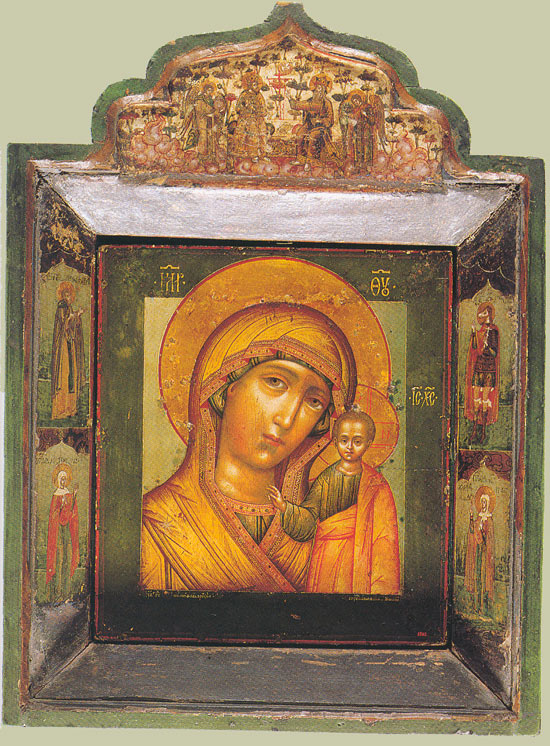
The Kazan Icon of the Mother of God is among the most beloved and most widely copied of Russian icons. It was found in the ashes of Kazan in 1579, a little girl having been shown in a vision where it lay buried; from that finding, kept on July 8, it became a national protectress. In the Time of Troubles a copy of the icon accompanied the volunteer army of Minin and Pozharsky, and the deliverance of Moscow from the Polish garrison on October 22, 1612 was ascribed to the Mother of God's intercession before it — the event this autumn feast commemorates. Revered across Russia and enshrined in great cathedrals at Moscow and Saint Petersburg, the original was stolen and destroyed at Kazan in 1904, but its innumerable venerated copies carry the image still.
.jpg)
The finding at Kazan, 1579
Kazan, the Tatar khanate on the Volga, had been taken by Ivan the Terrible in 1552 and its lands opened to the Christian mission; a see was established and churches raised, but the young Church stood among a largely Muslim and pagan population. In 1579 a great fire destroyed much of the city, and the pagans mocked, taking the disaster as a judgment on the new faith. Then the Mother of God appeared in a dream to a girl of about nine or ten named Matrona, daughter of a soldier, showing her a spot in the ashes of her family's burnt house and bidding her recover an icon buried there. The vision was repeated; when at last the ground was dug, on the site indicated, there was found — wrapped in a piece of cloth and shining as if freshly painted — an icon of the Mother of God. A priest of the city, Hermogenes, who would later become Patriarch of Moscow and himself a hieromartyr of the Time of Troubles, was present at the finding and wrote its account; a church was built on the spot and a convent established, and the icon at once became a source of healings, above all of the blind.
The deliverance of Moscow, 1612
The turn of the sixteenth and seventeenth centuries is remembered in Russia as the Time of Troubles: dynastic collapse, famine, imposture, and foreign invasion. Polish armies entered the land, scorned the Orthodox faith, plundered and burned churches, and by stratagem took Moscow itself, holding the Kremlin and Kitay-gorod. From his imprisonment the Patriarch Hermogenes — the same who had witnessed the finding at Kazan — sent out letters calling the people to rise in defence of their faith and country, and died a martyr's death of starvation for it. In answer a national militia was raised; from Kazan a copy of the wonderworking icon was brought to the army led by Prince Dmitry Pozharsky and the merchant Kuzma Minin. Knowing that their sufferings were the fruit of their sins, the whole army and people took upon themselves a three-day fast and prayed before the icon for help. The tradition relates that Sergius of Radonezh appeared to Saint Arsenius, afterward Bishop of Suzdal, then a prisoner in the Kremlin, with the promise that for the prayers of the Mother of God the city would be delivered. Emboldened, the Russian forces stormed the defences and on October 22, 1612 freed Moscow from the Polish garrison. A celebration in thanksgiving was established, and in 1649 Tsar Alexei Mikhailovich decreed the October 22 feast of the Kazan Icon to be kept throughout Russia.
The two feasts
The icon is thus honoured on two days. July 8 keeps the finding of the icon at Kazan in 1579 — the "appearance" (yavlenie) — and October 22 the deliverance of Moscow in 1612. Saint Demetrius of Rostov, in his Discourse on the day of the appearance, drew from the icon's wonders the lesson that the Mother of God delivers not the righteous only but sinners who turn to God in true repentance — like the prodigal, the publican, and the thief upon the cross — and it is in that spirit of penitence that both feasts are kept.
The icon and its loss in 1904
The Kazan icon's iconographic type — the Mother of God shown head-and-shoulders, her head inclined toward the Christ Child who stands upright before her, blessing — was reproduced in countless copies, several of which became famous wonderworking icons in their own right: the Moscow Kazan icon set in the cathedral raised on Red Square in thanksgiving for 1612, and the Saint Petersburg Kazan icon of the great Kazan Cathedral on the Nevsky Prospect. The original found at Kazan remained in the Theotokos Convent there until the night of June 29, 1904, when it was stolen; the thieves, soon caught, had taken it for the sake of its precious jewelled riza, and by their testimony the panel itself had been cut up and burned. The loss was mourned as a national calamity. Because so many venerated copies existed — and because the tradition never located the icon's grace in a single board — the veneration continued undiminished, and copies of the Kazan type remain among the most common icons of the Mother of God in Russian homes and churches to this day.
Feast and commemoration
October 22 (church date; Old Calendar civil November 4), kept in the Russian Church and throughout the Slavic world, and by the Orthodox Church in America, as the commemoration of the deliverance of Moscow from the Poles in 1612; the principal feast of the icon, the finding of 1579, falls on July 8. Both are days of the Mother of God, kept in Russian usage with the blue vestments there appointed for her feasts. The commemoration is a Russian national feast and is not on the Greek calendar. In modern Russia October 22 (civil November 4) coincides with the state holiday of National Unity Day, instituted in 2005 around the memory of 1612.
Hymns
Troparion — Tone 4
O fervent advocate, Mother of the Lord Most High, thou dost pray to thy Son Christ our God for all, and dost bring salvation to all who flee to thy mighty protection. Defend us all, O Sovereign Lady, Queen and Mistress, who in perils and afflictions and sickness are laden with our many sins, and stand praying before thee with contrite soul and broken heart, with tears, before thy most pure image; who have unfailing hope in thee: grant to all what is profitable, deliver us all from every evil, and save us all, O Virgin Theotokos; for thou art a divine shelter to thy servants.
Original translation from the Slavonic
Kontakion — Tone 8
Let us hasten, O people, to this quiet and goodly haven, the ready helper, the prompt and warm salvation, the protection of the Virgin; let us make speed to prayer and hasten to repentance: for the most pure Theotokos poureth out upon us her unfailing mercies, coming before us with her help, and delivering from great calamities and evils her servants who live uprightly and in the fear of God.
Original translation from the Slavonic
Appointed readings
Epistle — Philippians 2:5–11
5Let this mind be in you, which was also in Christ Jesus: 6Who, being in the form of God, thought it not robbery to be equal with God: 7But made himself of no reputation, and took upon him the form of a servant, and was made in the likeness of men: 8And being found in fashion as a man, he humbled himself, and became obedient unto death, even the death of the cross. 9Wherefore God also hath highly exalted him, and given him a name which is above every name: 10That at the name of Jesus every knee should bow, of things in heaven, and things in earth, and things under the earth; 11And that every tongue should confess that Jesus Christ is Lord, to the glory of God the Father.
Gospel — Luke 10:38–42; 11:27–28
38Now it came to pass, as they went, that he entered into a certain village: and a certain woman named Martha received him into her house. 39And she had a sister called Mary, which also sat at Jesus’ feet, and heard his word. 40But Martha was cumbered about much serving, and came to him, and said, Lord, dost thou not care that my sister hath left me to serve alone? bid her therefore that she help me. 41And Jesus answered and said unto her, Martha, Martha, thou art careful and troubled about many things: 42But one thing is needful: and Mary hath chosen that good part, which shall not be taken away from her. 27And it came to pass, as he spake these things, a certain woman of the company lifted up her voice, and said unto him, Blessed is the womb that bare thee, and the paps which thou hast sucked. 28But he said, Yea rather, blessed are they that hear the word of God, and keep it.
Iconography
The Kazan icon is a shortened, half-length form of the Hodegetria. The Mother of God is shown to the shoulders, without her hands, her head bowed toward the Christ Child, who stands upright at her left, turned frontally, his right hand raised in blessing. The gravity and tenderness of the type, and the absence of the Mother's hands, concentrate all on the exchange of gaze between Mother and Son and on the Child's blessing. The stored image is a Kazan icon painted by the royal iconographer Simon Ushakov in 1676 (now in the Hermitage), a characteristic and finely wrought example of the type from the great age of Muscovite icon-painting.