
Wednesday 8 July 2026
Greatmartyr Procopius of Caesarea
Wednesday of the 6th week after Pentecost
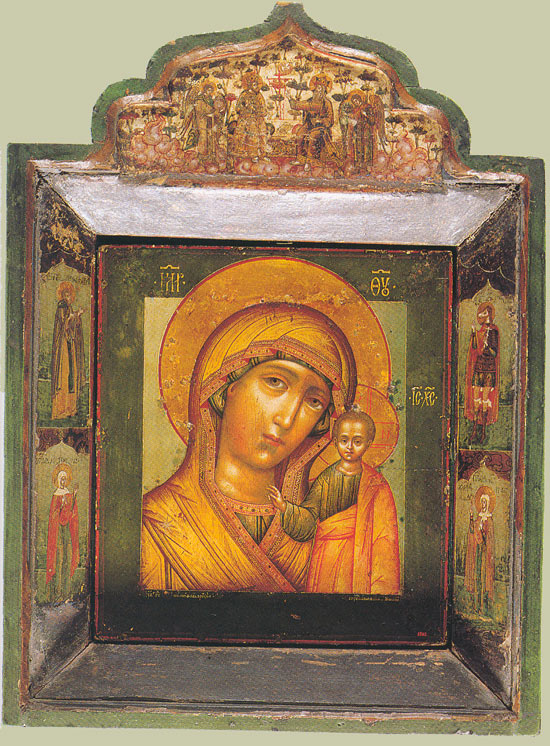
About Kazan Icon of the Mother of God →
.jpg)
Saints commemorated
-
Saint of the day Antiochian commemoration
Greatmartyr Procopius of Caesarea
Procopius (†303) is the most celebrated of the soldier-martyrs of Palestine and one of the great martyrs of the Eastern Church. The developed passion knows him first as Neanias, a young officer of a Roman senatorial family of Jerusalem, whom Diocletian appointed to Alexandria with a commission to break the Christians there. On the road he was arrested by a vision of the Cross and the voice of the crucified Christ — a deliberate re-telling of the conversion of St Paul on the Damascus road — and returned a Christian. He was tried and tortured at Caesarea in Palestine, and in the course of his passion his pagan mother Theodosia and twelve women of senatorial rank were converted by his constancy and beheaded before him; he himself was beheaded on July 8, 303. Behind the legend stands the sober notice of Eusebius, who names a Procopius as the first to die at Caesarea in the Great Persecution; the Byzantine calendar keeps that man separately, as Procopius the Reader, on November 22.
-
Appearance of the "Kazan" icon of the Most Holy Theotokos (1579)
-
St Procopius, Fool for Christ (1303)
Procopius of Ustyug (†1303) is the first fool-for-Christ of the Russian land and the patron of Great Ustyug in the far north. By the tradition of his Life he was a wealthy merchant "of the Varangians" — a Hanseatic German of the Latin confession — who came trading to Novgorod, was overcome by the beauty of Orthodox worship, was received into the Church, gave away everything he had, and, to escape the honour his conversion had won him, went east into the wilderness and settled at Ustyug, where for some forty years he lived on the cathedral porch in rags, sleeping on dunghills, taking food only from the honest poor, and carrying three wooden pokers in his hand. In 1290 his prayer before the icon of the Annunciation in the Dormition cathedral was held to have turned aside a rain of burning stones from the city. He foretold the birth of Stephen of Perm, and died in a summer snowfall on the night of July 8, 1303. The Council of Moscow of 1547 glorified him — the first of the Russian holy fools to be canonised.
-
Epictetus and Astion
Epictetus, a priest and monk, and Astion, the young nobleman he converted, are the protomartyrs of the land that is now Romania: two ascetics from Bithynia who crossed the Black Sea to the Roman frontier fortress of Halmyris on the Danube delta in Scythia Minor, lived there some seventeen years in prayer, healing and preaching, and were beheaded together on July 8, 290, under the persecution conducted by the commander Latronianus. Their Latin passion is one of the oldest hagiographic documents of the lower Danube, and their story has an unusual epilogue: Astion's pagan parents, coming from Bithynia to look for their son, were converted by the account of his death and baptised by the bishop of Tomis. In 2001 archaeologists excavating the basilica of Halmyris found beneath its altar a crypt containing the bones of two men, both decapitated — an identification the Romanian Church accepted, and the relics are now enshrined at Murighiol.
-
Mirdat of Kartli
Mirdat, king of Kartli (Iberia, eastern Georgia) about 408–410, is honoured by the Georgian Church as the first of its martyred kings. Reared by his grandfather King Trdat in the Christian faith and in the memory of Georgian independence, he used his short reign to throw off the Persian tribute and to recover Klarjeti from Byzantine control, and then took the field against the Persians. He was defeated near Gardabani and taken alive. The Persian king required him to renounce Christ; he refused, was tortured and loaded with chains, and died of his sufferings in prison. His memory is kept on July 8.
-
Theophilus the Myrrh-gusher
Theophilus (†1548) was a learned Macedonian who served the Ecumenical Patriarchate, refused a metropolitan see, and ended his life as a hermit of Mount Athos in a small cell near Karyes. He is remembered for the manner of his death: foreseeing it, he charged his disciple to treat his body with contempt — to drag it out of the cell and throw it into a ravine — so that no honour should come to him after death. The disciple obeyed; but the body was found, and myrrh flowed from it, so that the very self-abasement he had commanded became the occasion of his glory. His relics were taken to the monastery of the Pantokrator on Athos, and the Church styles him Myroblytes, the myrrh-gusher.
British Isles and Ireland
- Blessed King Edgar the Peaceable (975)
- St. Urith of Chittlehampton (6th C)
- St. Morwenna, Patron of Morwenstow (6th C)
- Hieromartyr Killian, Irish missionary bishop to the Franks, who suffered at Wurzburg (689)
- St. Withburga, anchoress at East Dereham (c.743)
- St. Grimbald, abbot of Winchester (901)
- St. Sunniva of Bergen and her Companions (10th C)
Troparia & kontakia
Kontakion — Tone 8
Let us hasten, O people, to this quiet and goodly haven, the ready helper, the prompt and warm salvation, the protection of the Virgin; let us make speed to prayer and hasten to repentance: for the most pure Theotokos poureth out upon us her unfailing mercies, coming before us with her help, and delivering from great calamities and evils her servants who live uprightly and in the fear of God.
Kontakion — Tone 4
By folly for Christ's sake thou didst pass untouched through the tollhouses of the air upon the hands of angels, and didst attain unto the royal throne, receiving from Christ our God, the King of all, the gift and the grace of healings. For by thy many wonders and by a fearful sign thou didst astonish thy city of Great Ustyug; and obtaining mercy for thy people, thou didst by prayer draw forth myrrh from the honoured image of the most holy Theotokos, and didst grant cures to the sick. Wherefore we entreat thee, O wonder-bearing Procopius: pray thou unceasingly to Christ our God, that He grant us the forgiveness of our sins.
Kontakion — Tone 2
Set ablaze with divine zeal for Christ, and walled about with the strength of the Cross, thou didst cast down the raging insolence of the enemy, O Procopius, and didst raise up the honoured Church, going forward in the faith and giving light to us.
Troparion — Tone 4
O fervent advocate, Mother of the Lord Most High, thou dost pray to thy Son Christ our God for all, and dost bring salvation to all who flee to thy mighty protection. Defend us all, O Sovereign Lady, Queen and Mistress, who in perils and afflictions and sickness are laden with our many sins, and stand praying before thee with contrite soul and broken heart, with tears, before thy most pure image; who have unfailing hope in thee: grant to all what is profitable, deliver us all from every evil, and save us all, O Virgin Theotokos; for thou art a divine shelter to thy servants.
Troparion — Tone 4
Trained from your youth in the discipline of the monks, and shining in the priesthood and in the ascetic life, ye were made worthy of the martyr's crown, O Epictetus and Astion; for having kept the faith unbroken under torments, ye were beheaded for Christ and inherited the land of the living. Wherefore intercede with the merciful God, that He grant our souls great mercy.
Troparion — Tone 4
Thy martyr Mirdat, O Lord, in his contest received an incorruptible crown from thee our God; for having thy might he cast down the tyrants and shattered the feeble arrogance of the demons. By his prayers save thou our souls.
Troparion — Tone 4
Enlightened by divine grace, O God-wise one, and setting thy whole mind and heart unswervingly upon the Creator and away from this vain world, by chastity and by much patient endurance thou didst finish well the course of this temporal life and didst keep the faith unstained. Wherefore after thy death also the brightness of thy living was made manifest, for thou pourest out an inexhaustible fountain of wonders upon them that come with faith to thy holy tomb, O all-blessed Procopius: pray thou to Christ our God, that our souls may be saved.
Troparion — Tone 4
Thy martyr Procopius, O Lord, in his contest received an incorruptible crown from thee our God; for having thy might he cast down the tyrants, and shattered the feeble arrogance of the demons. By his prayers save thou our souls.
Troparion — Tone 8
By a flood of tears thou didst make the barren desert fruitful, and with sighs from the depths thou didst bring forth thy labours a hundredfold; thou wast made a beacon of the whole world, shining with miracles, O Theophilus our father. Intercede with Christ God that our souls may be saved.
Readings
Epistle
1 Corinthians 2.9-3.8
9But as it is written, Eye hath not seen, nor ear heard, neither have entered into the heart of man, the things which God hath prepared for them that love him. 10But God hath revealed them unto us by his Spirit: for the Spirit searcheth all things, yea, the deep things of God. 11For what man knoweth the things of a man, save the spirit of man which is in him? even so the things of God knoweth no man, but the Spirit of God. 12Now we have received, not the spirit of the world, but the spirit which is of God; that we might know the things that are freely given to us of God. 13Which things also we speak, not in the words which man’s wisdom teacheth, but which the Holy Ghost teacheth; comparing spiritual things with spiritual. 14But the natural man receiveth not the things of the Spirit of God: for they are foolishness unto him: neither can he know them, because they are spiritually discerned. 15But he that is spiritual judgeth all things, yet he himself is judged of no man. 16For who hath known the mind of the Lord, that he may instruct him? But we have the mind of Christ. 1And I, brethren, could not speak unto you as unto spiritual, but as unto carnal, even as unto babes in Christ. 2I have fed you with milk, and not with meat: for hitherto ye were not able to bear it, neither yet now are ye able. 3For ye are yet carnal: for whereas there is among you envying, and strife, and divisions, are ye not carnal, and walk as men? 4For while one saith, I am of Paul; and another, I am of Apollos; are ye not carnal? 5Who then is Paul, and who is Apollos, but ministers by whom ye believed, even as the Lord gave to every man? 6I have planted, Apollos watered; but God gave the increase. 7So then neither is he that planteth any thing, neither he that watereth; but God that giveth the increase. 8Now he that planteth and he that watereth are one: and every man shall receive his own reward according to his own labour.
Gospel
Matthew 13.31-36
31Another parable put he forth unto them, saying, The kingdom of heaven is like to a grain of mustard seed, which a man took, and sowed in his field: 32Which indeed is the least of all seeds: but when it is grown, it is the greatest among herbs, and becometh a tree, so that the birds of the air come and lodge in the branches thereof. 33Another parable spake he unto them; The kingdom of heaven is like unto leaven, which a woman took, and hid in three measures of meal, till the whole was leavened. 34All these things spake Jesus unto the multitude in parables; and without a parable spake he not unto them: 35That it might be fulfilled which was spoken by the prophet, saying, I will open my mouth in parables; I will utter things which have been kept secret from the foundation of the world. 36Then Jesus sent the multitude away, and went into the house: and his disciples came unto him, saying, Declare unto us the parable of the tares of the field.