
Miracle of the Archangel Michael at Chonae
Kept 6 September — Commemoration of the miracle at Chonae (Colossae)
On September 6 the Church commemorates the miracle wrought by the Archangel Michael at Chonae, near the ancient Colossae in Phrygia. Beside a wonderworking spring of the Archangel stood a small church served for sixty years by the sacristan Archippus. Pagans, seeking to destroy shrine and sacristan together, joined two rivers into a single torrent and loosed it against the church; at Archippus's prayer the Archangel appeared, cleft the rock with his staff, and commanded the flood down into the chasm. From those "funnels" (Greek χῶναι) the place took the name Chonae. The feast was among the most beloved angelic commemorations of the Byzantine year and passed with equal honour into the Slavic lands.
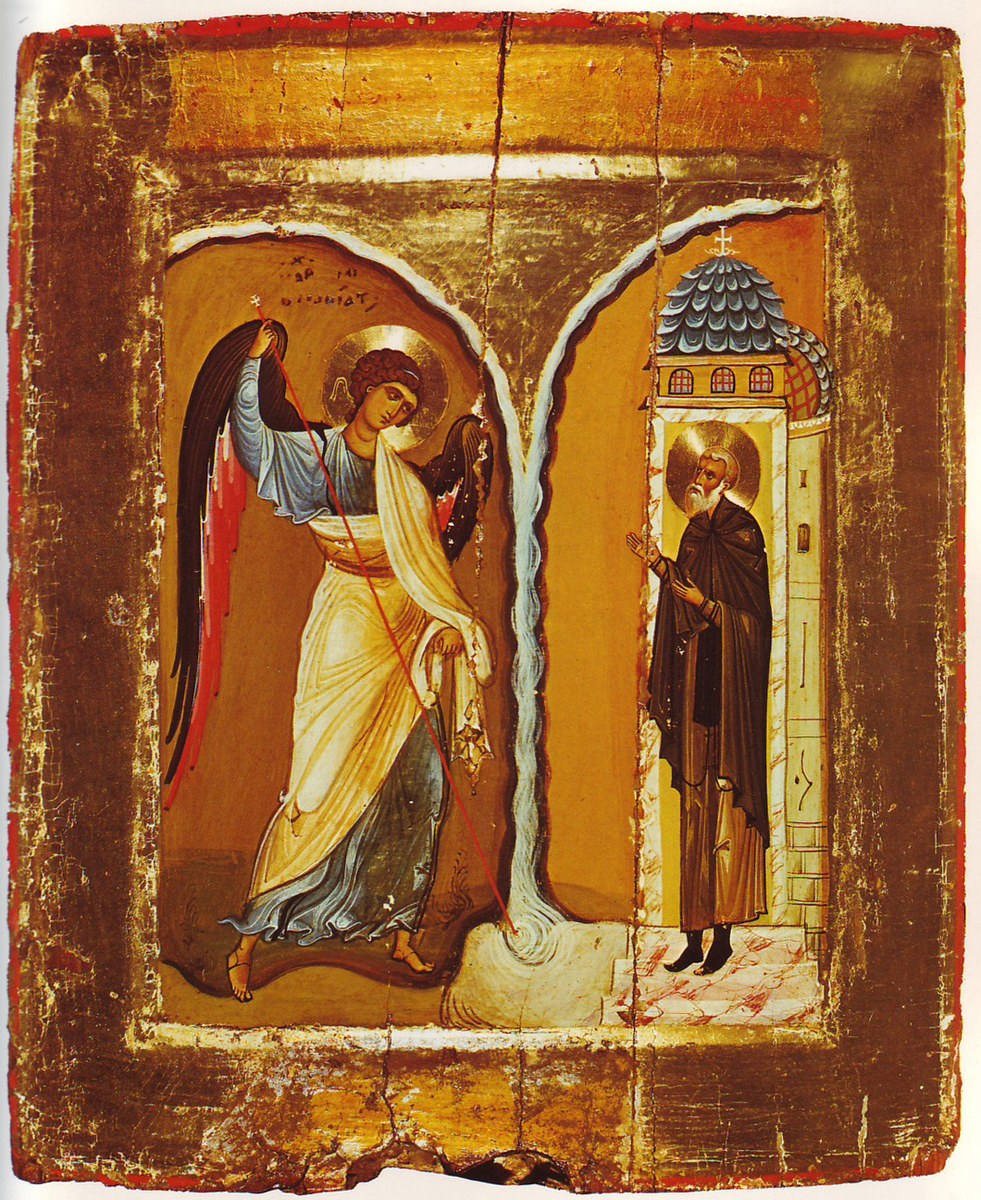

Colossae, the spring, and the shrine
Colossae lay in the valley of the Lycus in Phrygia, close by Laodicea and Hierapolis — Pauline ground, addressed in the apostle's Epistle to the Colossians. The region was marked from earliest times by an intense devotion to the angels: Paul himself had warned the Colossians against a "worship of angels" (Colossians 2:18), and the fourth-century Council of Laodicea, held a few miles away, legislated against angelolatry in its thirty-fifth canon, while Theodoret, commenting on the Pauline verse in the fifth century, remarks that oratories of the holy Michael could still be seen throughout the district. The Church's answer to this crooked local piety was not suppression but correction: the veneration of Michael the Archangel, chief commander of the bodiless hosts, flourished at Colossae in orthodox form, and the legend of Chonae is its monument.
The received narrative of the miracle relates that after the preaching of the apostles in the region — Philip at Hierapolis and John the Theologian at Ephesus — a healing spring broke forth at a place called Chairetopa (Cheretopos) near Colossae, foretold by the Theologian as a visitation of the Archangel's grace. A pagan of Laodicea, whose only daughter was mute, was told by Michael in a dream that she would receive speech if she drank of the water. She drank and spoke; the man was baptized with all his house, and in gratitude built over the spring a small church in the Archangel's name. Both Christians and pagans came to the water, and many of the latter, healed there, turned to Christ.
Archippus and the miracle
At this church a young man of Hierapolis named Archippus took up the office of sacristan (προσμονάριος) at the age of ten, and served there for sixty years in extreme ascetic simplicity, catechising the pagans who came to the spring and turning many to baptism. The pagans of the neighbourhood, exasperated by his preaching and by the stream of conversions, attempted his life more than once, and at last conceived a plan to destroy sacristan, church, and spring in a single blow. Two rivers descend from the heights above the place — the received text names them Lykokapros and Kouphos — and the conspirators laboured to join their beds into one channel aimed directly at the church, damming the waters until they had gathered into a flood, and then releasing them.
Archippus, refusing to abandon the holy place, remained in the church at prayer. The tradition relates that the Archangel Michael appeared beside the shrine, commanded the old man to stand and watch, and, striking the great rock before the church with his staff, opened in it a wide fissure, into which he commanded the torrent to pour. The waters plunged roaring into the chasm and were swallowed; the church and its sacristan stood unharmed, and the terrified conspirators fled. From those funnels the place was thereafter called Chonae (Χῶναι, "the plungings" or "funnels"), a name which in time displaced that of declining Colossae for the whole settlement.
Modern topographers have observed that the legend answers exactly to the country: the limestone landscape at the foot of Mount Cadmus, where the town of Chonae (the modern Honaz in Turkey) succeeded Colossae, is karstic, and its streams do in fact vanish underground into swallow-holes — the local wonder around which the narrative crystallised.
The shrine and town of Chonae in later history
Chonae inherited Colossae's bishopric and rose to the rank of an archbishopric and later a metropolis. Its great church of the Archangel — rebuilt on a magnificent scale in the middle Byzantine period — was one of the celebrated pilgrimage shrines of Asia Minor, and its annual festival drew crowds from the whole region. The city gave the twelfth century two of its most learned men, the brothers Michael Choniates, metropolitan of Athens, and the historian Nicetas Choniates, whose surname preserves the town's. Nicetas himself records the desecration of the shrine in the 1190s, when the rebel pseudo-Alexius with his Turkish troops ravaged the Maeander valley; with the Seljuk conquest of the region the great church passed out of Christian hands and eventually disappeared.
The feast in Byzantium and beyond
The commemoration on September 6 appears in the Typikon of the Great Church and the Synaxarion of Constantinople, and the miracle became one of the fixed angelic feasts of the Byzantine year, second in popularity only to the Synaxis of the Bodiless Powers on November 8. Its hold on the Slavic lands was, if anything, stronger: the "Miracle of Michael" (Михайлово чудо) was a marked day of the Russian folk calendar, and the Chudov ("of the Miracle") Monastery, founded in the Moscow Kremlin in 1365 by Metropolitan Alexis and dedicated to the Miracle at Chonae, was among the most venerable houses of Muscovy until its demolition by the Soviet state in 1929–30.
The narrative tradition and the date
The earliest surviving account of the miracle (BHG 1282) is an anonymous narrative, generally assigned by scholars to the fifth or sixth century and later reworked by Symeon Metaphrastes; the Synaxarion notices derive from it. The story's own chronology is legendary and unanchored: it sets the building of the church in the generation after the apostles, yet the conventional datings place Archippus and the miracle in the fourth century, and no source permits precision. Scholarship reads the narrative as an aetiology — of the ancient and originally suspect angel-cult of Phrygia, brought within the Church's order, and of the toponym Chonae itself. The Church's calendars commemorate the miracle without committing themselves to a year.
Feast and commemoration
September 6 (church date; Old Calendar civil September 19), kept universally in the Byzantine rite. The Menaion service of the day is of the Archangel, with the martyrs of the day (Eudoxius and his companions) commemorated at Vespers and Compline; the sacristan Archippus is honoured within the same service and separately as a venerable saint. The feast is one of several fixed commemorations of the Archangel Michael in the liturgical year, alongside the Synaxis of Michael and all the Bodiless Powers on November 8, with which it shares its principal hymns.
Hymns
Troparion — Tone 4
Commander of the heavenly hosts, we the unworthy entreat thee without ceasing: wall us about by thy prayers beneath the shelter of the wings of thine immaterial glory, and guard us who fall down before thee and earnestly cry: deliver us out of dangers, as marshal of the powers on high.
Original translation from the Greek
Kontakion — Tone 2
Chief commander of God, minister of the divine glory, guide of men and captain of the bodiless powers: ask for us what is profitable, and great mercy, as chief commander of the bodiless hosts.
Original translation from the Greek
Appointed readings
Epistle — Hebrews 2:2–10
2For if the word spoken by angels was stedfast, and every transgression and disobedience received a just recompence of reward; 3How shall we escape, if we neglect so great salvation; which at the first began to be spoken by the Lord, and was confirmed unto us by them that heard him; 4God also bearing them witness, both with signs and wonders, and with divers miracles, and gifts of the Holy Ghost, according to his own will? 5For unto the angels hath he not put in subjection the world to come, whereof we speak. 6But one in a certain place testified, saying, What is man, that thou art mindful of him? or the son of man, that thou visitest him? 7Thou madest him a little lower than the angels; thou crownedst him with glory and honour, and didst set him over the works of thy hands: 8Thou hast put all things in subjection under his feet. For in that he put all in subjection under him, he left nothing that is not put under him. But now we see not yet all things put under him. 9But we see Jesus, who was made a little lower than the angels for the suffering of death, crowned with glory and honour; that he by the grace of God should taste death for every man. 10For it became him, for whom are all things, and by whom are all things, in bringing many sons unto glory, to make the captain of their salvation perfect through sufferings.
Gospel — Luke 10:16–21
16He that heareth you heareth me; and he that despiseth you despiseth me; and he that despiseth me despiseth him that sent me. 17And the seventy returned again with joy, saying, Lord, even the devils are subject unto us through thy name. 18And he said unto them, I beheld Satan as lightning fall from heaven. 19Behold, I give unto you power to tread on serpents and scorpions, and over all the power of the enemy: and nothing shall by any means hurt you. 20Notwithstanding in this rejoice not, that the spirits are subject unto you; but rather rejoice, because your names are written in heaven. 21In that hour Jesus rejoiced in spirit, and said, I thank thee, O Father, Lord of heaven and earth, that thou hast hid these things from the wise and prudent, and hast revealed them unto babes: even so, Father; for so it seemed good in thy sight.
Iconography
The iconography of the miracle is remarkably stable from its earliest witnesses: the Archangel, winged and in tunic and himation (not in the loros of his court imagery), strides at the left, driving his long staff into the mouth of a funnel of water that divides the composition; at the right the aged Archippus, in monastic habit, stands in prayer before the little church, whose tower rises behind him. The stored image is the celebrated icon of the first half of the twelfth century from the Monastery of Saint Catherine on Sinai, probably of Constantinopolitan workmanship — one of the finest surviving Comnenian icons. The same composition appears c. 1000 in the Menologion of Basil II (the miniature is stored with the entry of Archippus), and the subject became a favourite of the Novgorod school and of Russian iconography generally, where it often forms the centrepiece of icons of the Archangel with scenes of his deeds.