
Archippus of Herapolis
Our Venerable Father Archippus of Herapolis, Sacristan of the Church of the Archangel Michael at Chonae
Venerable
Commemorated 6 September — With the Commemoration of the Miracle of the Archangel Michael at Chonae
Archippus of Herapolis (Hierapolis in Phrygia) was the sacristan of the church of the Archangel Michael at the healing spring near Colossae, which he served for sixty years from the age of ten in a life of severe asceticism, catechising the pagans who came to the water. When his enemies loosed the joined flood of two rivers against the church to destroy both shrine and sacristan, his prayer was answered by the appearance of the Archangel Michael, who cleft the rock and swallowed the torrent — the Miracle at Chonae commemorated with him on September 6. He is not to be confused with the apostle Archippus of the Seventy (Colossians 4:17), commemorated February 19 and November 22.
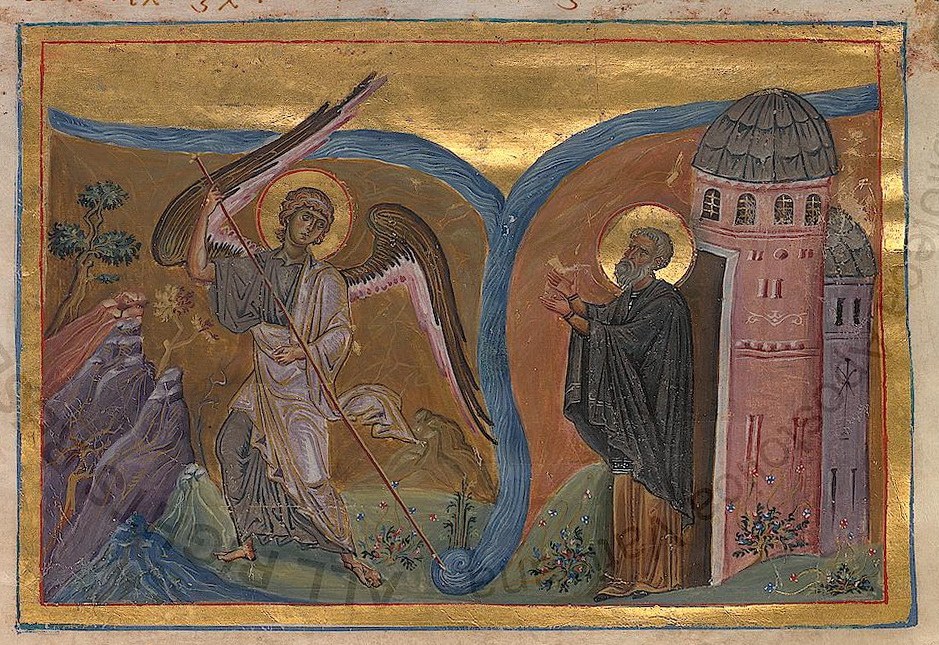
.jpg)
Archippus was born at Hierapolis in Phrygia — the "Herapolis" of the Slavic and OCA calendars — to Christian parents, in the district of the Lycus valley where the veneration of the Archangel Michael had taken deep root around the wonderworking spring at Chairetopa near Colossae. At the age of ten he came to pray at the small church of the Archangel built over the spring, and remained there for the rest of his life, taking up the humble office of sacristan (προσμονάριος) — the custodian who kept the shrine, trimmed its lamps, and received its pilgrims.
The hagiographic tradition dwells on the severity of his private rule: he kept an unbroken fast of the strictest kind, took the poorest of food and clothing, and gave himself to unceasing prayer, remaining in this manner of life for sixty years. His service was also an apostolate. To the spring came not only Christians but pagans in search of healing, and Archippus, by his instruction and still more by the example of his austerity, persuaded many of them to renounce idolatry and receive baptism.
This success drew upon him the hatred of the pagans of the neighbourhood, who, the tradition relates, more than once attempted to kill him and were each time prevented. At last they resolved to destroy sacristan, church, and spring together, by joining two mountain rivers into a single channel directed against the shrine. Archippus refused to flee, remaining at prayer within the church; and at his supplication the Archangel Michael appeared, cleft the rock before the church with a blow of his staff, and commanded the flood into the chasm, leaving the holy place and its keeper unharmed. The full account of the miracle and of the shrine's later history is given in the entry for the Miracle of the Archangel Michael at Chonae.
Delivered from death, Archippus continued his service at the church and reposed in peace in old age — the accounts say at seventy. Christians buried him at Chonae (Colossae), beside the scene of his labours.
Feast and commemoration
September 6 (church date; Old Calendar civil September 19), together with the Commemoration of the Miracle of the Archangel Michael at Chonae, within whose service the Menaion honours him; the calendars list him separately as a venerable saint (the OCA as "Saint Archippus of Herapolis", the Slavic calendars as Прп. Архипп). He has no separate feast apart from the miracle.
Hymns
Troparion — Tone 8
In thee, O father, that which is according to the image was preserved unimpaired; for taking up the cross thou didst follow Christ, and by thy deeds thou didst teach us to overlook the flesh, for it passeth away, but to care for the soul, an immortal thing; wherefore thy spirit, O venerable Archippus, rejoiceth with the angels.
Original translation from the Greek
Iconography
Archippus has no independent iconographic type: he appears within the composition of the Miracle at Chonae, as an aged, bearded figure in monastic habit standing in prayer before the little church at the right of the scene, opposite the Archangel who drives the waters into the chasm. The stored image is the miniature of the miracle from the Menologion of Basil II (c. 985, Vatican Library, Vat. gr. 1613), in which Archippus stands at the door of the shrine; the same pairing governs the twelfth-century Sinai icon stored with the feast entry.
Disputed questions
- Not to be confused with Archippus of the Seventy, the "fellow soldier" greeted by Paul (Colossians 4:17; Philemon 2), venerated as an apostle and commemorated on February 19 (with Philemon and Apphia) and November 22 (with Philemon, Onesimus and Apphia). The apostle belongs to the first century and to the same Colossian church whose district later produced the sacristan; the coincidence of name and place makes the confusion frequent, including in image collections and some popular calendars. The two are distinct in all the synaxaria.
- Chronology. No source dates Archippus precisely. The narrative of the miracle (BHG 1282) sets the building of the church in the generation after the apostles and gives Archippus sixty years of service, but the conventional dating of both sacristan and miracle — followed here for the century of repose — is the fourth century, and the whole chronology is legendary rather than documentary.
- The name of his city appears as Herapolis in the Slavic tradition and OCA calendar, for the Hierapolis of the Greek sources.