
Pochaev Icon of the Mother of God
Kept 23 July — The appearance of the Theotokos over the monastery and the deliverance of Pochaev from the Tatars, 1675, 8 September — Kept at the Lavra with the Nativity of the Theotokos; the day of the crowning of the icon in 1773
The Pochaev Icon is the great wonderworking image of the Orthodox West — of Volhynia, Galicia and the borderlands where Orthodoxy, Rome and Islam met and contended — and one of the most venerated icons of the whole Slavic world. A small Eleousa image in the old Byzantine manner, in which the Child leans his face against his Mother's, it was given by a visiting Greek metropolitan, Neophytus, to the Volhynian noblewoman Anna Hoyska — the monastery's tradition dates the gift to 1559 — and by her in 1597 to the monks who lived in the caves of the hill of Pochaev. It has hung there ever since, above the royal doors of the Dormition cathedral, lowered on ribbons to be venerated. Its feast on July 23 keeps the day in 1675 when, at the singing of the Akathist, the Mother of God was seen over the church with her omophorion spread and the angels about her, and Job of Pochaev at her side beseeching her, and the Tatar army broke and fled.
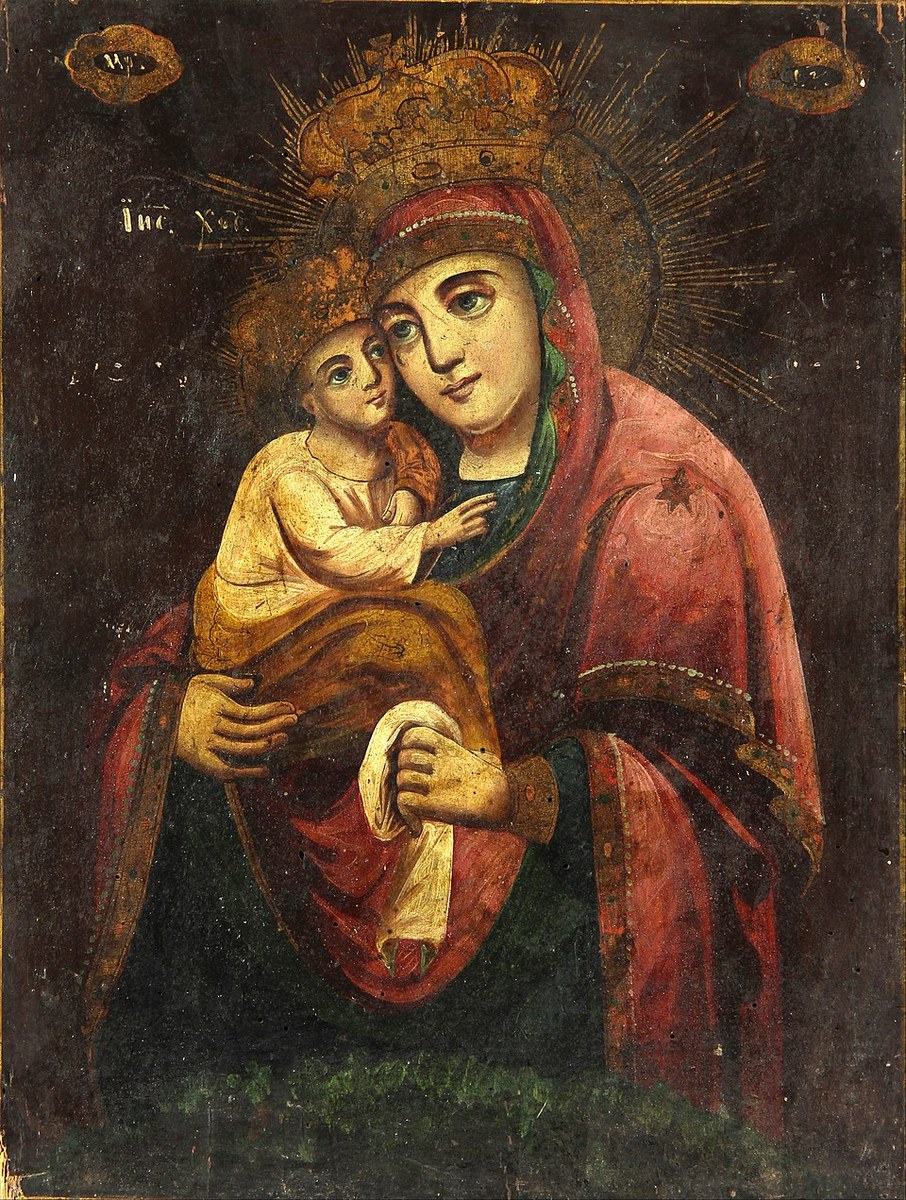

The mountain, the footprint, and the icon
The hill above Pochaev in Volhynia was a place of prayer before it was a monastery. The tradition of the house holds that in 1240, in the years of the Mongol invasion, the Mother of God appeared there in a pillar of fire to two monks and a shepherd, and that where she stood upon the rock she left the print of her right foot, from which a spring of water rose that has never failed. That footprint — the Stopa — is a distinct commemoration of its own in the Russian calendars, and it is also part of this icon: the image is painted with the rock and the print at its foot, so that the icon carries the whole story of the mountain within itself.
The image itself came later, and from Greece. In the second half of the sixteenth century — the house's tradition names the year 1559 — the Greek metropolitan Neophytus, travelling through Volhynia, was received by the widowed noblewoman Anna Hoyska, who owned Pochaev and its lands, and left the icon with her in thanks for her hospitality. In her house it began to be remarkable: a radiance was seen about it, and her brother Philip, blind from birth, received his sight before it. Judging that such an image did not belong in a private chapel, Anna Hoyska gave it in 1597, with an endowment, to the monks of the hill — and with that gift the Pochaev monastery, until then a scattering of cave-dwellers, became a house.
The icon is small, painted in the manner of Byzantium — some have thought it Greek, some Bulgarian work — and of the Eleousa ("tenderness") type: the Mother inclines her head, the Child presses his face to hers and holds a scroll, and the Mother's right hand is wrapped in a cloth beneath him. Around the border are set small figures of saints. A register of miracles was kept at the monastery from 1661 onward, and continued through every change of possession; the books record healings, deliverances from unclean spirits, release from captivity, and the conversion of sinners, each with the testimony of the person concerned.
The siege of 1675
The event kept on July 23 belongs to the Zbarazh war, in the reign of the Polish king Jan Sobieski (1674–1696). In the summer of 1675 Tatar regiments under the command of the Khan Nurredin, coming by way of Vishnevets, fell upon the monastery of Pochaev and surrounded it on three sides. The place was not a fortress: its walls were weak and its stone buildings few, and there was no prospect of holding out. The abbot, Joseph Dobromirsky, put the defence where the house had always put it, and called the brethren and the people who had taken refuge with them to pray — to the Mother of God, and to Job of Pochaev, whose relics lay in the church and who had been dead only twenty-four years.
At sunrise on July 23, as the Tatars were drawing up to assault, the abbot ordered the Akathist to be sung. At the opening words — To thee, the Champion Leader — the Mother of God appeared above the church, her omophorion unfurled and shining white over the roof, with angels around her holding drawn swords; and beside her stood Job, bowing to her and entreating her to defend the house. The Tatars took the vision for an apparition of war, and in their confusion shot arrows at the Mother of God and at Job; the arrows turned back in the air and struck the men who loosed them. The army broke and fled, trampling one another as it went, and the defenders came out and pursued them and took prisoners — of whom, the chronicle adds, some afterwards received Orthodox baptism and stayed at the monastery for the rest of their lives.
Under the Union, and the return
In 1721 the Lavra passed into the hands of the Uniates (Greek Catholics), and remained with them for more than a century. It is a mark of the icon's hold that its veneration did not falter: the monastery Chronicle records 539 miracles in the Uniate period alone. In those years, too, the icon was solemnly crowned — Pope Clement XIV sending two small golden crowns in April 1773, which were set on the Mother and the Child at a coronation on September 8, 1773, before a concourse said to number thirty-three thousand. The September 8 commemoration of the icon, kept to this day with the Nativity of the Theotokos, dates from that event.
The greatest benefactor of the Uniate period came to the icon by way of a miracle of his own. Count Nicholas Pototski, a Uniate nobleman, was thrown when his horses bolted and his carriage overturned, and drew a pistol on his coachman; the man turned toward the mountain of Pochaev, stretched out his hands and cried, "Mother of God of the Pochaev icon, save me!" The pistol, which had never failed its owner, misfired several times over. Pototski went straight to the wonderworking icon and vowed himself and his property to the monastery: with his money the great Dormition cathedral was raised, and the buildings for the brethren with it.
The Lavra returned to the Orthodox Church in 1832, after the Polish rising, and the return was marked by the healing at the shrine of a blind girl, Anna Akimchukova, brought two hundred versts on pilgrimage from Kremenets-Podolsk by her grandmother, a woman of seventy. In memory of it the archbishop of Volhynia and the archimandrite Innocent (1832–1840) appointed the Akathist to be read before the icon every Saturday, as it still is. Under Archbishop Agathangelus of Volhynia (1866–1876) a separate chapel was built in the galleries of the Holy Trinity church and consecrated on July 23, 1875, on the two-hundredth anniversary of the deliverance from the Tatars.
The icon today
The Pochaev icon remains in the Dormition cathedral of the Pochaev Lavra, above the royal doors, and is lowered morning and evening for veneration to the singing of the hymn "Before thy holy icon, O Lady." It is honoured far beyond its own borders — in Ukraine and Russia, in Serbia, Bosnia and Bulgaria — and copies of it are found in Orthodox churches across the diaspora, including houses of the Russian Church Abroad, whose brotherhood of Pochaev carried the devotion with it into exile. Christians outside Orthodoxy venerate it too, a legacy of the century in which the mountain was Uniate.
Feast and commemoration
July 23 (church date; Old Calendar civil August 5) is the principal feast, kept for the deliverance of 1675 and appointed as such in the Slavonic books; it is the chief commemoration of the day in Russian and Ukrainian usage, standing before the martyrs of Lycia and the hieromartyr Apollinaris. A second fixed commemoration falls on September 8 with the Nativity of the Theotokos, the anniversary of the crowning of 1773. A third commemoration, on the Friday of Bright Week, is movable (it follows Pascha) and therefore belongs with the movable rules and not to any fixed calendar day; it is noted here and excluded from the fixed feasts above.
The Footprint (Stopa) Icon of the Mother of God at Pochaev, kept in Russian usage on April 24, is a related but distinct commemoration of the same holy mountain and is not merged with this feast.
Hymns
Troparion — Tone 5
Before thy holy icon, O Lady, they that pray are counted worthy of healing; they receive the knowledge of the true faith, and they beat back the assaults of the Hagarenes. Wherefore for us also, who fall down before thee, ask forgiveness of sins; enlighten our hearts with thoughts of godliness, and raise up prayer to thy Son for the salvation of our souls.
Original translation from the Slavonic
Kontakion — Tone 1
A fountain of healings and a stronghold of the Orthodox faith hath thy Pochaev icon been shown to be, O Theotokos; wherefore set us also free, who run to it, from troubles and temptations; keep thy Lavra unharmed; establish Orthodoxy in the lands that stand round about; and loose the sins of them that pray to thee — for whatsoever thou willest, thou art able to do.
Original translation from the Slavonic
Appointed readings
Epistle — Philippians 2:5–11
5Let this mind be in you, which was also in Christ Jesus: 6Who, being in the form of God, thought it not robbery to be equal with God: 7But made himself of no reputation, and took upon him the form of a servant, and was made in the likeness of men: 8And being found in fashion as a man, he humbled himself, and became obedient unto death, even the death of the cross. 9Wherefore God also hath highly exalted him, and given him a name which is above every name: 10That at the name of Jesus every knee should bow, of things in heaven, and things in earth, and things under the earth; 11And that every tongue should confess that Jesus Christ is Lord, to the glory of God the Father.
Gospel — Luke 10:38–42; 11:27–28
38Now it came to pass, as they went, that he entered into a certain village: and a certain woman named Martha received him into her house. 39And she had a sister called Mary, which also sat at Jesus’ feet, and heard his word. 40But Martha was cumbered about much serving, and came to him, and said, Lord, dost thou not care that my sister hath left me to serve alone? bid her therefore that she help me. 41And Jesus answered and said unto her, Martha, Martha, thou art careful and troubled about many things: 42But one thing is needful: and Mary hath chosen that good part, which shall not be taken away from her. 27And it came to pass, as he spake these things, a certain woman of the company lifted up her voice, and said unto him, Blessed is the womb that bare thee, and the paps which thou hast sucked. 28But he said, Yea rather, blessed are they that hear the word of God, and keep it.
Iconography
The Pochaev image is an Eleousa: the Mother of God in half-length, turned slightly to her right, the Child seated on her right arm with his cheek laid against hers and a small scroll in his left hand, his right hand raised toward her face; her right hand is drawn up beneath him, wrapped in a fold of the maphorion — a detail that distinguishes the type at a glance. Around the border of the original are set eight small figures of saints, listed in the Lavra's descriptions as the prophet Elias, the protomartyr Stephen, the venerable Abraham, the martyr Menas, the martyr Catherine, Paraskeva, Irene, and the venerable-martyr Anna; the reading of the two or three most worn of them varies between accounts, and the list is given here as the monastery gives it. Both heads carry the golden crowns of 1773, and the rock with the footprint and its spring is shown below.
Copies multiplied from the seventeenth century onward, in panel, in engraving and in the cheap woodcut lubok prints that carried the image into peasant houses across the Russian empire; a well-known eighteenth-century Volhynian panel surrounds the central image with eight scenes of its miracles, and printed sheets of the 1770s and 1880s show the mountain, the church and the apparition together.
The image stored with this entry is a Ukrainian panel of the Pochaev type, painted between about 1840 and 1860 and now in the Ivan Honchar Museum at Kyiv: the Mother in the deep red maphorion with the Child pressed to her cheek, both crowned, the rays of the uncreated light behind the crowns, the abbreviations ΜΡ ΘΥ and ΙΣ ΧΣ in the upper corners.