
Job of Pochaev
Our Venerable Father Job, Abbot and Wonderworker of Pochaev, in the great schema John
Venerable · Wonderworker · b. c. 1551, Pokutia, Galicia — d. 1651
Commemorated 28 August — Uncovering of the relics (1659); a second uncovering in 1833 is kept on the same day, 28 October — Repose (1651)
Job of Pochaev (c. 1551–1651) was for more than half a century the abbot of the monastery on the hill of Pochaev in Volhynia and the foremost defender of Orthodoxy in the south-western Russian lands during the generation of the Union of Brest. Tonsured a monk at twelve, later abbot at Dubno at the patronage of Prince Constantine Ostrozhsky, he withdrew to a cave beside the wonderworking Pochaev Icon of the Mother of God and there governed the lavra with unbroken gentleness and labour, standing against the pressure of Latin and Uniate proselytism by copying and printing Orthodox books, taking part in the 1628 Council of Kiev against the Unia, and pouring out his life in ascetic prayer. He reposed above a hundred years old; his incorrupt relics, uncovered in 1659, made the Pochaev Lavra one of the great pilgrimage centres of Orthodoxy. He is not to be confused with the Old Testament patriarch Job the Long-suffering (May 6), whose name he bore, nor with his fellow Russian ascetic Job of Anzersk (†1720).
.jpg)
Origins and early monastic life
He was born about 1551 in Pokutia, in Galicia, of a pious family, and given in the world the name Ivan (John) Zhelezo. At the age of ten he came to the Transfiguration monastery at Ugornitsy, and at twelve he was tonsured with the name Job. From his youth he was marked by a strict ascetic life and deep piety, and in time was ordained to the priesthood.
Abbot of Dubno
About the year 1580, at the request of the great champion of Orthodoxy Prince Constantine of Ostrog (Ostrozhsky), Job was made head of the Monastery of the Exaltation of the Cross near Dubno, and governed it for more than twenty years in an age of mounting pressure on the Orthodox of the Polish–Lithuanian Commonwealth. Prince Constantine, who financed the first printed Slavonic Bible (the Ostrog Bible of 1581), was the patron of an Orthodox literary revival, and Job's monastery shared in that work.
Pochaev
At the beginning of the seventeenth century Job withdrew to the hill of Pochaev, settling in a cave near the ancient Dormition monastery already famous for its wonderworking Pochaev Icon of the Mother of God (kept July 23 — the day of the apparition of 1675, in which Job himself was seen standing beside the Theotokos above the church). Beloved of the brethren, he was chosen their igumen, and gave himself to the office with the same humility he had always shown: gentle and unassuming, he did much of the manual work himself, planted the monastery garden, and built up its waterworks. He was an ardent defender of the Orthodox faith against the persecution that followed the Union of Brest (1596), when many of the Orthodox in Poland were stripped of their rights and pressed toward Rome and not a few hierarchs went over to the Unia. Job answered by copying and disseminating Orthodox books, and he was present at the Council of Kiev of 1628 convened against the Union.
Ascetic struggle and repose
After 1642 he received the great schema, taking again the name John. He would sometimes shut himself in his cave for three days, or a whole week, the Jesus Prayer unceasing in his heart; his disciple Dositheus, who wrote his Life, records that once as he prayed in the cave he was illumined by a heavenly light. He reposed in 1651, more than a hundred years old, having led the Pochaev monastery for over fifty years. The uncovering of his relics took place on August 28, 1659, and a second uncovering on August 27–28, 1833; they rest at the Pochaev Lavra, incorrupt, a chief object of its pilgrimage.
Feast and commemoration
October 28 (church date; Old Calendar civil November 10) is the day of his repose and his principal feast. The uncovering of his relics is kept on August 28, and he is honoured also among the synaxis of the saints of Volhynia. He is venerated in the Russian and Ukrainian Churches and by the Orthodox Church in America; the entry records his jurisdictions honestly rather than claiming a universal observance.
Hymns
Troparion — Tone 4
Having gained the long-suffering of the much-afflicted forefather, and likening thyself to the abstinence of the Forerunner, and sharing in the divine zeal of them both, thou wast counted worthy to bear their names, and wast a fearless preacher of the true faith; therefore thou didst lead multitudes of monks to Christ, and didst establish all the people in Orthodoxy, O venerable Job: entreat the Saviour for our souls.
Original translation from the Slavonic
Kontakion — Tone 4
Thou wast shown to be a pillar of the true faith, a zealot of the Gospel's commandments, a reproof of pride, and to the humble a protector and a teaching; therefore ask forgiveness of sins for those who bless thee, and keep thy monastery unharmed, O Job our father, likened to the much-suffering one.
Original translation from the Slavonic
Appointed readings
Epistle — Galatians 5:22–6:2
22But the fruit of the Spirit is love, joy, peace, longsuffering, gentleness, goodness, faith, 23Meekness, temperance: against such there is no law. 24And they that are Christ’s have crucified the flesh with the affections and lusts. 25If we live in the Spirit, let us also walk in the Spirit. 26Let us not be desirous of vain glory, provoking one another, envying one another. 1Brethren, if a man be overtaken in a fault, ye which are spiritual, restore such an one in the spirit of meekness; considering thyself, lest thou also be tempted. 2Bear ye one another’s burdens, and so fulfil the law of Christ.
Gospel — Luke 6:17–23
17And he came down with them, and stood in the plain, and the company of his disciples, and a great multitude of people out of all Judæa and Jerusalem, and from the sea coast of Tyre and Sidon, which came to hear him, and to be healed of their diseases; 18And they that were vexed with unclean spirits: and they were healed. 19And the whole multitude sought to touch him: for there went virtue out of him, and healed them all. 20And he lifted up his eyes on his disciples, and said, Blessed be ye poor: for yours is the kingdom of God. 21Blessed are ye that hunger now: for ye shall be filled. Blessed are ye that weep now: for ye shall laugh. 22Blessed are ye, when men shall hate you, and when they shall separate you from their company, and shall reproach you, and cast out your name as evil, for the Son of man’s sake. 23Rejoice ye in that day, and leap for joy: for, behold, your reward is great in heaven: for in the like manner did their fathers unto the prophets.
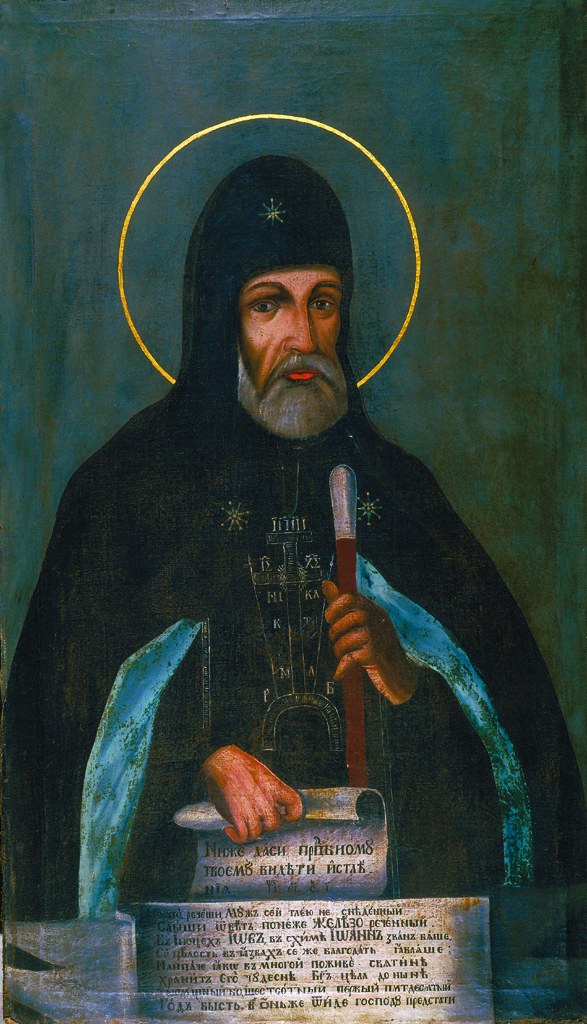
Iconography
Job is painted as an aged monk of the great schema — long white beard, the schema's cross and cowl — often with the Pochaev hill and the wonderworking Icon of the Mother of God behind him, or holding a scroll. The stored image is a nineteenth-century icon-portrait inscribed with his name and his worldly style, "the hegumen Job (in the world Ivan Zhelezo)": the venerable at prayer, in monastic habit.