
"Seven Arrows" Icon of the Mother of God
Kept 13 August — Principal commemoration of the wonderworking image of Vologda, Pascha offset 56
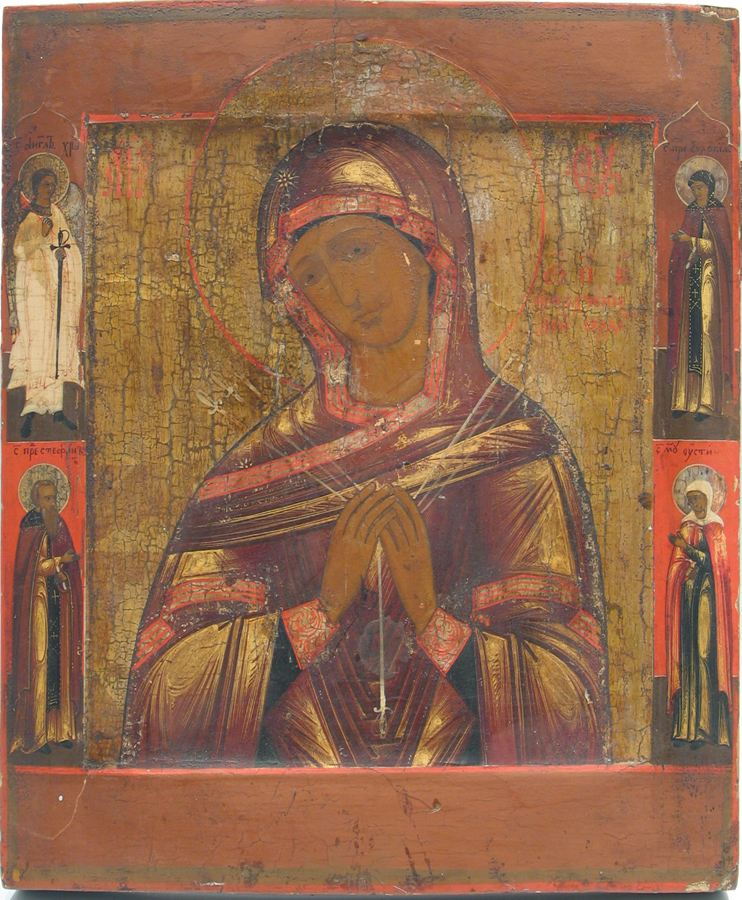
The "Seven Arrows" (Russian Semistrelnaya) is the great image of the Vologda land, and one of the very few Orthodox icons of the Mother of God that shows her without the Child. She is painted alone, her head bowed toward her right shoulder, her hands crossed on her breast, and seven swords or arrows pierce her heart — four entering on one side and three on the other. The subject is the prophecy of the elder Symeon in the temple: and a sword shall pierce through thy own soul also (Luke 2:35), with the number seven taken for the fullness of her sorrows. The panel itself is reckoned to be some six hundred years old; it was found, according to the tradition, being trodden underfoot as a plank in the belfry stair of a church near Vologda, was revealed by a vision to a paralysed man of Kadnikov who was healed before it, and became famous throughout the north during the cholera of 1830 at Vologda. It is commemorated on August 13.

The finding at the belfry
The story as the Vologda tradition transmits it is a story of neglect. The icon had been in the church of St John the Theologian on the river Tosna, in the district of Vologda, and had come to be laid face-down on the landing of the bell-tower stair, where it was taken for an ordinary board and walked on by everyone going up to the bells.
A peasant of the town of Kadnikov, crippled for years and unable to walk, was told three times in a dream that he would be healed if he prayed before an icon of the Mother of God in that church. He had himself carried there; the icon was looked for and not found; and only when the dream was told again was the plank on the belfry stair thought of, taken up, washed and set in its place. A moleben was served before it, and the man recovered the use of his limbs. It is the first of the recorded miracles of the image.
The cholera of 1830
The wide fame of the icon dates from 1830, when cholera came to Vologda in the great epidemic that crossed the empire from the south. The image was carried in procession round the city, and the ending of the plague there was ascribed to it. From that time the Semistrelnaya was one of the most copied icons of the Russian north, and its copies multiplied still faster in the twentieth century.
The icon since
The original panel was moved when the churches of the district were closed, and has been kept since 1945 in the church of St Lazarus in Vologda, where it remains. Two of its copies in the Moscow region — one in a church of the Archangel Michael in Moscow, one at the village of Bachurino — are reported to have streamed myrrh in recent decades, and are themselves venerated.
The related types
Three closely related images are constantly confused with one another, and with some reason, since the difference is only in the arrangement of the swords and in the posture:
- the Seven Arrows (Semistrelnaya) proper, with four swords on the left and three on the right, the Mother of God usually shown half-length with hands crossed at the breast;
- the "Softener of Evil Hearts" (Umyagcheniye zlykh serdets), with three swords on each side and one below, the Mother of God's hands often open at her breast;
- "Symeon's Prophecy" (Simeonovo prorochestvo), in which the swords are arranged as in the second type but the elder Symeon may be shown.
Russian usage treats all three as one commemoration in practice and the names are often interchanged, but the arrangement of the swords is the reliable distinguishing mark.
Feast and commemoration
The commemoration is August 13 — civil August 13 on the New Calendar, civil August 26 on the Old — falling on the leavetaking of the Transfiguration and within the Dormition Fast (August 1–14). A second commemoration is kept on the Sunday of All Saints, the first Sunday after Pentecost, which is movable and belongs to the movable calendar rather than to a fixed day.
The icon is Russian in observance and is not in the Greek books. It is prayed before for the softening of hardened and embittered hearts, for reconciliation between enemies and within families, and — from the events of 1830 — in time of epidemic.
Hymns
Troparion — Tone 4
Soften our evil hearts, O Mother of God, and quench the assaults of those that hate us, and loose every straitness of our soul; for beholding thy holy image we are pierced with compunction at thy suffering and thy tender mercy toward us, and we kiss thy wounds, and are afraid of the arrows of our own sins. Suffer us not, O Mother of compassion, to perish in our cruelty and from the cruelty of our neighbours.
Original translation from the Slavonic
Kontakion — Tone 8
Seven swords pierced thy soul, O Virgin, when thou didst stand beneath the Cross of thy Son; and now thou standest for us before him, healing by thy wounds the hardness of our hearts. Wherefore we cry: rejoice, thou that art wounded for our sake.
Original translation from the Slavonic
Appointed readings
Epistle — Philippians 2:5–11
5Let this mind be in you, which was also in Christ Jesus: 6Who, being in the form of God, thought it not robbery to be equal with God: 7But made himself of no reputation, and took upon him the form of a servant, and was made in the likeness of men: 8And being found in fashion as a man, he humbled himself, and became obedient unto death, even the death of the cross. 9Wherefore God also hath highly exalted him, and given him a name which is above every name: 10That at the name of Jesus every knee should bow, of things in heaven, and things in earth, and things under the earth; 11And that every tongue should confess that Jesus Christ is Lord, to the glory of God the Father.
Gospel — Luke 10:38–42; 11:27–28
38Now it came to pass, as they went, that he entered into a certain village: and a certain woman named Martha received him into her house. 39And she had a sister called Mary, which also sat at Jesus’ feet, and heard his word. 40But Martha was cumbered about much serving, and came to him, and said, Lord, dost thou not care that my sister hath left me to serve alone? bid her therefore that she help me. 41And Jesus answered and said unto her, Martha, Martha, thou art careful and troubled about many things: 42But one thing is needful: and Mary hath chosen that good part, which shall not be taken away from her. 27And it came to pass, as he spake these things, a certain woman of the company lifted up her voice, and said unto him, Blessed is the womb that bare thee, and the paps which thou hast sucked. 28But he said, Yea rather, blessed are they that hear the word of God, and keep it.
Iconography
The type is instantly recognisable and is unusual on two counts: the Mother of God appears alone, without the Child, which is rare in the Orthodox tradition outside the Deesis and a very few images of the Passion; and she is shown wounded, which is rarer still.
She is painted half-length, the head inclined to her right shoulder in the attitude of grief, the hands crossed on the breast or laid one over the other, the eyes lowered. Seven swords — thin, straight, with visible hilts — enter her breast, four from her left and three from her right in the Semistrelnaya arrangement. There is no throne, no attendant angel, and usually no ornament: the whole weight of the image is on the face and the swords. The Slavonic monogram МР ѲУ stands in the upper field as always.
The panel reproduced below is a good mid-nineteenth-century example of the type, with the crackled gold ground characteristic of Russian provincial work of the period and four saints painted in narrow borders at the sides — a family icon, whose owners' patrons stand round the central image.
Russian panel, c. 1850.