
"The Sign" Icon of the Mother of God
"The Sign" (Slavonic Znamenie) is one of the oldest and most widely reproduced iconographic types of the Mother of God in the Russian Church, showing the Theotokos with hands raised in prayer (the orans posture) and the Christ-Emmanuel enclosed in a medallion upon her breast. The type is ancient, descending from the early praying-Virgin images of the catacombs and the Byzantine Platytera and Nikopoia; in Russia it took its Slavonic name from a "sign" — a miracle — worked through the Novgorod icon in 1170, when, during the siege of Great Novgorod by a coalition of princes under the son of Andrew Bogolyubsky of Suzdal, the icon was carried in procession upon the walls, was struck by an arrow, wept, and turned its face to the city, and the besiegers were thrown into confusion and routed. The feast, established at Novgorod in thanksgiving, is kept on November 27, and the type spread across Russia in countless venerated copies — the Kursk-Root, Abalak, Tsarskoye Selo, Seraphim-Ponetayevka and other "Znamenie" icons among them.
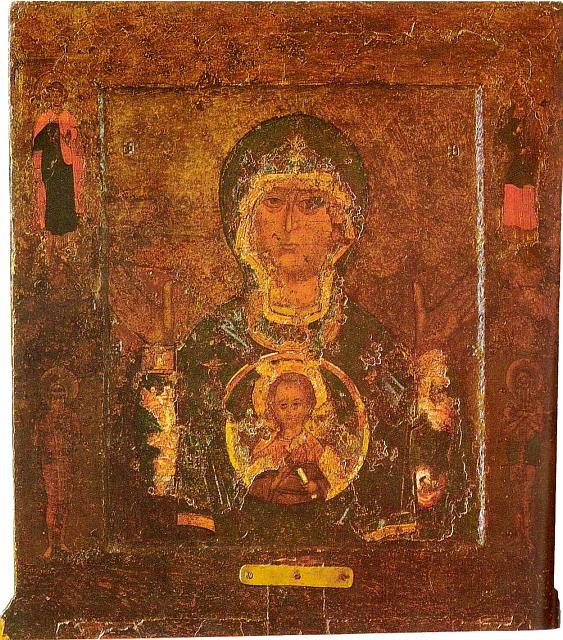

The iconographic type and its antiquity
The "Sign" is a half- or full-length image of the Mother of God with both hands lifted in prayer, and upon her breast, within a round medallion or mandorla, the Christ-child — the pre-existent Word, styled Emmanuel ("God with us") — shown frontally and blessing. The composition is a confession of the Incarnation: the Virgin who carries the uncircumscribable God in her womb is depicted with him enthroned upon her heart. The type is among the earliest known depictions of the Theotokos: a praying Virgin with the Child on her knees is painted in the catacomb of Saint Agnes at Rome and ascribed to the fourth century, and the sixth-century Byzantine "Nikopoia" shows the Mother of God enthroned holding an oval shield with the image of the Saviour. In Byzantium the developed standing form is called the Platytera ("more spacious than the heavens") or the Blachernitissa; in Russia such icons appeared in the eleventh and twelfth centuries and came to be known as icons "of the Sign," after the Novgorod miracle of 1170.
The sign at Novgorod, 1170
In 1170 the allied forces of several Russian appanage princes, led by a son of Prince Andrew Bogolyubsky of Suzdal, marched against Great Novgorod and laid siege to its walls. The Novgorodians, greatly outnumbered, gave themselves to prayer, beseeching God not to abandon the city. On the third night the Bishop of Novgorod, Elias (later Archbishop John), heard a voice commanding that the icon of the Mother of God be taken from the Church of the Saviour's Transfiguration on Ilyina Street and carried upon the city walls. As the icon was borne in procession the besiegers loosed a volley of arrows, and one struck the very face of the Mother of God; tears flowed from her eyes, and the icon turned its face away from the attackers and toward the city. At this sign a sudden terror fell upon the enemy: they were thrown into disorder, began to strike one another, and the Novgorodians, taking courage, sallied out and won the victory. Archbishop Elias established a feast in memory of the deliverance, which the Russian Church keeps to this day; some Novgorod icons of the Sign depict the events of 1170 in narrative registers around the central image, the battle between the men of Novgorod and Suzdal.
The icon and its copies
For 186 years the wonderworking icon remained in the Church of the Transfiguration on Ilyina Street; in 1356 it was translated to a church built in Novgorod in its honour, which became the cathedral of the Znamensky (Sign) monastery. The Athonite hieromonk Pachomius the Logothete, present at a celebration of the feast in Russia, composed two canons for it. From Novgorod the type spread throughout the Russian land, and many copies became famous wonderworking icons in their own right, taking their names from the places of their glorification: the Kursk-Root Icon of the Sign, the Abalak (Abalatsk) Icon of Siberia, the Tsarskoye Selo, Seraphim-Ponetayevka, Verkhnetagilsk, Dionysievo-Glushitsa and Korchemnaya icons among them. Through these innumerable copies the "Sign" remains one of the most familiar images of the Mother of God in Russian churches and homes.
Feast and commemoration
November 27 (church date; Old Calendar civil December 10), kept in the Russian Church and throughout the Slavic world, and by the Orthodox Church in America, as the commemoration of the sign given at Novgorod in 1170. It is a feast of the Mother of God, kept in Russian usage with the blue vestments appointed for her feasts, and falls within the Nativity Fast. The feast is proper to the Russian tradition and is not on the Greek calendar. The several derivative "Znamenie" icons carry their own commemorations on other days — the Kursk-Root icon on November 27 together with the parent feast (its principal days falling in the autumn), the Abalak icon on July 20 — while sharing the one iconographic type.
Hymns
Troparion — Tone 4
As an unassailable rampart and a fountain of wonders have we thy servants gained thee, O most pure Theotokos; therefore do we cast down the assaults of our adversaries. Wherefore we pray thee: grant peace to thy city, and to our souls great mercy.
Original translation from the Slavonic
Kontakion — Tone 4
Keeping the feast of the sign of thy holy image, O Mother of God, thy people, by which thou didst grant a marvellous victory over the adversaries of thy city, therefore with faith we cry to thee: Rejoice, O Virgin, praise of Christians.
Original translation from the Slavonic
Appointed readings
Epistle — Philippians 2:5–11
5Let this mind be in you, which was also in Christ Jesus: 6Who, being in the form of God, thought it not robbery to be equal with God: 7But made himself of no reputation, and took upon him the form of a servant, and was made in the likeness of men: 8And being found in fashion as a man, he humbled himself, and became obedient unto death, even the death of the cross. 9Wherefore God also hath highly exalted him, and given him a name which is above every name: 10That at the name of Jesus every knee should bow, of things in heaven, and things in earth, and things under the earth; 11And that every tongue should confess that Jesus Christ is Lord, to the glory of God the Father.
Gospel — Luke 10:38–42; 11:27–28
38Now it came to pass, as they went, that he entered into a certain village: and a certain woman named Martha received him into her house. 39And she had a sister called Mary, which also sat at Jesus’ feet, and heard his word. 40But Martha was cumbered about much serving, and came to him, and said, Lord, dost thou not care that my sister hath left me to serve alone? bid her therefore that she help me. 41And Jesus answered and said unto her, Martha, Martha, thou art careful and troubled about many things: 42But one thing is needful: and Mary hath chosen that good part, which shall not be taken away from her. 27And it came to pass, as he spake these things, a certain woman of the company lifted up her voice, and said unto him, Blessed is the womb that bare thee, and the paps which thou hast sucked. 28But he said, Yea rather, blessed are they that hear the word of God, and keep it.
Iconography
The "Sign" type is defined by the orans posture — the Mother of God facing the viewer with both arms raised, palms outward, in prayer — and by the medallion of the Christ-Emmanuel upon her breast: the Child shown frontally, his right hand raised in blessing, sometimes holding a scroll, enclosed in a circular glory that signifies both the womb that bore him and the disc of divine light. The image is usually cut at the waist, though full-length standing forms exist. The stored image is the wonderworking Novgorod icon itself, of the first half of the twelfth century — the obverse of a double-sided panel, darkened with age, on which the arrow-wound and the inclined face belong to the tradition of 1170.