
Nativity Fast, day 13
About "The Sign" Icon of the Mother of God →
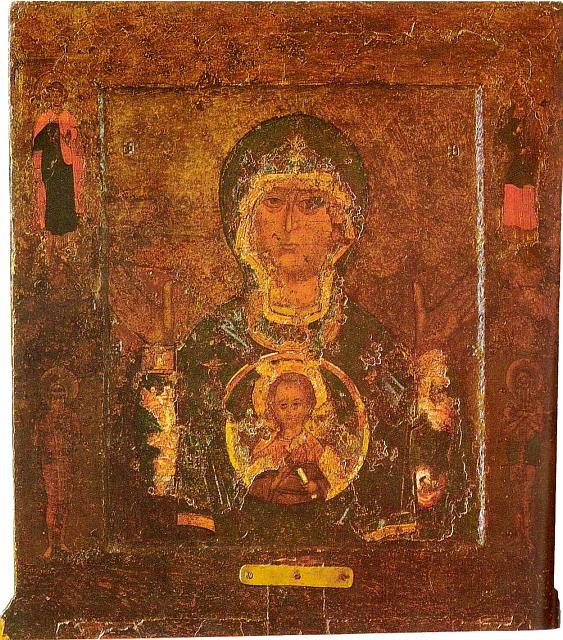

Saints commemorated
-
Saint of the day
Greatmartyr Jacob of Persia
-
Repose of Archimandrite Lazarus (Moore) (1992) (Nov. 14 OC)
-
James the Persian
James the Persian (died c. 421), surnamed Intercisus — "the sawn-asunder" or "cut to pieces" — is among the most venerated of the Persian martyrs. A Christian of noble and wealthy family, he rose to high favour at the court of the Sassanid kings Yazdegerd I and Bahram V; and when Yazdegerd turned to persecuting the Church, James, to keep the royal friendship, joined the king in the worship of the sun and fire. His mother and his wife, both Christians, wrote to rebuke him and to break off communion with him, and their letter recalled him to repentance. Confessing Christ before Bahram V, he was condemned to be dismembered joint by joint — fingers, toes, hands, feet, arms and legs cut away one by one, some twenty-eight pieces — and at last beheaded. Throughout the long torture he gave thanks that God had granted him to redeem his denial by such a death. His graphic martyrdom passed into the Menologia and into the iconography of the Church.
-
Palladius of Thessalonica
Palladius of Thessalonica was a monastic saint of the late sixth and early seventh centuries. Born at Thessalonica, he pursued the ascetic life in Egypt, in the region of Alexandria, and reposed in peace. Little of his history survives beyond his name, his origin, and the memory of his ascetic labours; his service is appointed to be sung at Compline. He is commemorated on November 27, and is to be distinguished from the fourth-century Palladius of Galatia, the author of the Lausiac History.
-
Romanos of Cilicia
Romanos of Cilicia was a hermit of the fifth century who, though a native of Rhoson in Cilicia, passed his ascetic life in a cave near Antioch. In strict fasting, wearing heavy chains beneath a hair shirt and keeping no fire in his cell for many years, he was granted by God the gift of wonderworking: he healed grave illnesses and obtained children for the barren through his prayers, so that he is invoked especially by the childless. He wore his gifts with humility, teaching that it is no great thing to work miracles but to keep God's commandments, and reposed in peace. He is commemorated on November 27 and again on February 9.
-
Seventeen Monastic Martyrs of India
The Seventeen Monastic Martyrs of India are a company of monks commemorated on November 27, known from the celebrated story of Barlaam and Josaphat. In that narrative — transmitted in Greek under the name of Saint John of Damascus — they suffered in the fourth century under King Abenner of India, who persecuted the Christians because his people, and even members of his own court, were turning to Christ. Seized by the king's officer and questioned about the whereabouts of the hermit Barlaam, they refused to betray him; they were tortured, brought before Abenner, and at last had their eyes put out and their limbs cut off, exhorting one another to accept death for Christ. Saint John of Damascus likens them to the seven holy Maccabees of the Old Covenant.
-
Vsevolod-Gabriel of Pskov
Vsevolod-Gabriel (†1138) was a prince of the house of Kiev — son of Mstislav the Great and grandson of Vladimir Monomakh — who ruled Novgorod and became the first beloved prince of Pskov. Born at Novgorod and given in baptism the name Gabriel, he governed Novgorod for many years as a builder of churches and a protector of the poor, founding the stone Church of Saint John the Forerunner at Opoki and beginning the great works of the city. After a disputed campaign and a falling-out with the turbulent Novgorodians, who expelled him, he was received in Pskov, which took him gladly as its prince; there, in the brief months left to him, he laid the foundation of the Cathedral of the Holy Trinity, the mother-church of Pskov, and reposed on 11 February 1138. His relics, uncovered incorrupt in 1192 and enshrined in the cathedral he had founded, made Pskov's Trinity Cathedral a place of wonders, and Vsevolod-Gabriel its heavenly patron; his sword, inscribed Honorem meum nemini dabo — "I will yield my honour to no one" — was long kept above his tomb.
British Isles and Ireland
- St. Virgilius (Fergal), bishop of Salzburg (784)
- St. Seachnall, bishop of Dunsaughlin (457)
- St. Congar, abbot of Congresbury (6th C)
- St. Gallgo of Llanallgo (6th C)
- St. Fergus, missionary to the Picts (c.721)
Troparia & kontakia
Kontakion — Tone 4
Keeping the feast of the sign of thy holy image, O Mother of God, thy people, by which thou didst grant a marvellous victory over the adversaries of thy city, therefore with faith we cry to thee: Rejoice, O Virgin, praise of Christians.
Kontakion — Tone 2
Persuaded by thy good wife, O stout-hearted one, and fearing the dread judgement seat, thou didst spurn the mind and the terror of the Persians, O James, and wast shown a wondrous martyr, thy body cut through like a vine-branch.
Troparion — Tone 4
As an unassailable rampart and a fountain of wonders have we thy servants gained thee, O most pure Theotokos; therefore do we cast down the assaults of our adversaries. Wherefore we pray thee: grant peace to thy city, and to our souls great mercy.
Troparion — Tone 4
Thy martyr James, O Lord, in his contest received an incorruptible crown from thee our God; for possessed of thy might, he cast down the tyrants and shattered the feeble insolence of the demons. By his prayers, O Christ God, save our souls.
Readings
Epistle
1 Timothy 4.4-8, 16
4For every creature of God is good, and nothing to be refused, if it be received with thanksgiving: 5For it is sanctified by the word of God and prayer. 6If thou put the brethren in remembrance of these things, thou shalt be a good minister of Jesus Christ, nourished up in the words of faith and of good doctrine, whereunto thou hast attained. 7But refuse profane and old wives’ fables, and exercise thyself rather unto godliness. 8For bodily exercise profiteth little: but godliness is profitable unto all things, having promise of the life that now is, and of that which is to come. 16Take heed unto thyself, and unto the doctrine; continue in them: for in doing this thou shalt both save thyself, and them that hear thee.
Gospel
Luke 19.12-28
12He said therefore, A certain nobleman went into a far country to receive for himself a kingdom, and to return. 13And he called his ten servants, and delivered them ten pounds, and said unto them, Occupy till I come. 14But his citizens hated him, and sent a message after him, saying, We will not have this man to reign over us. 15And it came to pass, that when he was returned, having received the kingdom, then he commanded these servants to be called unto him, to whom he had given the money, that he might know how much every man had gained by trading. 16Then came the first, saying, Lord, thy pound hath gained ten pounds. 17And he said unto him, Well, thou good servant: because thou hast been faithful in a very little, have thou authority over ten cities. 18And the second came, saying, Lord, thy pound hath gained five pounds. 19And he said likewise to him, Be thou also over five cities. 20And another came, saying, Lord, behold, here is thy pound, which I have kept laid up in a napkin: 21For I feared thee, because thou art an austere man: thou takest up that thou layedst not down, and reapest that thou didst not sow. 22And he saith unto him, Out of thine own mouth will I judge thee, thou wicked servant. Thou knewest that I was an austere man, taking up that I laid not down, and reaping that I did not sow: 23Wherefore then gavest not thou my money into the bank, that at my coming I might have required mine own with usury? 24And he said unto them that stood by, Take from him the pound, and give it to him that hath ten pounds. 25(And they said unto him, Lord, he hath ten pounds.) 26For I say unto you, That unto every one which hath shall be given; and from him that hath not, even that he hath shall be taken away from him. 27But those mine enemies, which would not that I should reign over them, bring hither, and slay them before me. 28And when he had thus spoken, he went before, ascending up to Jerusalem.