
Abdias of Persia
The Holy Martyr Abdias of Persia
Martyr · d. c. 420
Commemorated 5 September
Abdias (Abda, Abidas — the name is glossed Obadiah, "servant of the Lord") was a martyr of the Church of Persia under the Sassanid king Yazdegerd I (399–420). Refusing to renounce Christ and to worship the sun and the sacred fire of the Zoroastrian state religion, he was subjected to many tortures — the synaxaria record that he was beaten with thorny rods — and died of them, giving thanks to God to his last breath that he was counted worthy to suffer for the holy Name. He is commemorated on September 5.
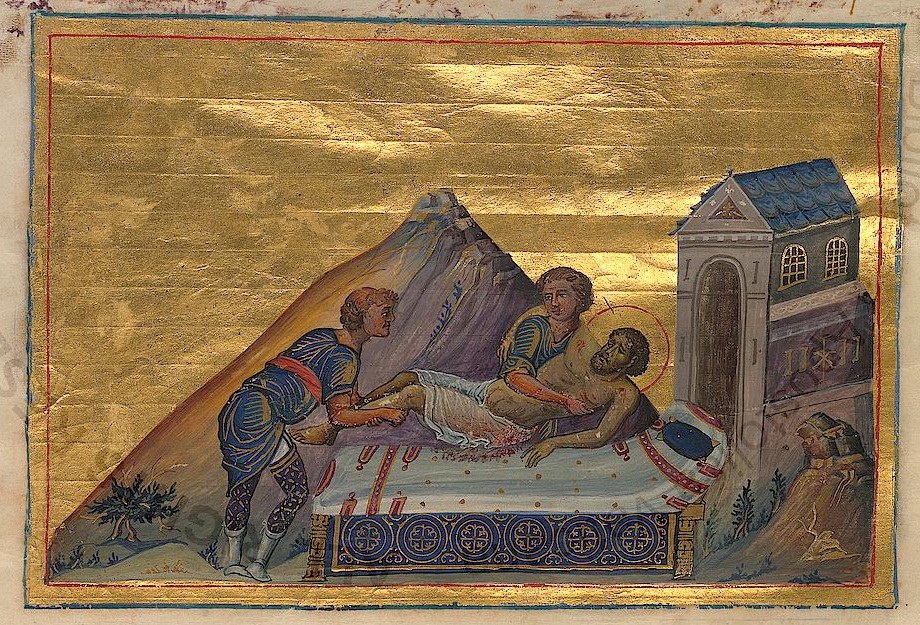

The record of Abdias is brief. The synaxaria commemorate him among the martyrs of Persia, and the OCA places his suffering under "the emperor Izdegerd" — Yazdegerd I, the Sassanid king in whose last years (c. 419–420) a fierce persecution broke upon the Persian church after decades of relative toleration, when Christian zeal against the fire-temples gave the Zoroastrian clergy their occasion. Brought to trial, Abdias refused to renounce Christ or to offer the worship of sun and fire demanded as the test of loyalty; he was tortured at length — the Greek synaxarion notice remembers the beating with rods of thorns — and died under or shortly after his torments, thanking God, as the tradition records, that His chosen one was permitted to die for His holy Name. Nothing further — his rank, his city, his burial — is transmitted in the calendars consulted.
Feast and commemoration
September 5 (church date; Old Calendar civil September 18), among the Persian martyrs of the day. No proper service is appointed; the common of martyrs serves where his memory is kept liturgically.
Hymns
Troparion — Tone 4 (from the common of martyrs)
Thy martyr, O Lord, in his contest received an incorruptible crown from Thee, our God; for possessing Thy strength he cast down the tyrants and shattered the feeble insolence of the demons. By his intercessions save our souls.
Original translation from the Greek
Iconography
The stored image is the miniature of the Menologion of Basil II (Constantinople, 985): the martyr lies dying on a bed, his body torn by the thorny rods of his scourging, tended by a companion — the manuscript's rendering of his death from the beating. In portrait icons he would be depicted as a martyr of the Persian church, bearing the martyr's cross.
Disputed questions
- Identity and name. The name appears as Abdias, Abidas, Abdaios, and Abda, all renderings of a Syriac-Persian name meaning "servant." A bishop Abda (Audas), whose destruction of a fire-temple is linked by Theodoret (Ecclesiastical History 5.39) with the outbreak of Yazdegerd's persecution and who was martyred c. 420, is commemorated in the calendars on March 31 (with Benjamin the Deacon); whether the September 5 Abdias is a distinct martyr of the same name and persecution — as the calendar, keeping both commemorations, implies — or a doubled entry of the bishop, cannot be settled from the surviving notices. The two are kept distinct here, as the calendar keeps them, and the question is recorded.
- Century. The OCA gives the fifth century (under Yazdegerd I); older tables occasionally assign the fourth-century persecution of Shapur II. The entry follows the OCA's live listing.
- Not to be confused with the Old Testament Prophet Obadiah (commemorated November 19), whose name is the same word "servant of the Lord" and who appears in the Greek Menaia under the identical form Abdias (Ἀβδιού). The prophet and this Persian martyr are wholly distinct.