
Obadiah the Prophet
The Holy Prophet Obadiah
Prophet
Commemorated 19 November
Obadiah — Abdias in the Greek of the Septuagint and the Byzantine service books — is the fourth of the Twelve Minor Prophets and the author of the shortest book in the Old Testament, a single chapter of twenty-one verses proclaiming the judgment of God upon Edom and the deliverance of Zion. The tradition the Church received identifies him with the God-fearing steward of King Ahab who, in the days of Jezebel's persecution, hid a hundred prophets of the Lord in two caves and fed them (1 Kings 18). His name means "servant" or "worshipper of the Lord." He is commemorated on November 19, within the Nativity Fast.
,_RP-P-1963-217.jpg)
In the Scriptures
The Book of Obadiah gives no genealogy, date, or biography — only its oracle. The Church has therefore read the prophet through the received hagiographic tradition, which identifies the seer of the book with the Obadiah of the historical books: the man "over the household" of Ahab, king of Israel, "who feared the Lord greatly," and who, when Jezebel "cut off the prophets of the Lord," took a hundred of them and hid them by fifties in two caves, feeding them with bread and water at the risk of his own life (1 Kings 18:3–4). It is this Obadiah whom Elijah meets on the road as the prophet goes to confront Ahab, and whom he sends ahead to announce his coming (1 Kings 18:7–16).
The synaxarion tradition, drawing these threads together, tells the prophet's life as follows. Obadiah was of the village of Bethacharam near Shechem (Sychem), in Samaria, and served as steward in the palace of the impious Ahab while secretly keeping faith with the God of Abraham, Isaac, and Jacob amid a kingdom that had turned to the worship of Baal. Under Ahab's son and successor Ahaziah (Ochoziah), the same account continues, Obadiah was made captain of the third company of soldiers sent to seize the Prophet Elijah on the mountain; where the first two captains and their fifties were consumed by fire called down from heaven, the third captain fell on his knees and begged for his life and that of his men, and was spared (2 Kings 1:9–15). From that hour, the tradition holds, Obadiah left the king's service, attached himself to Elijah as a disciple, and himself received the gift of prophecy. He was buried, it is said, in Samaria among his fathers.
The Book of Obadiah
The prophecy that bears his name is an oracle against Edom — the nation descended from Esau, brother of Jacob, dwelling in the rock-fortresses south of the Dead Sea. Edom had gloated over the fall of Jerusalem and cut down or handed over the fugitives of Judah in the day of her calamity; against this the prophet thunders that though Edom set her nest among the stars, the Lord would bring her down (Obadiah 1–4), that "as thou hast done, it shall be done unto thee" (v. 15), and that the house of Jacob shall possess its inheritance while "saviours shall come up on mount Zion" and "the kingdom shall be the Lord's" (vv. 17, 21). The Fathers read the closing verses — the deliverance on Zion, the passing of the kingdom to the Lord — as a prophecy of the salvation wrought by Christ and extended to the nations, and Edom, the proud brother-nation brought low, as a figure of every earthly power that exalts itself against God.
Feast and commemoration
November 19 on the church calendar (Old Calendar civil December 2), among the prophets of the Old Covenant and within the Nativity Fast. The Greek Menaion appoints a proper canon to the prophet, the work of Theophanes, whose acrostic runs "I sing the glory of Obadiah the seer" (Τὸ τοῦ βλέποντος Ἀβδιοὺ μέλπω κλέος); the martyr Barlaam of Antioch is joined with him on the same day.
Hymns
Troparion — Tone 2
As we celebrate the memory of thy prophet Obadiah, O Lord, through him we entreat thee: save our souls.
Original translation from the Greek
Iconography
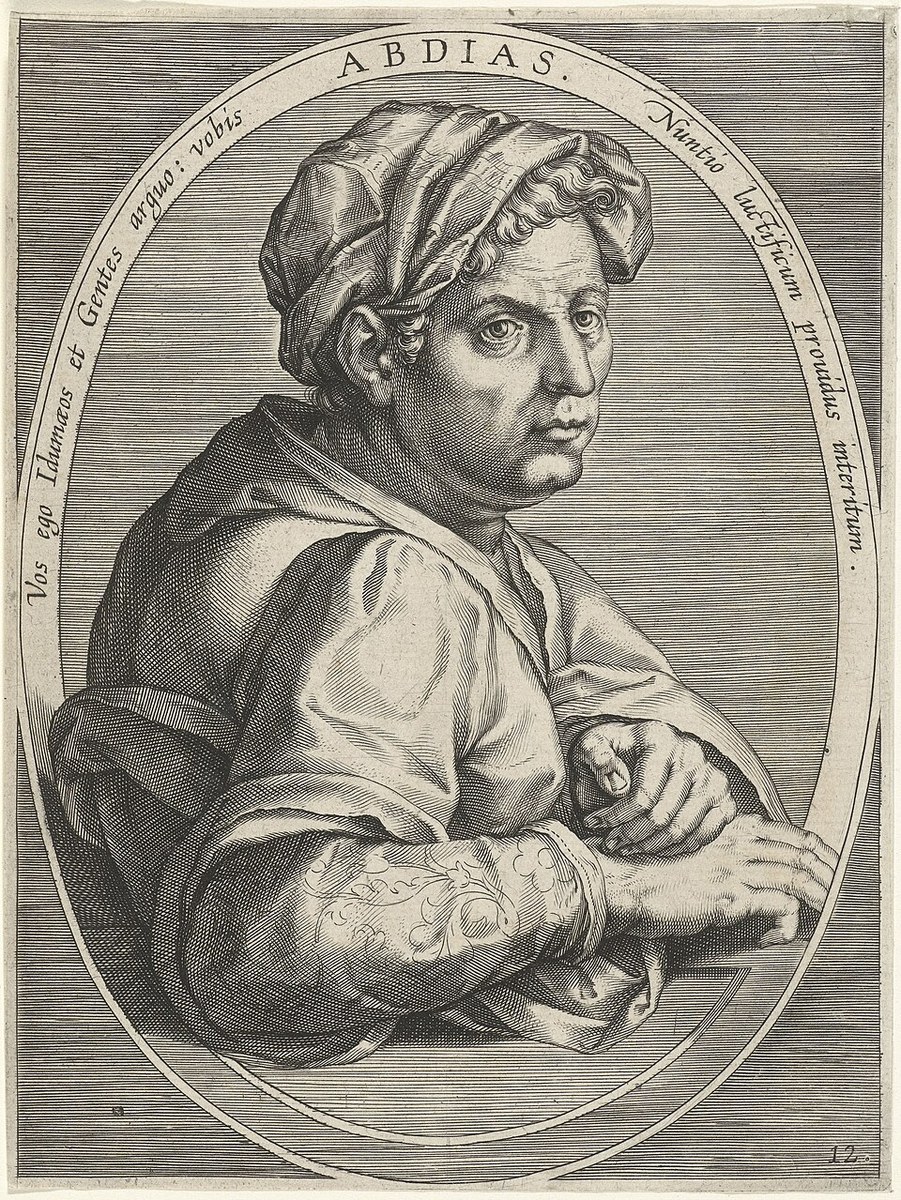
Obadiah is depicted in the traditional manner of the prophets: an elderly, grey-haired man with a short rounded beard, holding a scroll. The scroll bears a verse of his oracle — most often the words "Thus saith the Lord: I will destroy the wise men out of Edom" (Obadiah 8), or the promise of deliverance on Zion. He appears in the prophet-rows of the iconostasis and in the illustrated prophet-books. The stored image is an engraving of the prophet from the Icones Prophetarum Veteris Testamenti (1613), a series of prophet-portraits, which shows him as an aged seer with his scroll.
Disputed questions
- One Obadiah or several. Modern biblical scholarship distinguishes the author of the book (whom it commonly places after the fall of Jerusalem in 587 BC, the catastrophe the oracle presupposes) from the ninth-century steward of Ahab, and often from the several other men named Obadiah in the Old Testament. The Church's calendar commemorates the prophet as the tradition received him — the steward of Ahab, disciple of Elijah, and seer of the oracle against Edom, placed in the ninth century BC — and the entry above presents that tradition, noting the scholarly question rather than resolving it.
- Not to be confused with the martyr Abdias of Persia (commemorated September 5), a victim of the Sassanid persecution under Yazdegerd I whose name is the same Semitic word "servant of the Lord" rendered into Greek as Abdias — the same form under which the prophet Obadiah appears in the Menaia. The two are wholly distinct: one an Old Testament seer, the other a fifth-century Persian martyr.