
Abraham and Lot
The Righteous Forefather Abraham and his Nephew the Righteous Lot
Righteous · Forefather
Commemorated 9 October
Abraham, the father of all believers, is the patriarch whom God called out of Ur of the Chaldees with the promise that in his seed all the nations of the earth would be blessed; the friend of God who received the covenant and its sign, entertained the Lord under the oak of Mamre, interceded for Sodom, and did not withhold his only son. With him the Church commemorates his nephew Lot, "righteous Lot" of Sodom, delivered by angels from the overthrow of the cities. Ancestors of Christ according to the flesh, they are commemorated together on October 9 and again among the Holy Forefathers before the Nativity; from Abraham's hospitality at Mamre the Church draws the Old Testament image of the Holy Trinity, and into "the bosom of Abraham" she prays her departed may be received.

The call and the promise
Abram, son of Terah, of the line of Shem, was brought out from Ur of the Chaldees to Haran, and there the word came that stands at the head of the whole history of faith: "Get thee out of thy country, and from thy kindred, and from thy father's house, unto a land that I will shew thee" (Genesis 12:1). With the command came the promise — a great nation, a great name, and blessing for all families of the earth in him. Abram went, seventy-five years old, taking Sarai his wife and Lot his brother's son, into the land of Canaan; and at Shechem the Lord appeared to him and added: "Unto thy seed will I give this land" — whence Canaan is called the Land of Promise. He built altars and "called upon the name of the Lord," a sojourner his whole life in the land his descendants would inherit.
Abraham and Lot
Lot, son of Abram's brother Haran, had come with him from Ur, and the two prospered until the land could not bear their herds together. The parting (Genesis 13) is drawn as a study in two kinds of choosing: Abram, the elder, yielding the choice; Lot lifting his eyes to the well-watered plain of Jordan and pitching his tent toward Sodom, "the men of which were wicked and sinners before the Lord exceedingly." When the four kings of the East sacked Sodom and carried Lot away, Abram armed the three hundred and eighteen men of his house, pursued to Dan, and brought back his nephew with all the spoil; and returning he was met by Melchizedek king of Salem, priest of the Most High God, who brought forth bread and wine and blessed him — the meeting the Church reads, with Psalm 110 and the Epistle to the Hebrews, as the Old Testament's own figure of the priesthood of Christ and of the Eucharist. To the king of Sodom's offer of the goods Abram lifted his hand in the oath that he would take not a thread nor a shoe-latchet.
The covenant
"Fear not, Abram: I am thy shield, and thy exceeding great reward" (Genesis 15). Childless still, Abram was led out under the night sky — "so shall thy seed be" — "and he believed in the Lord; and he counted it to him for righteousness," the verse on which the apostle Paul builds the whole doctrine of justifying faith. The covenant was cut that night between the divided sacrifices, in the smoking furnace and burning lamp that passed between the pieces; and when Abram was ninety-nine the Lord sealed it with the change of names — Abram to Abraham, "father of a multitude of nations," Sarai to Sarah — and with the sign of circumcision in his flesh (Genesis 17).
The hospitality at Mamre
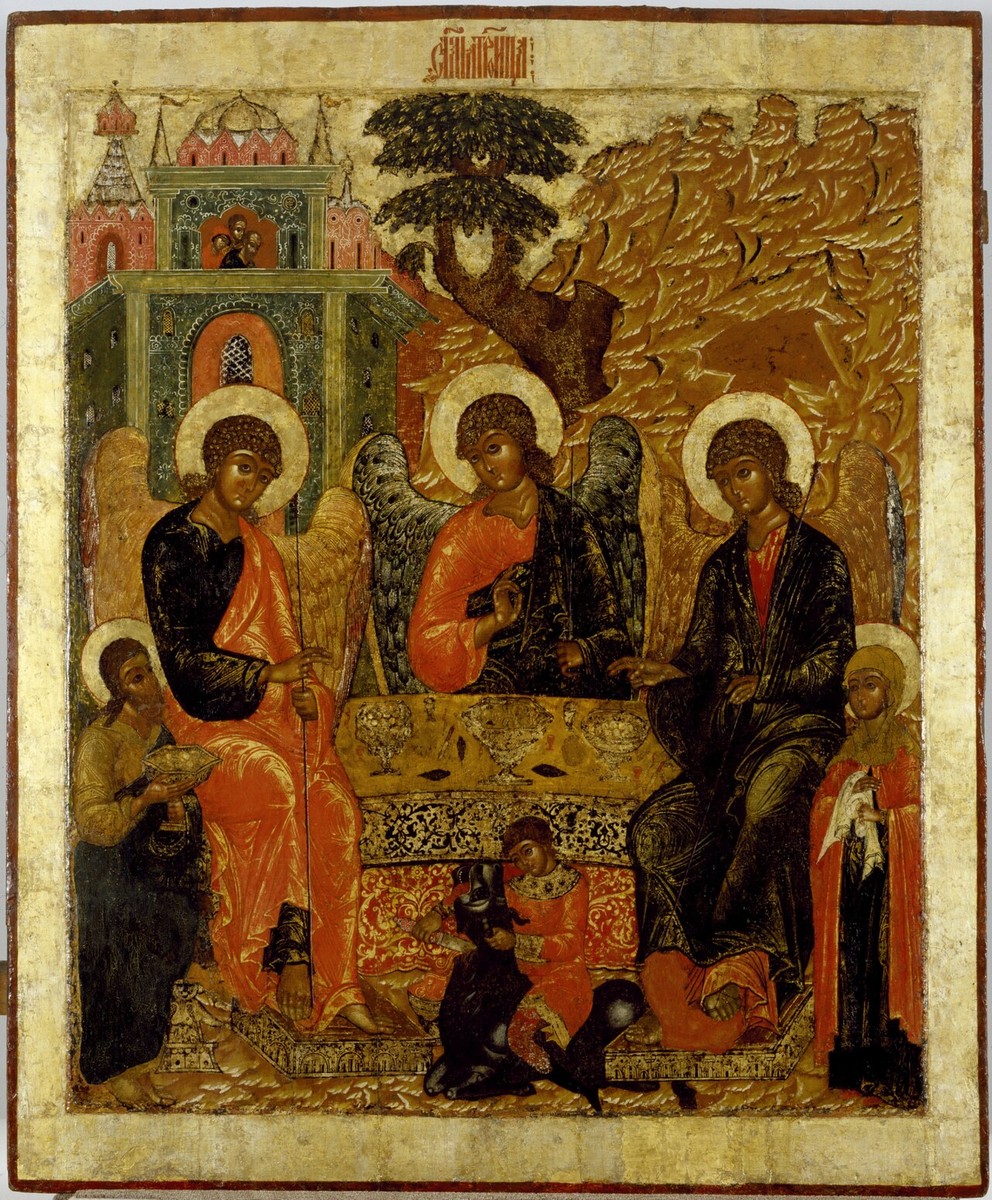
As Abraham sat in his tent door in the heat of the day by the oaks of Mamre, "he lift up his eyes and looked, and, lo, three men stood by him" (Genesis 18). He ran to meet them, bowed himself toward the ground, and addressed the three as one — "My Lord, if now I have found favour in thy sight, pass not away" — washed their feet, and set before them the calf tender and good, with bread that Sarah made ready, and stood by them under the tree while they ate. There the promise was made exact: "Sarah thy wife shall have a son"; and Sarah, listening at the tent door and laughing within herself at the thought — she being ninety — received the answer that names the divine power itself: "Is any thing too hard for the Lord?"
The Church has never read this scene as a mere visit of angels. The three who are addressed as one Lord, who eat at Abraham's table and speak the promise of the son, became for the Fathers the Old Testament's veiled self-disclosure of the Holy Trinity — "Abraham entertained the Trinity in figure" — and for the iconographers the one scriptural scene in which the Triune God could be shown at all (see Iconography below).
The intercession for Sodom and the deliverance of Lot
When the men rose toward Sodom, "Abraham stood yet before the Lord" and dared the most audacious prayer of the Old Testament: "Wilt thou also destroy the righteous with the wicked?… Shall not the Judge of all the earth do right?" Six times he lowered the count — fifty righteous, forty-five, forty, thirty, twenty, ten — and six times was answered, "I will not destroy it for their sake" (Genesis 18:23–33). The ten were not found. Two of the three came at even to Sodom, where Lot sat in the gate; he received them with his uncle's own urgent hospitality, and shielded them at his door against the men of the city. At dawn the angels led him out by the hand with his wife and two daughters — "Escape for thy life; look not behind thee" — and at his pleading spared for his refuge the little city of Zoar. The Lord rained fire and brimstone upon Sodom and Gomorrah; Lot's wife looked back and became a pillar of salt, the warning the Lord himself fixed for the Church in one word: "Remember Lot's wife" (Luke 17:32). Scripture then tells, without adornment, the shame of Lot's later fatherhood of Moab and Ammon by his own daughters in the cave above Zoar (Genesis 19:30–38) — an episode the Church reads soberly, honouring Lot for that in which Scripture itself calls him righteous, and remembering that from Moab would come Ruth, ancestress of David and of Christ.
The offering of Isaac
Isaac was born to the aged pair as the promise had said; and then came the trial that the Church reads every Holy Week toward Pascha: "Take now thy son, thine only son Isaac, whom thou lovest… and offer him there for a burnt offering" (Genesis 22). The three days' journey to Moriah, the wood laid on the son's back, the father's answer — "God will provide himself a lamb" — the bound son upon the altar, the stayed knife, the ram caught in the thicket: the Fathers read the whole as the exact figure of the Cross, the beloved Son carrying the wood of his own sacrifice, offered by the Father and received back alive as from the dead — "from whence also he received him in a figure" (Hebrews 11:19). For his obedience the promise was sworn by God's own self: "In thy seed shall all the nations of the earth be blessed."
Repose
Sarah died at Hebron, and Abraham bought of Ephron the Hittite the field and cave of Machpelah — the one piece of the promised land he ever owned — and buried her there. He died "in a good old age, an old man, and full of years," a hundred threescore and fifteen, and his sons Isaac and Ishmael buried him beside Sarah in the cave of Machpelah (Genesis 25:7–10). Of Lot's death Scripture records nothing; the synaxarion verses supply the theology in place of the biography (see below).
In the New Testament and the Fathers
No Old Testament figure stands so large in the New. The Gospel of Matthew opens with him: "the book of the generation of Jesus Christ, the son of David, the son of Abraham." The Lord names the blessedness of the age to come a sitting down "with Abraham, and Isaac, and Jacob, in the kingdom of heaven" (Matthew 8:11), and the resting place of the poor man's soul "Abraham's bosom" (Luke 16:22); he declares to the Judeans, "Your father Abraham rejoiced to see my day: and he saw it, and was glad… Before Abraham was, I am" (John 8:56–58). For Paul, Abraham who "believed God, and it was counted unto him for righteousness" is the father of all who believe, circumcised or not (Romans 4; Galatians 3), and the promise to his seed is fulfilled in Christ; for James, the offering of Isaac shows the faith that works; Hebrews sets him at the centre of the catalogue of faith and hangs the theology of Christ's priesthood on his meeting with Melchizedek. Peter canonises the nephew in a phrase: "just Lot, vexed with the filthy conversation of the wicked… that righteous man dwelling among them, in seeing and hearing, vexed his righteous soul from day to day with their unlawful deeds" (2 Peter 2:7–8).
The liturgical tradition breathes Abraham throughout. The funeral and memorial services pray repeatedly that the departed be given rest "in the bosom of Abraham"; the marriage crowning invokes the blessing of God upon the couple "as thou didst bless Abraham and Sarah"; the Theotokos sings of him in the Magnificat — "as he spake to our fathers, to Abraham, and to his seed for ever" — and the canticle of Zachariah remembers "the oath which he sware to our father Abraham." A later Palestinian tradition, attached to the Monastery of the Holy Cross outside Jerusalem, tells that Lot in penance watered a tree from which, in the fulness of time, the wood of the Cross was taken — a legend, recorded as such, that shows how completely the tradition drew even Lot's repentance into the economy of salvation.
Feast and commemoration
October 9 (church date; Old Calendar civil October 22): the Synaxarion of Constantinople appoints on this day, after the Apostle James son of Alphaeus, "the memory of the righteous Abraham, and of Lot his nephew," and the pair have been kept together on this day across the Greek and Slavic calendars. No proper hymns are appointed to them in the received Menaion; the synaxarion marks the memory with verses whose sense is: for Abraham — "What house is there, now that Abraham is dead? No bosom is a home for others, as his was for Lazarus"; for Lot — "Zoar was a new heaven to Lot: reaching it, he fled this life as he had fled the fire." Abraham (with Lot, as the OCA calendar notes) is commemorated again among the ancestors of Christ on the Sunday of the Holy Forefathers before the Nativity, and in the anticipation of that Sunday his name stands first whenever the Church numbers the righteous of the Old Covenant. He is commemorated in this collection jointly with Lot, as the calendars commemorate them; the pre-Nativity Sundays' commemorations are treated at the movable rules.
Iconography
Abraham's great icon is not a portrait but a table. The Hospitality of Abraham (in Greek usage the Philoxenia) — the three angels seated at Abraham's table beneath the oak of Mamre — is among the oldest continuously painted compositions in Christian art, present already in the fifth-century mosaics of Santa Maria Maggiore in Rome and the sixth-century sanctuary mosaics of San Vitale in Ravenna, and it became in the Byzantine and Russian tradition the canonical image of the Old Testament Trinity. In its full form Abraham and Sarah wait upon the seated angels — so in the stored primary icon, a Russian Hospitality of c. 1600 (Walters Art Museum): the three winged figures at the table with its chalice-like vessels, the oak and the tower of Mamre above, aged Abraham bringing a dish at the left, Sarah standing at the right, and the servant slaughtering the calf below.
The most celebrated icon of the type — and the most celebrated Russian icon of any type — is the Trinity of Andrei Rublev (c. 1411 or 1425–27), painted for the Trinity-Sergius Lavra and stored here as the variant image. Rublev's radical reduction removes Abraham and Sarah altogether, leaving the three angels alone in silent converse around a single chalice: the hospitality scene distilled into pure theology, the tree, house and mountain reduced to signs, the three figures composed within an implied circle of mutual love. The Stoglav council of 1551 held it up as the model of how the Trinity should be painted. Its very perfection explains why it is filed here only as a variant: Abraham himself does not appear in it. Abraham also appears throughout the festal and Last Judgment iconography — receiving the souls of the righteous into his bosom in paradise, at table in the "Bosom of Abraham" composition — and in scenes of the Sacrifice of Isaac; Lot is seen in the Sodom cycle, receiving the angels and led out of the burning city.
Disputed questions
- Dating. The conventional reckoning, which the calendars repeat, places Abraham "around 2000 BC"; the Byzantine world-era chronology makes its own (higher) computation, and modern scholarship regards any precise date as unrecoverable. The frontmatter records the conventional round figure; no precision is claimed.
- The three visitors of Mamre. The Fathers themselves diverge: some (so the mainstream Byzantine exegesis and the iconographic tradition) read the three as a manifestation of the Holy Trinity; others as the Lord (the Word) with two angels — the reading reflected in Genesis 19, where "two angels" come to Sodom while Abraham "stood yet before the Lord." The icon tradition holds both together: three angelic figures, venerated as the image of the Trinity.
- Lot's later history. The cave episode of Genesis 19:30–38 is in the canon of Scripture and is not suppressed by the tradition; the Church's veneration of Lot rests on 2 Peter's "righteous Lot" and on his deliverance, and the synaxarion verses for this day pass over the episode in silence.