
James son of Alphaeus
The Holy and All-praised Apostle James the Son of Alphaeus, of the Twelve
Apostle · d. 1st century
Commemorated 30 June — Synaxis of the Twelve Apostles, 9 October
James the son of Alphaeus is one of the Twelve Apostles, named in all four New Testament lists of the Twelve and otherwise nowhere singled out in the Gospels — a disciple whose whole biography is his apostleship. The tradition of the Church makes him a brother of the Evangelist Matthew, a preacher of the Gospel with Andrew the First-called in Judea and the cities of the southern coasts and of Syria, and a martyr — most accounts say by crucifixion, the Menologion of Basil II by beating. He is to be distinguished from James the son of Zebedee (April 30) and from James the Brother of the Lord (October 23), with both of whom the naming traditions of East and West have long entangled him. His feast is October 9.
.jpg)
In the Gospels
James the son of Alphaeus appears by name in every list of the Twelve — Matthew 10:3, Mark 3:18, Luke 6:15, Acts 1:13 — and in each of them he stands ninth, opening the third group of four, immediately identified by his father's name to distinguish him from the other apostolic James, the son of Zebedee. That is the whole of his certain record. The Gospels report no word spoken by him and no separate deed; like most of the Twelve, his person is absorbed into the company itself — present at the teaching and the miracles, at the Mystical Supper, a witness of the risen Lord, in the upper room at the election of Matthias, and among those upon whom the Holy Spirit descended in tongues of fire at Pentecost. The hymnography of his feast makes this anonymity itself the point of praise: the doxastikon of the aposticha sings that the Church honours him "not as the son of Alphaeus, but as the Apostle of Christ and herald of his ineffable incarnation."
Because the call of Matthew names the tax-collector "Levi the son of Alphaeus" (Mark 2:14), a widespread tradition — stated as fact in the Slavic synaxaria and by the Orthodox Church in America's Lives — makes James and Matthew brothers, sons of one Alphaeus. Whether the two Alphaei are the same man cannot be proven, and the Greek sources are more reserved; the tradition is recorded here as tradition.
Apostolic preaching and martyrdom
After Pentecost, the hagiographic tradition gives James a missionary field in partnership with Andrew the First-called: the two preached in Judea, at Edessa, in Gaza and Eleutheropolis and the surrounding country, proclaiming the Gospel, healing the sick, and turning multitudes to Christ — labours the hymns of his feast describe as drawing mortals "out of the deep of vanity with the reed of grace," and as burning up "the thorny godlessness of the nations" with the tongue of fire he received. The canon salutes him as "divine seed" (θεῖον σπέρμα) sown in the nations.
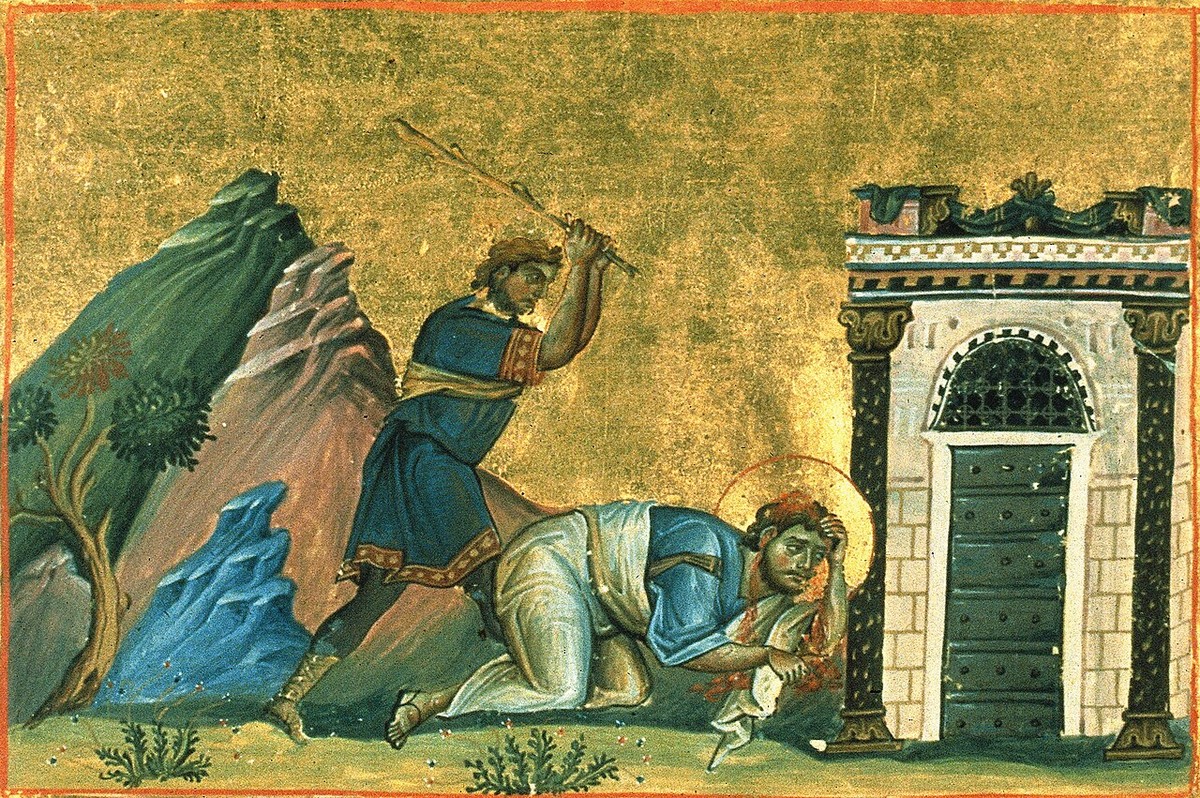
Of his end the traditions agree that he died a martyr but diverge in the manner and place. The received Greek synaxarion notice closes with the verse "About the ninth, James was stretched upon a cross," and the Slavic tradition locates the crucifixion at Ostracine (Ostrachina), a city on the Egyptian coast toward Palestine, at the end of a preaching journey through Egypt: for this the tradition styles him a sharer of the Master's own death. The Menologion of Basil II, however, depicts him beaten to death before the gate of a city (see Iconography below) — an older or parallel strand of the tradition. No year is transmitted; the martyrdom belongs to the apostolic age.
Veneration and later cultus
The universal Byzantine calendar has kept his memory on October 9 from at least the tenth century, with a full sung service; he is gathered again with his fellows at the Synaxis of the Twelve on June 30. In the West, under the identification of James of Alphaeus with James the Less and with the Brother of the Lord (see below), his Roman feast was kept on May 1 (later May 3) together with the Apostle Philip, and relics venerated as his rest with Philip's in the Church of the Holy Twelve Apostles in Rome — a cultus which, on the Orthodox reading of the identity question, belongs rather to the Brother of the Lord or remains uncertain, and is therefore recorded here without adjudication.
Feast and commemoration
October 9 (church date; Old Calendar civil October 22) is his primary feast, kept universally in the Byzantine rite; the Menaion joins his service with that of the venerable Andronicus and Athanasia (Andronicus and Athanasia of Antioch). He is commemorated again at the Synaxis of the Holy, Glorious and All-praised Twelve Apostles on June 30. The Roman calendar, following the Western identification, has no October feast but commemorates "Philip and James" in early May; the Orthodox calendars know nothing of this and keep the two Jameses of October distinct.
Hymns
Troparion — Tone 3
O holy Apostle James, intercede with the merciful God, that he grant unto our souls forgiveness of offences.
Original translation from the Greek
Kontakion
As a morning star shining out upon the whole creation, let us with hymns acclaim James, the eyewitness of Christ and speaker of God, honouring his festival today; for he intercedes without ceasing for us all.
Original translation from the Greek
Kontakion
Let us all bless with praises, as a herald of God, James, who firmly planted the doctrines of wisdom in the souls of the godly; for standing before the throne of the Master's glory, he rejoices with all the angels, praying unceasingly for us all.
Original translation from the Greek
Stichera
With faith we keep festival on the all-honoured day of thy memory, hymning thee, O glorious James — not as the son of Alphaeus, but as the Apostle of Christ and herald of his ineffable incarnation. Wherefore, standing ever with the Bodiless Hosts before the Master's throne, and with the choirs of Apostles and of Martyrs, entreat earnestly our Saviour and God, that we may be saved.
Appointed readings
Epistle — 1 Corinthians 4:9–16
9For I think that God hath set forth us the apostles last, as it were appointed to death: for we are made a spectacle unto the world, and to angels, and to men. 10We are fools for Christ’s sake, but ye are wise in Christ; we are weak, but ye are strong; ye are honourable, but we are despised. 11Even unto this present hour we both hunger, and thirst, and are naked, and are buffeted, and have no certain dwellingplace; 12And labour, working with our own hands: being reviled, we bless; being persecuted, we suffer it: 13Being defamed, we intreat: we are made as the filth of the world, and are the offscouring of all things unto this day. 14I write not these things to shame you, but as my beloved sons I warn you. 15For though ye have ten thousand instructers in Christ, yet have ye not many fathers: for in Christ Jesus I have begotten you through the gospel. 16Wherefore I beseech you, be ye followers of me.
Gospel — Luke 10:16–21
16He that heareth you heareth me; and he that despiseth you despiseth me; and he that despiseth me despiseth him that sent me. 17And the seventy returned again with joy, saying, Lord, even the devils are subject unto us through thy name. 18And he said unto them, I beheld Satan as lightning fall from heaven. 19Behold, I give unto you power to tread on serpents and scorpions, and over all the power of the enemy: and nothing shall by any means hurt you. 20Notwithstanding in this rejoice not, that the spirits are subject unto you; but rather rejoice, because your names are written in heaven. 21In that hour Jesus rejoiced in spirit, and said, I thank thee, O Father, Lord of heaven and earth, that thou hast hid these things from the wise and prudent, and hast revealed them unto babes: even so, Father; for so it seemed good in thy sight.
Iconography
As one of the Twelve, James of Alphaeus appears in every full apostle tier: a middle-aged, dark-bearded apostle in tunic and himation, holding a scroll or Gospel book. Because his portrait type is not strongly individualised, the identifying inscription does the work of identity — as on the stored variant icon, a nineteenth-century Russian deesis-row figure from the Mstyora icon-painting villages, inscribed "the holy Apostle James Alphaeus," which shows him full-length, turned in intercession, clasping the Gospel book to his breast.
The stored primary image is the miniature for October 9 in the Menologion of Basil II (Vat. gr. 1613, p. 337, c. 1000): the haloed apostle, in white tunic and blue mantle, driven to his knees before the closed gate of a city while an executioner raises a club over him, blood already running at his temple — the beating tradition of his martyrdom, against the crucifixion of the received synaxarion verse (see Disputed questions).
Disputed questions
The identity of James the son of Alphaeus is one of the classic knots of New Testament prosopography, and the calendars themselves take sides. The elements are these:
- James "the Less." Mark 15:40 names among the women at the Cross "Mary the mother of James the Less (τοῦ μικροῦ) and of Joses." Whether this "little James" is the son of Alphaeus is unstated. The identification became standard in the West (whence the English habit of calling the son of Alphaeus "James the Less"), but it is an inference, not a datum.
- The son of Clopas, and the Alphaeus–Clopas equation. John 19:25 places at the Cross "Mary the wife of Clopas." If the James of Mark 15:40 is her son, and if — as many have argued since antiquity — Alphaeus and Clopas are two Greek renderings of one Aramaic name (Ḥalphai), then James the Less, the son of Clopas, and the son of Alphaeus collapse into one man. The linguistic equation is possible but unprovable, and it carries the whole weight of the Western construction.
- The Brother of the Lord. Jerome, defending the perpetual virginity of the Theotokos against Helvidius, pressed the identification further: the "brethren of the Lord" were cousins, sons of Mary of Clopas; hence James the Brother of the Lord, first bishop of Jerusalem, is James of Alphaeus, one of the Twelve. This became the common Western position. The Orthodox tradition rejects it: the Byzantine calendar commemorates James the son of Alphaeus on October 9 and James the Brother of the Lord — a son of Joseph the Betrothed by his first marriage, not one of the Twelve — on October 23, each with his own service, and the synaxaria keep their lives wholly distinct. Galatians 1:19 ("other of the apostles saw I none, save James the Lord's brother") is read by the one side as proving the Brother was of the Twelve, by the other as using "apostle" in its wider sense.
- Manner and place of death. Crucifixion (the synaxarion verse; at Ostracine in the Slavic accounts) stands against the beating shown and implied by the Menologion of Basil II; some Western strands, conflating him with the Brother of the Lord, transfer to him the fuller's-club death at Jerusalem. The crucifixion tradition is the one the received Byzantine service assumes.
- The brother of Matthew. See above: affirmed in the Slavic tradition on the strength of Mark 2:14, unverifiable beyond it.
- Not to be confused with James the son of Zebedee, the other apostolic James of the Twelve — brother of John the Theologian, one of the inner three, beheaded by Herod Agrippa I in 44 (Acts 12:2), feast April 30. The Gospel lists themselves distinguish the two by their fathers' names, and the Western epithets "the Greater" and "the Less" refer to this pair (the son of Zebedee being the elder), not to any difference of sanctity.