
Acacius of Sinai
Our Venerable Father Acacius of Sinai, who is mentioned in the Ladder
Venerable · d. 6th century
Commemorated 7 July, 29 November — Principal commemoration
Acacius of Sinai was a young monk of the sixth century whose perfect obedience, kept for nine years under a harsh and negligent elder, became one of the most celebrated examples of the monastic virtue. He endured constant hardship, hunger, and beatings with unfailing meekness and thanksgiving, and died worn out by them. Five days after his burial, when his elder doubted whether so obedient a disciple could really be dead, the saint answered from the tomb that a doer of obedience does not die. John Climacus records the story in The Ladder of Divine Ascent as a pattern of obedience and its reward. Acacius is commemorated on November 29 and July 7.

The disciple and his elder
Acacius lived in the sixth century and was a novice in a monastery — the notices place it in Asia Minor, and his epithet "of Sinai" comes from the channel through which his story reached the Church rather than from the site of his struggle. He was given into the charge of an elder, a monk described as ill-tempered, negligent, and dissolute, who treated his disciple with extraordinary harshness: he burdened him with excessive labour, kept him short of food, and beat him without mercy, so that the young man's face often bore the marks of the blows.
Acacius bore all of it. He met every cruelty with silence and patience, thanked God for each affliction, and would not be turned from his obedience. When brothers who saw his bruised condition asked how he fared, he answered simply that all was well — as one who had entrusted his soul to his elder as to Christ. He continued in this way for nine years, and then died.
The witness of the tomb
Some days after the burial the elder went to a certain great old man of the neighbourhood and told him that his disciple Acacius had died. The old man did not believe it. "Brother," he said, "I do not think that man is dead." The two went together to the grave, and the old man called into the tomb as though to one living: "Brother Acacius, are you dead?" And the obedient one, who even in death would not disobey, answered from the grave: "No, father; it is not possible for a doer of obedience to die." The elder, seized with fear and compunction, fell weeping at the tomb and begged his disciple's forgiveness. He built himself a cell beside the grave and lived out his remaining days there in prayer and humility, telling the fathers, "I have committed murder."
In the Ladder
The account is preserved because John Climacus — John of the Ladder, abbot of the monastery of Sinai, commemorated on March 30 and on the Fourth Sunday of Great Lent — set it down in the fourth step of The Ladder of Divine Ascent, the great treatise "On Blessed and Ever-memorable Obedience." John says that he had the story from John the Sabaite, a truthful man who had witnessed it, and he offers Acacius as proof that obedience carried to its perfection is not swallowed up by death but crowned by God. Through the Ladder, read every Lent in the monasteries, the memory of the obedient young monk became known throughout the Orthodox world.
Feast and commemoration
November 29 (church date; Old Calendar civil December 12), within the Nativity Fast, kept together with the martyrs Paramon and the 370 of Bithynia and Philumenus of Ancyra. In the liturgical year this is the first of Acacius's two commemorations; the Church also keeps his memory on July 7. Because the corpus is authored in the order of the church year, his entry is written here, at his November feast, and his July commemoration links back to it.
He is not to be confused with Acacius the Confessor, bishop of Melitene (†c. 251, commemorated March 31), a martyr-confessor of an earlier age and of episcopal rank; nor with Acacius the Centurion (†303, commemorated May 7), the Cappadocian soldier-martyr beheaded at Byzantium.
Hymns
Troparion — Tone 8
In thee, O Father, that which is according to the image was surely preserved; for taking up thy cross thou didst follow Christ, and by thy deeds thou hast taught us to despise the flesh, for it passeth away, but to care for the soul, a thing immortal. Therefore, O venerable Acacius, thy spirit rejoiceth with the angels.
Original translation from the Greek
Kontakion — Tone 2
Having forsaken the world, from childhood thou didst follow after Christ, O most wise and venerable Acacius; and imitating His voluntary humility, thou didst cast down the arrogant tormentor. Pray without ceasing for us all.
Original translation from the Greek
Iconography
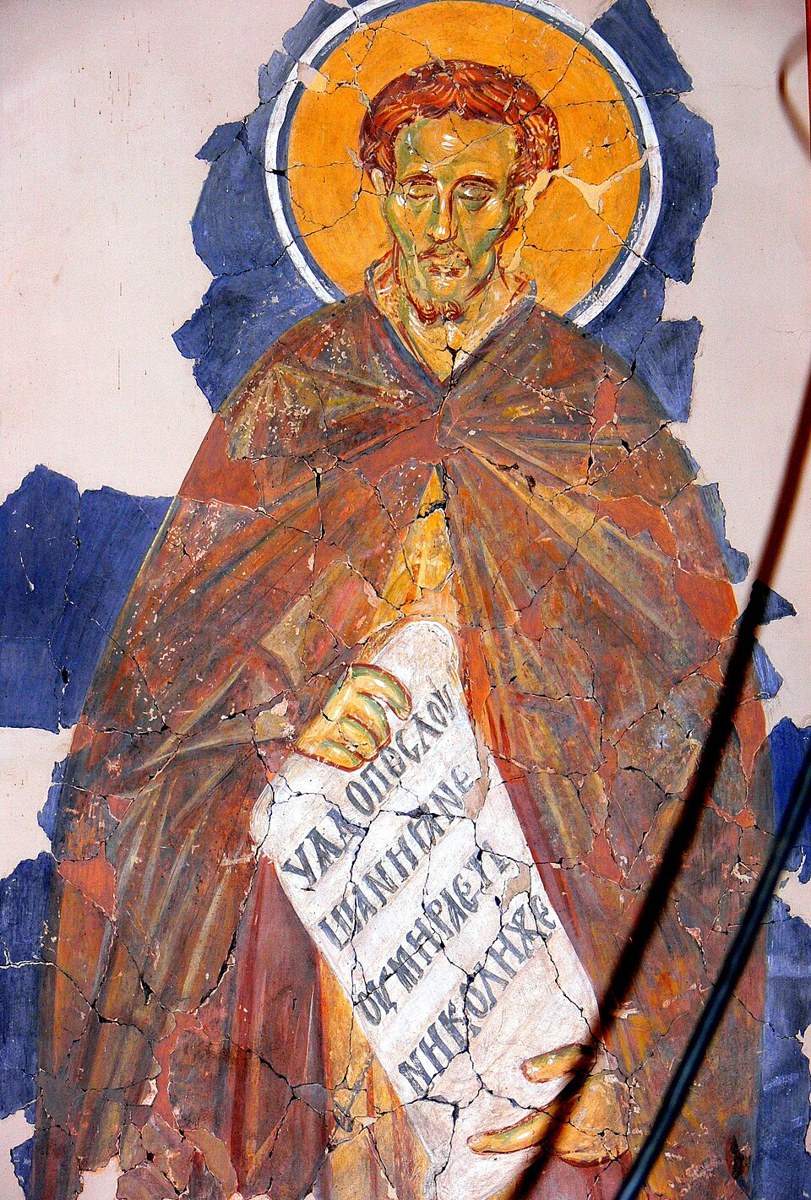
Acacius is depicted as a monastic saint in the habit — most often as a young or youthful monk, in keeping with the story of the obedient disciple who died young. He may hold a scroll or a cross, and in narrative cycles he is shown answering from the tomb while his elder and the old man stand over the grave. The stored image is a fragment of the fresco cycle of 1380 in the Church of the Saviour on Kovalevo at Novgorod (the frescoes were destroyed in 1941 and painstakingly reconstructed from the surviving pieces): a young monastic saint with reddish hair holding an inscribed scroll, identified as Acacius of Sinai.