
Acacius the Confessor
Our Father among the Saints Acacius the Confessor, Bishop of Melitene
Confessor · Bishop · d. c. 251
Commemorated 31 March — Repose, 17 April — Commemoration of the confessor-bishop of Melitene, 15 September — Uncovering of the relic
Acacius the Confessor was bishop of Melitene in Armenia in the middle of the third century. Arrested in the persecution of Decius (249–251) and brought before the governor Marcianus, he confessed Christ boldly under torture but was not put to death; released, he bore the marks of his sufferings for the rest of his life and died in peace. His memory is kept on March 31, and the uncovering of his relic — whose year is not transmitted — on September 15.
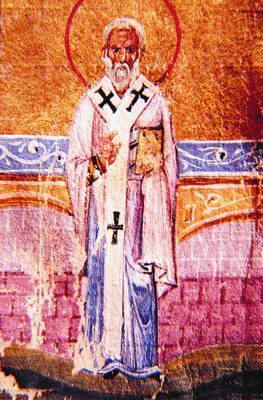

Acacius (the name the Greek verses play upon: ἄκακος, "without evil") was bishop of Melitene, the chief city of Roman Armenia Minor on the upper Euphrates, in the reign of Decius, whose empire-wide order to sacrifice (249–251) produced the first universal persecution of the Church. Arrested as a Christian and brought before the governor Marcianus, Acacius answered the interrogation with a confession that the hagiographic tradition preserves at length — a defence of the one God against the idols, given with such freedom that the governor, after subjecting him to torture, ultimately released him. Accounts differ on the mechanism of his release (some later notices say Decius himself, struck by the confessor's answers, ordered him freed); all agree that he survived, "bearing the wounds of Christ on his body," and governed his church until he died in peace, in or soon after the persecution years.
At an unrecorded later date his relic was uncovered and became a source of veneration; the Synaxarion of Constantinople lists "the finding of the relic of the holy Acacius, bishop of Melitene" under September 15, with the verses: "We who honour the finding of thy relic — may we find, O Acacius, release from our ills."
Feast and commemoration
The confessor's memory is kept on March 31 (church date; Old Calendar civil April 13); the finding of his relic on September 15 (Old Calendar civil September 28), within the afterfeast of the Elevation of the Cross. Both are universal Byzantine commemorations, though on September 15 the day's service belongs to the Cross and the great-martyr Nicetas, the finding being a synaxarion commemoration without proper hymns.
Hymns
Troparion — Tone 4 (from the common of a hierarch)
A rule of faith and an image of meekness, a teacher of temperance did the truth of things show thee to thy flock; therefore thou didst gain by humility the things on high, by poverty the things that are rich: O Father and hierarch Acacius, intercede with Christ God that our souls may be saved.
Original translation from the Greek
Iconography
Acacius is depicted as a bishop of the early Church: in phelonion and omophorion, blessing and bearing the Gospel book. The stored image is an eleventh-century portrait of the saint standing vested as a hierarch (the reproduction circulates with the identification "Acathius of Melitene" and is linked to this saint in the Wikidata record; its manuscript or fresco source is not stated in the hosting file, which is noted here for honesty's sake). The Menologion of Basil II illustrates the September 15 finding with the bishop standing whole before venerating figures — a miniature not yet available in the collections searched at reproducible resolution (Vat. gr. 1613, p. 40).
Disputed questions
- Which Acacius? Melitene produced more than one sainted bishop named Acacius, and the synaxaria entangle them. The saint of March 31 and of the September 15 finding is the third-century confessor under Decius. He is to be distinguished from Acacius of Melitene the friend of Euthymius the Great, who took part in the Third Ecumenical Council at Ephesus (431) and is commemorated on April 17. Some sources further assert that an Acacius of Melitene sat among the fathers of the First Ecumenical Council at Nicaea (325); this cannot be the Decian confessor, whose confession fell some seventy-five years earlier, and either reflects yet another homonymous bishop of the see or a conflation in transmission. The OCA's September 15 notice explicitly identifies the saint of the finding with the Decian confessor of March 31 and warns against confusion with the fifth-century Acacius; this collection follows that identification.
- The epithet "Agathangelus" attaches to him in part of the western and later literature (whence the German form "Akakios Agathangelos"); it is not used by the Byzantine liturgical books.
- Not to be confused with the venerable Acacius of Sinai, the obedient young monk of The Ladder (November 29 / July 7) — a different saint of a different age and office; nor with the martyr Acacius the Centurion of Cappadocia, beheaded at Byzantium in 303 and commemorated on May 7, whom the Latin West calls Achatius or Agathius and numbers among the Fourteen Holy Helpers.
- Year of the finding. No year is transmitted for the uncovering of the relic; only the date September 15 is fixed by the synaxaria.