
Achilles of Larissa
Our Father among the Saints Achillios, Bishop and Metropolitan of Larissa, the Wonderworker
Bishop · Wonderworker · b. late 3rd century, said to be of Cappadocia — d. c. 330, at Larissa in Thessaly
Commemorated 15 May — Repose at Larissa; principal feast and patronal feast of the city
Achillios, bishop and metropolitan of Larissa in Thessaly, was one of the fathers of the First Ecumenical Council at Nicaea in 325, where he is remembered for his blunt denunciation of Arius and for the sign by which — the tradition says — he silenced the Arian party, commanding oil to flow from a stone. Returning to his city he threw down the temples of the old gods, built and adorned the first churches of Larissa, and was so abundant in healings, and especially in the deliverance of the possessed, that the calendars call him simply the Wonderworker. He reposed in peace about the year 330. In 978 his relics were carried off by the Bulgarian tsar Samuel to the island in the lake of Prespa, which has borne the saint's name ever since; he remains the patron of Larissa, and his memory is kept on May 15.
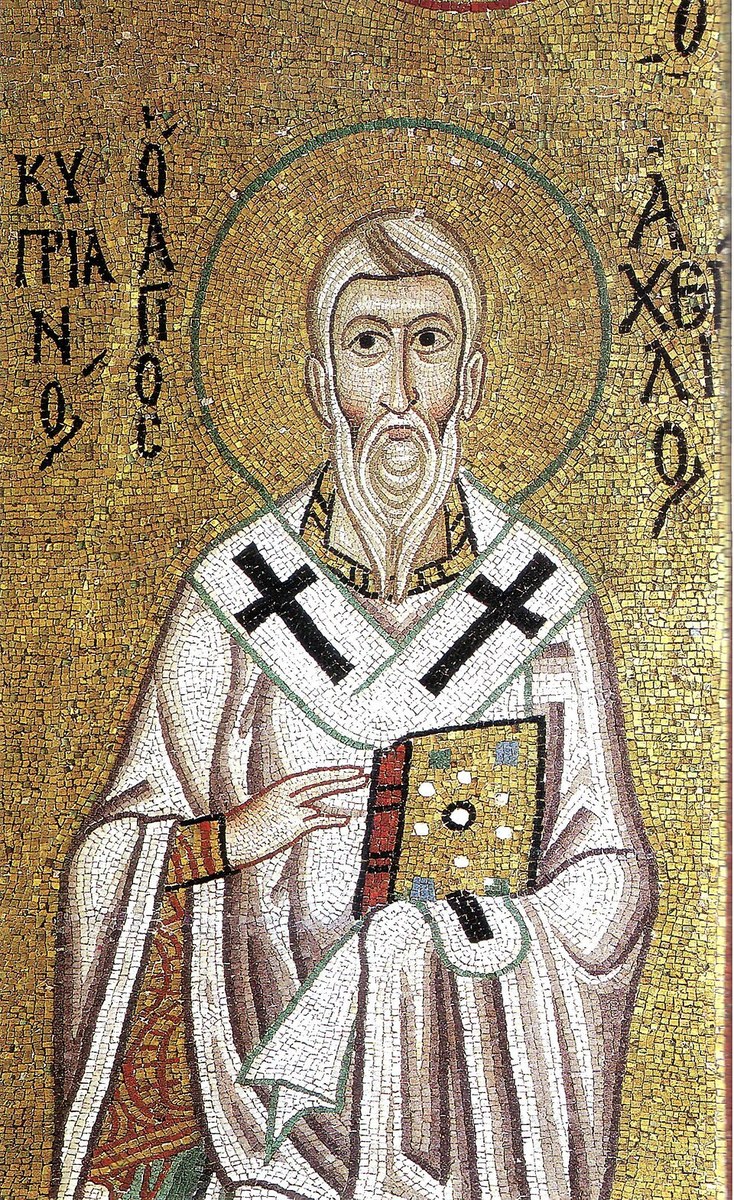
_-_Achillios.jpg)
Origins and coming to Thessaly
The Greek synaxaria make Achillios a native of Cappadocia, born in the last decades of the third century of parents of standing and piety, and educated in letters. The tradition takes him from Cappadocia to Rome, where his learning and manner of life made him known, and thence — in the reign of Constantine the Great, and with the emperor's own favour, according to the fuller Greek accounts — to the see of Larissa, the metropolis of Thessaly. Larissa was an ancient and stubbornly pagan city, and the early Church there is very thinly documented; Achillios is the first of its bishops whose memory the Church has kept, and the whole subsequent episcopal tradition of Thessaly is reckoned from him.
The First Council of Nicaea
Achillios is numbered by the Greek tradition among the three hundred and eighteen fathers of the Council of Nicaea in 325, and it is on this that his fame chiefly rests. He is remembered there not as a theologian producing arguments but as a hierarch who would not be talked round: the synaxarion says that he "boldly denounced the heretic Arius," and the later Greek accounts place him among the outspoken opponents of the Arian party in the debates.
To this belongs the miracle by which he is known. Pressed by the Arians — who argued that the Son, being begotten, must be a creature — Achillios is said to have answered with a challenge rather than a syllogism. Pointing to a stone, he told them: if Christ is a creature of God, as you say, then bid this stone yield oil. They were silent. Then, if the Son is equal to the Father, he said, let oil flow from the stone — and at his word, the tradition relates, oil ran out of the stone before the assembly. The story belongs to the class of hagiographical signs by which the Church expresses in narrative what the Creed states in doctrine: that the Arian account of Christ has no power in it, and the Orthodox account has. It should be read as the tradition's testimony to the content of his witness at Nicaea, and not as a minuted proceeding of the Council.
Larissa: the temples thrown down, the churches built
Returning from Nicaea, Achillios turned to the paganism of his own city with the energy that the fourth-century bishops of the newly free Church so often show. The notices record that he cast down many idolatrous temples — the sanctuaries of Athena, Apollo and Artemis are named in the fuller Greek accounts — and that he built and adorned churches in their place, so that the Christian topography of Larissa is his work. Alongside this he catechised and preached, and the synaxarion adds that he was distinguished by learning as well as holiness.
His particular charism was healing, and above all the casting out of demons: the Greek notices dwell on the possessed brought to him and delivered, and it is for this that the epithet θαυματουργός, wonderworker, attaches to his name in the calendars. He reposed in peace, not by martyrdom, about the year 330, and was buried in Larissa, where his tomb at once became a place of healings.
Relics, and the translation to Prespa
The strange afterlife of Achillios' relics is the most historically solid part of his record. In 978, in the course of the Bulgarian tsar Samuel's campaigns into Thessaly, Larissa was taken and the relics of its patron were carried off as the most valuable spoil of the city — a characteristic act of medieval Balkan statecraft, since possession of a great saint conferred legitimacy on a new capital. Samuel deposited them on the island in the Little Prespa lake, on what is now the Greek–Albanian–North Macedonian border, and built there the great basilica of St Achillios, a three-aisled church whose ruins still stand; for a period the island was the seat of the Bulgarian patriarchate, and the church contains the celebrated painted inscriptions listing the episcopal sees of Samuel's realm. The island, the village on it, and by extension the lake itself are called Agios Achillios to this day, and a saint of fourth-century Thessaly is thus commemorated in the toponymy of three modern countries.
Portions of the relics have since returned to Thessaly, and a reliquary of St Achillios is venerated in Larissa; the details of the modern translations are recorded in the local archives of the Metropolis of Larissa and Tyrnavos rather than in the synaxaria, and are not stated here with dates that the printed sources consulted do not support.
Veneration
Achillios is the patron of Larissa, of its metropolis (Larissa and Tyrnavos), and of a district and a great church of the city; churches carry his name in Thessaly, in North Macedonia and in Serbia. That his cult was not merely local is shown by his appearance among the hierarchs of the great eleventh-century mosaic programme of Hosios Loukas in Boeotia — a monument of the imperial school, far from Thessaly, which sets him beside the universal fathers of the Church. He is invoked for the possessed and for the sick.
Feast and commemoration
May 15 (church date; New Calendar civil May 15, Old Calendar civil May 28). In the Byzantine Menaion the day belongs to Pachomius the Great, who has the full proper office; Achillios is commemorated in the synaxarion notice — "On the same day, the memory of our venerable father Achillios, Metropolitan of Larissa" — with his own couplet of verses, and is served from the common of a hierarch. In Larissa itself, where he is patron, May 15 is the great feast of the city and is kept with a vigil, procession and proper hymnography composed for local use; the Metropolis of Larissa and Tyrnavos observes it as its patronal day. The commemoration is also kept in North Macedonia in connection with the shrine at Prespa, where his relics lay for a thousand years.
Hymns
Apolytikion — Tone 4 (common of a hierarch)
O God of our fathers, who dealest with us ever according to Thy gentleness: take not Thy mercy from us, but by the prayers of Achillios direct our life in peace.
Kontakion — Tone 2 (common of a hierarch)
Thou didst shine forth as a lamp of Orthodoxy at Nicaea, and thou didst cast down the temples of the idols in thy city, O all-wise hierarch; wherefore, having received the grace of healings, thou dost drive out the spirits of wickedness and dost cure the sick, O Achillios our father.
Synaxarion
Larissa tells aloud thy strange deeds of prowess, keeping thy memory, Father, even after thy death.
Iconography
Achillios is painted as a hierarch of middle age or older: a short, rounded, greying beard, receding hair, in the phelonion with the crossed polystaurion or the plain white omophorion, blessing with the right hand and holding a jewelled Gospel-book in the left, veiled by the vestment. He is not given a narrative attribute of his own in the standard programmes; where the miracle of Nicaea is depicted — rarely, and chiefly in Thessalian churches — he is shown before the assembled Council with a stone from which oil runs. In Thessaly he appears with the city of Larissa in the background, and at Prespa with the model of the basilica in his hands as its founder-saint by adoption.
The stored image is the early eleventh-century mosaic of the diakonikon arch of the Monastery of Hosios Loukas in Boeotia, one of the finest surviving monuments of middle-Byzantine mosaic. Against a gold ground the saint is shown bust-length in a white polystaurion patterned with large dark crosses, holding a jewelled Gospel and reaching across it with the right hand, the hair swept back from a high forehead and the beard short and forked. The inscription flanking the halo reads Ο ΑΓΙΟC / Ο ΑΧΙΛΛΙΟC; the genitive ΚΥΠΡΙΑΝΟΥ visible at the left edge belongs to the neighbouring figure of St Cyprian in the same arch. That an eleventh-century imperial foundation in Boeotia gave Achillios a place in its sanctuary among the great hierarchs is the best single witness to the reach of his cult before the Bulgarian translation of his relics.
Disputed questions
Nicaea. The presence of Achillios at the First Council is universal in the Greek synaxaria and is the anchor of his cult. It should nevertheless be said that the surviving subscription lists of Nicaea are transmitted in several divergent and demonstrably incomplete recensions, in which the sees of Thessaly and of the Illyrian provinces are thinly and inconsistently represented, and the name of a bishop of Larissa is not securely preserved in them. This is not evidence against his attendance — many fathers certainly present are missing from one list or another — but it means that the tradition rests on hagiographical rather than conciliar documentation. The same qualification applies with more force to the miracle of the oil.
Dating. The synaxaria place his episcopate under Constantine and his repose about 330; the figures are consistent with attendance at Nicaea but are not independently attested. Some accounts extend his life to about 340.
Not to be confused with:
- Achillas the anchorite of Scetis (January 17), one of the Desert Fathers of the Apophthegmata — a different name (Ἀχιλλᾶς) and a different person, though the two are frequently confused in indexes;
- Achillas, archbishop of Alexandria (†313), the predecessor of Alexander who ordained Arius to the diaconate — an entirely distinct figure, and the coincidence of a similar name with an Arian connection has caused real muddle;
- the Roman martyr Achilleus, companion of Nereus (May 12 in the Latin calendars);
- Achilles the martyr of the Egyptian and Cypriot lists.