
Pachomius the Great
Our Venerable and God-bearing Father Pachomius the Great, Founder of Cenobitic Monasticism
Venerable · b. c. 292, in the Upper Thebaid of Egypt, of pagan parents — d. May 9 (14 Pashons), 348, at Pbow in the Thebaid, aged about fifty-six
Commemorated 15 May — Repose at Pbow in the Thebaid; the Byzantine commemoration
Pachomius is the father of cenobitic monasticism — the man who took the solitary ascetic life of the Egyptian desert and gave it a common table, a common wardrobe, a common purse, a written Rule and a structure of obedience, and so invented the coenobium, the monastery as the Church has known it ever since. A pagan conscript of the Thebaid, he was shown unasked-for charity by the Christians of Thebes while under guard with his fellow recruits, vowed to serve their God, was baptised at Šeneset, and spent some seven years under the anchorite Palamon. About 323, at the deserted village of Tabennisi, a voice bade him build a monastery, and — the tradition says — an angel delivered him the Rule inscribed on a bronze tablet. At his death in the plague of 348 the koinonia he had founded comprised some nine monasteries and two convents with thousands of monks and nuns; and through Basil, Cassian and Benedict the whole organised monasticism of East and West descends from what he built beside the Nile.

Origins in the Thebaid
Pachomius was born about the year 292 in the Upper Thebaid, in the district of Snē — Latopolis, the modern Esna — of parents who were pagans and, by the account of the Lives, of some substance, since they gave him a Greek education alongside his native Coptic. The Coptic tradition makes him bilingual, a fact of consequence for everything that followed: he could frame a rule in Coptic for Egyptian peasants and see it carried into Greek for the wider Church.
The Lives keep two boyhood anecdotes, both told to show that he was marked before he knew it. Taken by his parents to sacrifice by the river, he was driven away by the priests, who cried out that an enemy of their gods was present; and having been given wine from a pagan libation to drink, he vomited it up. Whatever their historical value, the notices are the tradition's way of saying that the founder of the coenobium began outside the Church altogether — that the institution which would order Christian asceticism for sixteen centuries was given to a man who had first to be converted from idolatry.
The conscript and the charity of the Christians
About 312 or 313, when he was some twenty years old, Pachomius was caught in a military levy — the Lives say for the wars of Constantine, and the confused politics of the Egyptian levies of those years make the identification of the campaign impossible to fix. He and the other recruits were pressed aboard a boat, taken down the Nile, and held under guard in a prison at Thebes, fed badly and treated as what they were, unwilling conscripts.
There, in the evening, the townspeople came and brought them food and drink and every kindness, asking nothing. Pachomius, astonished, asked who these people were and why they did it. He was told that they were Christians, and that they behaved so towards all men, and towards strangers most of all, because their God had commanded them to love their neighbour. The Lives make this the hinge of his whole life: he withdrew and prayed — the first prayer of his life, addressed to a God he did not yet know — and vowed that if he were delivered he would serve that God and be the servant of all men. This scene is the true foundation-charter of the coenobium. Pachomius did not come to the common life through a theory of asceticism; he came to it because he had been shown Christian charity by a community, and everything he afterwards built was an attempt to make that charity institutional.
The campaign ended, the recruits were released, and Pachomius did not go home.
Baptism at Šeneset, and the years with Palamon
He came up the river to the village of Šeneset — Chenoboskion, the modern Qasr es-Sayyad, in the Upper Thebaid — asked for instruction, and was baptised there about 313 or 314. For some three years he lived in the village as a Christian layman of a very deliberate kind: he cultivated a plot and gave what it yielded to the poor and to passing travellers, tended the sick, and, when a pestilence came, nursed those whom others would not touch. Already the pattern is service rather than solitude.
Then, wanting the monastic life, he went to the old anchorite Palamon (Palaemon), who lived not far off. Palamon received him with the classic discouragement: the way was hard, he said — bread and salt, no oil and no wine, work at mat-weaving and hair-cloth, vigil for half the night and often the whole of it, no relaxation for the flesh at all; many had come and gone. Pachomius answered that he would try, and stayed. He remained with Palamon some seven years (some recensions say ten), learning the anchoritic discipline in its severest form: the two of them working through the nights, reciting the Psalter, praying with the arms extended in the figure of the Cross until the strain broke the body's resistance, eating a diet without savour. The importance of these years is that Pachomius never repudiated them. He knew the eremitic life from the inside; when he came to legislate for a community, he legislated as a man who had measured what a single ascetic could bear alone, and had concluded that most men could not bear it.
The voice at Tabennisi and the angel's Rule
About 323, Pachomius went some way down the river to a deserted village called Tabennisi, on the east bank of the Nile in the Thebaid, and there, at prayer, he heard a voice bidding him remain in that place and build a dwelling, "for many will come to thee to become monks with thee." He told Palamon, who came, blessed the foundations, prophesied the future greatness of the place, and went back to his cell; he died soon after, and Pachomius buried him.
His elder brother John came and joined him, and for a time the two lived together as ascetics. But John belonged to the old way and could not see the point of the new: when Pachomius began to enlarge the enclosure for the brethren he expected, John reproached him for vainglory, and Pachomius, stung, spent a night in bitter self-examination and prayer before he could answer without anger. The episode is preserved because it is the first collision between the anchoritic and the cenobitic ideals — and it happened inside the founder's own family. John died not long afterwards.
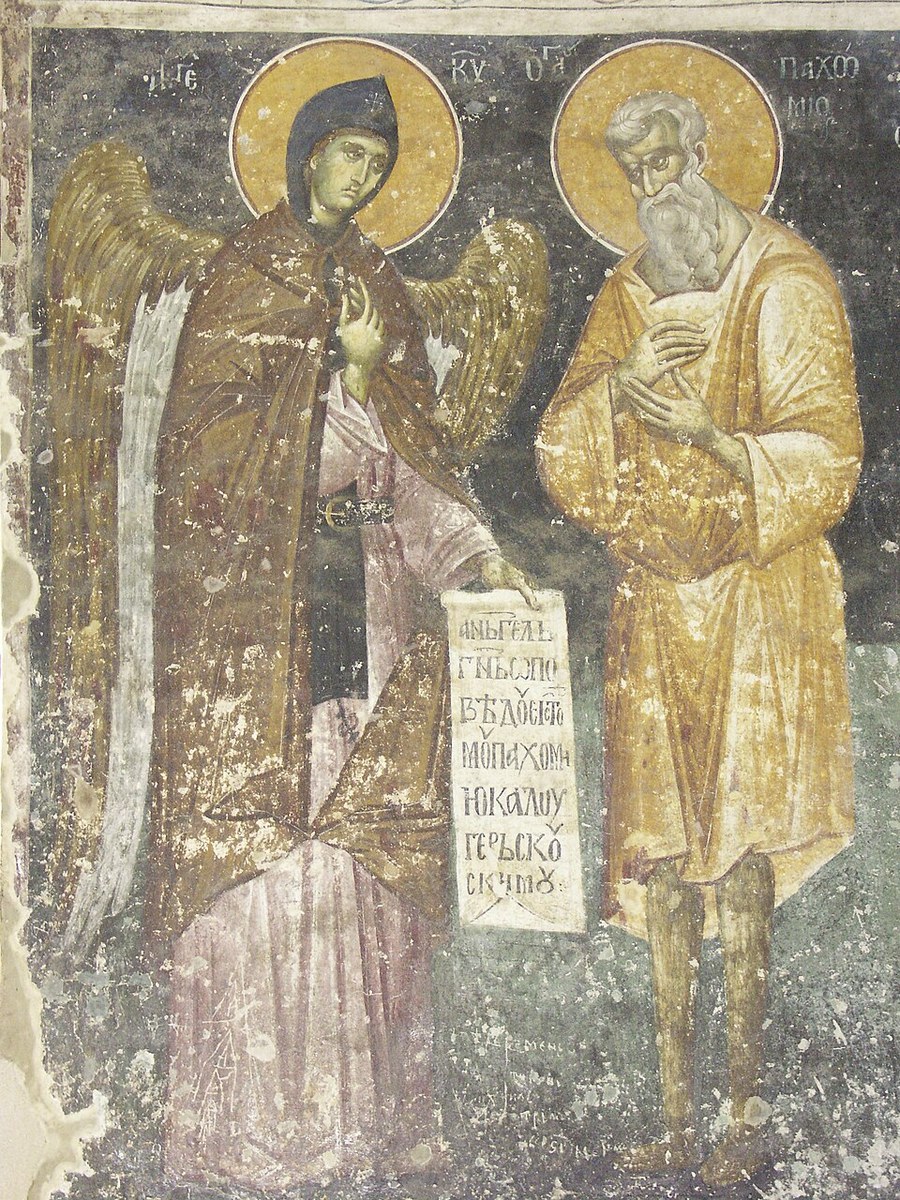
Then came the vision that the tradition has never let go of. An angel appeared to Pachomius — "in the schema of a monk," say the sources — and gave him the Rule of the monks, written on a tablet of bronze. Palladius, who had the story from the Thebaid within two generations, reports its contents: that each should be permitted to eat and drink and work according to his strength; that all should be clothed alike, in the linen tunic and the hood; that the brethren should be distributed into twenty-four orders designated by the twenty-four letters of the Greek alphabet, the simple and guileless assigned the letter iota and the crooked and difficult the letters xi and zeta, each character matched to the shape of the soul, so that the superiors might speak of a man's condition in a word without shaming him; and that they should say twelve prayers by day, twelve at the lighting of the lamps, twelve in the night and three at the ninth hour. When Pachomius objected that the prayers were too few, the angel answered that he had appointed them so that the little ones might fulfil the rule without grief — for the perfect need no law at all. That answer is the whole genius of Pachomius in one sentence, and it is why his Rule, and not the heroic individualism of the anchorites, became the pattern of Christian monasticism: it legislates for the weak.
The Rule and the shape of the coenobium
What Pachomius actually built can be reconstructed from the Precepts and the other rule-texts, and it is astonishingly concrete. A Pachomian monastery was a walled village with a gate, a gatehouse where postulants were tested and taught, a church, a refectory, a bakery, an infirmary, workshops, and a number of houses — each house of some twenty to forty monks under a housemaster and his second, the houses grouped by trade and by language, so that weavers lived with weavers and the Greek-speakers together. Over the monastery stood a father (apa, the later abbot) and a steward for its goods; over the whole federation stood Pachomius himself, with a general steward at the head house.
The principles were few and absolute. Nothing personal: no property, no private food, no gift from one's family, not so much as a distinctive garment; all clothing issued alike from a common store, all food from a common table, all earnings from mats, baskets, gardens and boats paid into a common fund, whose surplus went in alms to the poor, to prisons and to neighbouring villages. Obedience as the ordinary medium of life, exercised through the housemaster in small daily things rather than through extraordinary feats. Work as a duty and not a concession: Pachomius held that the brother who worked willingly for the community stood higher than the brother who fasted splendidly for himself. Scripture as the common language: every entrant, literate or not, was taught to read, and was required to learn by heart at least the Psalter and the New Testament, so that the day's labour was accompanied by recitation. And an even measure applied to all — the same food and the same clothing for the strong and the weak, with the weak permitted more and the strong not permitted to display less.
Two general assemblies bound the federation together: all the monasteries came up to the head house for Pascha, and again in the month of Mesore (August) for the annual reckoning, at which accounts were rendered, offices reassigned, and grievances between brethren remitted before the new year of the community began. It is the earliest monastic chapter in Christian history.
One further decision of Pachomius deserves note, because it was later abandoned by almost everyone: he would not have his monks ordained, and refused ordination for himself. Clerics who entered were received but exercised no rank; priests came in from the neighbouring villages to celebrate the Liturgy for the brethren. His stated reason was that the beginning of the love of power is the desire for the priesthood, and that "jealousy and contention" would follow rank into the monastery. The instinct proved right, and the practice proved impossible to keep.
The koinonia
From Tabennisi the thing grew with a speed that surprised its founder. A first generation of disciples proved unwilling to be governed and was dismissed; a second — Psentaesi, Souros, Psoi, then Pekyssios, Cornelios, Paul and others — took the yoke, and after that the numbers never stopped. About 336–337 Pachomius founded, or rather transferred his centre to, Pbow (Phbow, the modern Faw Qibli), a larger site nearer the river, which became the head house of the federation and the place of the general assemblies; Tabennisi remained, under its own father.
Around these grew the koinonia — the word is the Pachomians' own for their federation, and it means simply communion. Šeneset (Chenoboskion) and Thmoušons and Tse were added; at Thmoušons and Tse the founders of existing ascetic settlements, seeing that Pachomius had solved the problem of order, asked to be received into his obedience and brought their houses with them — one of the most telling facts about him, that other monks surrendered their independence to join his system. Bishops began asking for foundations in their cities: the bishop of Panopolis (Šmin, the modern Akhmim) obtained one, and there were houses at Tsmine, Thbew and Phnoum near Latopolis, the place of his birth. By the time he died there were, on the usual reckoning, nine monasteries of men and two of women — some sources count eight — and the number of monks under his rule is given by the Greek tradition as seven thousand, by more cautious modern estimate at perhaps three to five thousand at his death, growing to the larger figure within a generation. Jerome, writing in 404, was told that fifty thousand gathered for the Pasch; that is the enthusiasm of a distant admirer, not a census.
His sister, and the women's houses
Pachomius' sister — the Coptic tradition names her Maria — came to Tabennisi to see him. He would not come out to her, sending word by the gatekeeper that he was alive and well and that she should not grieve, but that if she wished to see him truly she should embrace the same life. She took the rebuke as a vocation. The brethren built her a dwelling at a distance from the monastery, and other women gathered to her, and so there arose the first convent of the Pachomian federation, governed by the same Rule, under a woman superior, with an elderly and proven monk appointed to visit it for instruction and for the care of its business, and every kind of casual traffic between the two houses forbidden. A second women's house followed. In this too Pachomius was the first: the double federation of men's and women's monasteries under a single Rule and a single spiritual head is a Pachomian invention, and it passed into Syrian, Cappadocian and Western practice after him.
Athanasius, the bishops, and the synod of Latopolis
Pachomius' relations with the hierarchy were warm, deferential and carefully guarded. About 329–330, when St Athanasius the Great sailed up into the Thebaid, Serapion the bishop of Tentyra asked the archbishop to ordain Pachomius and set him over the monks of the district as a father in orders. Hearing of it, Pachomius hid among his brethren until Athanasius had gone by; Athanasius, when he learned why, praised him for it publicly. The koinonia was thereafter unwaveringly Athanasian and anti-Arian through all the archbishop's exiles; the Lives record letters between them, and the brethren of Pbow received and helped Athanasius on his returns.
Not all was smooth. About 345 Pachomius was summoned before a synod of bishops at Latopolis, on complaints brought by monks who had left him; among the charges was that he claimed, or was credited with, a discernment of spirits amounting to the reading of hearts. He answered with restraint — his disciple Theodore is said to have drawn his own cowl over the old man's face to spare him the stares of the assembly — and the synod did not condemn him. The episode is a useful corrective to the picture of a serene founder: the koinonia was contested in his lifetime, from without by bishops and from within by monks who found the Rule too heavy or the father too searching.
Miracles, discernment, and the sadness of the last years
The Lives credit him with healings, with authority over demons and over the beasts of the desert, with the reading of thoughts, and with revelations. The most affecting of these is not a wonder but a grief. Praying about the future of the monks, he was shown, in the Greek Life's telling, the generations to come walking in a great valley in darkness and mist, calling out and unable to find their way, because they would have no experienced fathers to guide them; and he wept. Whether or not the vision is his, its inclusion tells us how the Pachomians themselves understood the Rule — as a lamp provided against exactly that darkness, a written form of life to serve where living fathers failed.
The last years were also marked by the strain of success. He had to depose and restore, to correct the ambitious, and once to put aside his own beloved Theodore, whom the brethren had begun to treat as heir apparent while Pachomius still lived; Theodore submitted to years of humiliation and was afterwards restored to favour.
The plague of 348 and his repose
About the year 348 a pestilence swept the monasteries of the Thebaid; something approaching a hundred of the brethren died, and Pachomius, having buried many of them, took the sickness himself. He lay ill some forty days, still governing. When he saw that he would die, he called the brethren, gave his last instruction, and appointed as his successor Petronios, the father of the house at Tsmine — who was himself already dying of the same plague. Pachomius reposed on the 14th of Pashons, that is the ninth of May, 348, aged about fifty-six. He was buried on the mountain near Pbow, and afterwards, according to a wish he had expressed, his body was removed secretly by Theodore and laid where it should not become a shrine; the Coptic tradition preserves the memory of the transfer without disclosing the place.
Petronios died within a few months, having named Horsiesios (Orsisius) father of the koinonia. A revolt of several houses against central authority drove Horsiesios into retirement, and Theodore the Sanctified — the disciple of Pachomius' own household, commemorated the very next day, May 16 — governed the federation from about 350 until his death in 368, holding it together through its gravest crisis; Horsiesios then resumed and ruled until about 380, leaving the Testament which is the most theologically searching of all Pachomian writings. That the koinonia survived its founder by generations, and survived a constitutional crisis without dissolving, is itself the strongest evidence that what Pachomius had made was not a personal following but an institution.
Historical significance: the coenobium, East and West
The claim made for Pachomius is a large one and it is exact: the monastery is his invention. Before him there were solitaries, and there were loose colonies of solitaries — the lauras of Nitria and Scetis, where anchorites lived within reach of one another, met on Saturdays and Sundays, and were governed by nothing but the authority of the great elders and the customs of the place. St Anthony the Great is the father of that life; the Church has always distinguished the two men accurately, calling Anthony the father of monks and Pachomius the father of the coenobium. What Pachomius added was law: a written rule, a novitiate, an enclosure, a hierarchy of offices, a common economy, a general chapter, a federation with a constitution capable of transmitting authority after the founder's death.
Everything organised in Christian asceticism thereafter descends from that. In the East, St Basil the Great, who travelled among the Egyptian and Syrian ascetics about 357, carried the cenobitic principle into Asia Minor and into the Asketikon on which the whole Byzantine monastic tradition rests; the Studite reform, and through it Athos and the Slavonic monasticism of Rus', stand in that line. In Egypt the federation of Shenoute at the White Monastery was built on Pachomian foundations, and the Coptic and Ethiopian traditions have never lost them. In the West, St John Cassian spent years in Egypt and wrote the Institutes to bring Egyptian practice to Provence; St Jerome translated the Pachomian Rule, Letters and Instructions into Latin in 404, from a Greek version made for the Latin-speaking monks of Egypt; and the Rule of St Benedict, itself dependent on Cassian and on the anonymous Rule of the Master, inherited from that stream the common table and common wardrobe, the obedience to an abbot, the officers of the house, the deanery structure, the balance of prayer with manual work, and the measured moderation that legislates for the weak. Benedict's own prologue and epilogue commend the Egyptian fathers to his monks. The unbroken line runs: Tabennisi — Cappadocia — Provence — Monte Cassino — and thence the whole monastic West.
It is worth adding what Pachomius did not do. He did not write a spiritual theology; his Instructions are plain and pastoral. He did not seek ordination, office, or influence. He legislated for peasants who could not read, and his Rule is full of the smallest practical mercies — how to care for the sick, what to do about a brother who cannot keep the fast, how to receive a guest, how not to shame a slow learner. The greatness the Church means when it calls him ὁ Μέγας is a greatness of ordering charity.
Relics and veneration
Because his grave was deliberately concealed, Pachomius has no great relic-shrine, and his cult was carried by his Rule and his Life rather than by a tomb. His name entered the Byzantine synaxaria early and firmly, is kept by the Copts on the day of his death, and is honoured wherever the coenobium exists. The ruins of the great basilica at Pbow were excavated in the twentieth century; the Coptic monastery of Anba Pachom near Edfu and numerous churches in Egypt bear his name, and the Nag Hammadi codices, discovered in 1945 within a few miles of Šeneset and Pbow, have provoked a long and unresolved debate about whether Pachomian monks were among their readers or their buriers.
Feast and commemoration
May 15 (church date; New Calendar civil May 15, Old Calendar civil May 28). Pachomius leads the day in the Byzantine books, with a full proper office in the Menaion — three stichera at Lord, I have cried, two doxastika, a proper apolytikion and kontakion, a kathisma, an exaposteilarion, and a canon by Theophanes — and he is joined in the synaxarion by St Achilles of Larissa and by Barbarus the Myrrh-streamer. The Antiochian and Greek usage keeps him as a venerable father of the middle rank with the doxastikon of the monastic order; the Slavic books add the Russian saints of the day. His disciple Theodore the Sanctified follows immediately on May 16, so that the two Pachomian fathers are read on consecutive days — an arrangement of the calendar that preserves the shape of the koinonia itself. The Coptic Church keeps him on 14 Pashons (May 9), the day of his repose, with a proper office of its own.
Because May 15 can fall either within the Paschal season or after Pentecost depending on the year, the propers of the day are combined with whatever movable office is in force — in most years with the after-feast texts of the Paschal period, as the Menaion's rubric for the day presumes ("three stichera of the Feast and three of the venerable one").
Hymns
Apolytikion — Tone 5 (plagal first — prosomoion *Τὸν συνάναρχον Λόγον*)
Thou wast shown to be a leader of the flocks under the Chief Shepherd, O Father Pachomius, guiding the herds of monks toward the fold that is in heaven; and being thyself initiated from thence into the habit that befits ascetics, thou didst initiate them in it also. And now thou art glad together with them, and dancest with them in the tabernacles of heaven.
Kontakion
A shining luminary wast thou shown to be unto the ends of the earth, and thou didst make a city of the desert with thy multitudes. Thou didst crucify thyself, taking up thy cross upon thy shoulders, and by ascetic labour didst waste the body away, praying without ceasing for us all.
Original translation from the Greek
Doxastikon
We, the multitudes of monks, honour thee as our teacher, O Pachomius; for through thee we have learned to walk the way that is truly straight. Blessed art thou, who didst serve Christ and didst triumph over the power of the enemy: O companion of angels, sharer with the venerable and the righteous, with them entreat the Lord that our souls may find mercy.
Kathisma — Tone 8 (plagal fourth)
Watering thy soul richly with the showers of thy tears, O wise Father, thou didst reap a manifold harvest of the virtues; and becoming a shepherd of holy sheep, thou didst pasture them on the green grass of ascesis. Therefore, having departed gloriously out of this life, thou art numbered, O Pachomius, with the choirs of the Fathers.
Synaxarion
Pachomius, thinning away the thickness of the flesh, was gathering fatness for his soul before he passed over. On the fifteenth they bore Pachomius hence.
Iconography
Pachomius is painted as an aged desert father: gaunt, long white beard, high bald or sparsely-haired brow, in the monastic analavos and mantle, sometimes in the plain undyed tunic of an Egyptian ascetic with a hood, the hands crossed on the breast or one raised in prayer, and frequently holding an unrolled scroll — for he is the monk who wrote. Where he is shown with a scroll bearing text, the text is characteristically a sentence of the Rule or of his Instructions.
His distinguishing scene, and the one by which he is recognised anywhere, is the angel delivering the Rule: Pachomius standing before a winged angel who is dressed as a monk, in the schema, with hood or koukoullion — an iconographic detail that follows the sources exactly — and who extends to him a tablet or scroll. This is the Pachomian equivalent of Moses receiving the Law, and it is composed on the same visual pattern. Other narrative scenes are the charity of the Christians to the conscripts, the angel's command at Tabennisi, and the crossing of the crocodile-infested Nile on the back of a beast that carried him at his word.
The stored image is the fresco of 1317 in the church of St George at Staro Nagoričane in Macedonia, painted by Michael Astrapas and Eutychios, the leading Palaiologan workshop of the region. It is the classic type: at the right, inscribed ПАХѠМИѠ, the aged Pachomius stands in a pale golden tunic with his hands drawn up before his breast; at the left the angel, winged and dressed in the black monastic koukoullion over rose-coloured robes, points down to an unrolled scroll between them whose Slavonic text reads, in effect, "the angel of the Lord delivered this to Pachomius the monk." The angel in a monk's habit and the delivered scroll together make the image an unusually complete visual statement of the whole tradition of the Rule.
Disputed questions
The sources. Pachomius is better documented than any other fourth-century monk, and the documentation is a thicket. The principal witnesses are:
- the Greek Life (Vita Prima, G1), the fullest early narrative, with a family of later Greek recensions (G2–G6);
- the Coptic Lives, surviving in Sahidic fragments (S1–S20 and more) and in one substantially complete Bohairic Life (Bo), preserved in a late manuscript but resting on early material;
- the Arabic Lives, which preserve Coptic matter otherwise lost;
- the Paralipomena (Ascetica), a collection of edifying anecdotes about Pachomius and Theodore, later and much less controlled than the Lives;
- the Letter of Ammon (Epistula Ammonis), c. 400, the memoir of a Greek who spent three years at Pbow under Theodore, and the only strictly eyewitness source;
- Palladius, Lausiac History 32, the earliest external notice and the source for the bronze tablet;
- Jerome, preface and Latin translation of the Rule, Letters and Instructions (404);
- the Rule-texts themselves (Praecepta, Praecepta et Instituta, Praecepta atque Iudicia, Praecepta ac Leges), Pachomius' eleven Letters, his Instructions, and the Testament of Horsiesios;
- and the historians Sozomen (HE 3.14) and Gennadius.
The scholarly dispute is over priority. Paul Ladeuze (1898) argued that the Greek Vita Prima was the original and the Coptic Lives derivative. L.-Th. Lefort, who edited the Coptic dossier in the 1930s and 1940s, reversed this, holding the Coptic tradition primary and the Greek a translation and rearrangement. François Halkin's edition of the Greek (1932) and Armand Veilleux's analysis (1968), followed by his complete English Pachomian Koinonia (1980–82), produced the position now generally held: that both the Greek and the surviving Coptic Lives descend from an early, lost Coptic dossier of memoirs assembled at Pbow, so that neither extant tradition is simply the parent of the other, and the historian must work back through both. The consequence for a reader is that the narrative outline of Pachomius' life is well founded, while particular episodes — especially the more wonderful ones — may belong to any stratum, and the Paralipomena in particular must be used with care.
The bronze tablet. The story that the angel delivered the Rule written on a tablet of bronze is reported by Palladius, by the Paralipomena, and by Jerome in his preface; the Greek Vita Prima and the Bohairic Life speak rather of an angel who instructed Pachomius in the form of life, without the tablet. Two further difficulties attach to it. First, the contents Palladius ascribes to the tablet — the twenty-four alphabetical classes, the fixed counts of prayers — do not correspond to the surviving Precepts, which order the day quite differently; Jerome, who had the letter-classes before him, confessed that he could not make out what they meant and took them for a deliberate code. Second, the Rule as we have it is visibly a stratified and accreted text, plainly grown over decades and expanded under Theodore and Horsiesios, not a single revealed code. The Church's reading of the tablet and the historian's are therefore both intelligible and need not be at war: the tradition asserts, in the only language available to it, that the common life was given and not invented — that the coenobium is a divine dispensation for the many rather than a human expedient — while the documents show the ordinary process by which a founder's practice hardens into written law. What is not in doubt is that Pachomius and his monks believed the Rule to rest on a revelation received at Tabennisi.
Chronology. The dates are all approximate and the sources do not agree. Birth is placed at 292 by most, at 287–290 by some; the conscription at 312 or 313 (the Slavonic and Russian tradition, followed by the OCA synaxarion, gives about 315); the baptism at 313–314; the years with Palamon at seven or ten; the foundation of Tabennisi anywhere from 318 to 329, with 323 the usual compromise; the death on 9 May of 348, which is the majority reckoning, though 346 and 349 are defended, and his age at death is given as fifty-three by the Slavonic tradition and about fifty-six by the calculation from 292.
The numbers. Eight monasteries or nine; two convents; three thousand monks or seven thousand or Jerome's fifty thousand at the Pasch. The disagreement is not merely sloppiness: the koinonia was still expanding when he died, and figures reported a generation later describe a larger body than he governed.
Feast day. The Byzantine calendars keep him on May 15; the Coptic Church on 14 Pashons, which is 9 May, the day of his death; the Latin martyrologies have varied between 9 and 14 May. The Byzantine date is not a death-date and no satisfactory explanation of it has been offered.
Not to be confused with Pachomius, abbot of Nerekhta (†1384), a Russian saint commemorated on the same day, May 15, whose monastic name honours this Pachomius; nor with Pachomius of Chios, nor the several later Pachomiuses of the Russian and Athonite calendars.