
Adrian of Ondrusov
Our Venerable Father and Martyr Adrian of Ondrusov, Igumen of the Monastery of Saint Nicholas on Lake Ladoga
Venerable · Venerable Martyr · d. 1549 or 1550, killed by peasants near the river Obzha
Commemorated 17 May — Finding and translation of his relics, 26 August — Burial of his relics in his monastery
Adrian of Ondrusov (†1549/1550) was, in the world, Andrei Zavalishin, a landowner of the Olonets country north-east of Lake Ladoga who, hunting a stag through the forest, came upon the hermitage of Alexander of Svir and was converted by the meeting. He supplied the hermit with bread for years, was tonsured at last on Valaam, and about 1520 founded on a peninsula of Lake Ladoga the hermitage of Saint Nicholas at Ondrusov, of which he became igumen; there he is said to have won over the brigands of the lake, one of whose chiefs gave the place its name. Called to Moscow to stand godfather at the baptism of a daughter of Ivan the Terrible, he was seized on the road home by peasants who believed he carried money, and killed, his body hidden in a marsh. Two years later, by his own appearing to his monks, the body was found incorrupt and brought back to the monastery. The finding is kept on May 17 and the burial on August 26.

The stag, and Alexander of Svir
Andrei Zavalishin was a syn boyarsky — a serving landholder of the middle rank — with an estate in the district of Ostrechina, in the Olonets lands between Lake Ladoga and Lake Onega. The event that turned his life is one of the most attractive scenes in Russian hagiography, and it is told from the side of the hermit as well as of the hunter: pursuing a stag deep into the forest by the river Svir, about the year 1493, Andrei lost the beast in a thicket and came instead upon a wretched hut and a man in rags who had been living there alone for years without seeing a human face — Alexander, afterwards the great abbot of the Svir monastery and one of the chief saints of the Russian north.
Alexander, alarmed, begged him to tell no one; Andrei, subdued, asked him how he lived and what he ate. Thereafter he came back, bringing bread, and became the hermit's only link with the inhabited world, and in time his disciple in spirit. The friendship lasted, and Alexander's own Life records it.
Valaam, and the founding of Ondrusov
At length Andrei left his estate altogether, went to the great island monastery of Valaam in Lake Ladoga, and was tonsured there with the name Adrian. After some years of coenobitic obedience he withdrew, with Alexander's counsel, to a peninsula on the eastern shore of Lake Ladoga in the Olonets district, and there built a chapel and cells: the hermitage of Saint Nicholas at Ondrusov, of which he was made igumen, and which survived as a monastery into the twentieth century.
The brigands of the lake
The shores and islands of Ladoga were then the haunt of river-robbers, and the tradition of Ondrusov is that Adrian dealt with them not by appealing to the authorities but by conversion. The chief of one band, a man remembered as Ondrus (whence, in the local account, the name of the place), is said to have been won over by the monk's fearlessness and hospitality, to have repented, and to have ended his life in the monastery; a second robber captain, seized and condemned, was released after Adrian interceded for him, and himself became a monk. The stories are of a type, but they are early and they belong to a real frontier: a monastery in that country either came to terms with the brigands or did not last.
Adrian's reputation grew, and reached Moscow. In 1549 he was summoned to the capital to be godfather at the baptism of a daughter of Ivan IV — an extraordinary honour for the abbot of a small northern hermitage, and a measure of the standing of the Ladoga monasteries at the opening of Ivan's reign.
Murder on the road
Returning from Moscow, Adrian was set upon near the river Obzha, close to his own monastery, by peasants of the neighbourhood who supposed that a man coming from the tsar's court must be carrying money. They killed him and hid the body in a marsh. The date given is 15 May, in the year 1549 or, in other accounts, 1550. The brethren of Ondrusov waited, searched, and at last gave him up for dead without knowing what had become of him.
The finding of the relics
Two years afterwards — so the Life — Adrian appeared to the monks of his monastery and told them where to look. They went to the place and found the body incorrupt, and brought it home. The finding and translation are commemorated on 17 May, and the burial of the relics in the monastery church, beside the chapel he had built, on 26 August; healings were recorded at the tomb, and he is styled in the Russian calendars a wonderworker. The monastery of Ondrusov kept his relics until the Soviet closures, and the saint is honoured throughout the Olonets and Ladoga country as one of its founders, in the company of Alexander of Svir and the fathers of Valaam.
Feast and commemoration
May 17 (church date; New Calendar civil May 17; Old Calendar civil May 30) is the finding and translation of his relics, kept within the Pentecostarion, where the movable office of the year takes precedence over the fixed. His principal commemoration is August 26, the burial of the relics at Ondrusov. Both belong to the Russian calendar and to its daughter jurisdictions, notably the Orthodox Church in America, which lists him on both days; he is not a commemoration of the Greek or Antiochian books. He is honoured locally in the Olonets and Ladoga region, in the synaxis of the saints of Karelia, and at the restored monastery of Ondrusov. A proper Russian service exists; elsewhere the day is served with the common of a venerable father.
Hymns
Apolytikion — Tone 8
Thou didst forsake thy lands and thy hunting to follow a poor hermit in the forest, and thou becamest a shepherd of monks on the shore of the great lake, and a friend of thieves for their salvation; and at the last thou wast slain on thy road and hidden in the marsh, until thou didst thyself reveal thy body incorrupt. O venerable father and martyr Adrian, intercede with Christ God that our souls may be saved.
Iconography
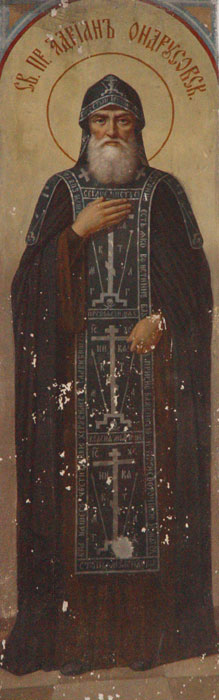
Adrian is painted as a Russian monastic saint of the northern type: standing, full-length and frontal, in the black mandyas over the analavos of the great schema — the black cloth worked with the cross, the spear and the reed and the inscriptions of the Passion, which is his most conspicuous attribute — with the koukoulion on his head or thrown back, the right hand raised in blessing or held at the breast, the left holding a scroll. He is white-bearded, aged. Where a setting is given it is the water and low shore of Lake Ladoga with his monastery church behind him, and in marginal cycles the two scenes of the stag-hunt that brought him to Alexander of Svir and of the finding of his body in the marsh. He appears also in composite icons of the saints of Karelia and among the disciples of Alexander of Svir.
The stored image is a panel of the seventeenth or eighteenth century from the Transfiguration church of the Monastery of Alexander of Svir — a fitting provenance, since Alexander was the occasion of his conversion. The saint stands in the great schema, blessing, inscribed at the head СВ. ПР. АДРІАНЪ ОНДРУСОВСК[ІЙ] — "Saint Adrian of Ondrusov" — which confirms the identification directly. The paint is much lost in places, and the style is later than the dating given at the source suggests; the source's dating is reported here as given.
Disputed questions
- Martyr, venerable-martyr, or hieromartyr? The Russian books style him prepodobnomuchenik — venerable-martyr, a monastic put to death — and this entry follows them; the Orthodox Church in America's calendar heads the May 17 commemoration "Hieromartyr Adrian of Ondrusov," which would require him to have been in priestly orders. As igumen of a house that served the Liturgy he very probably was a hieromonk, but the sources do not say so in terms, and the classification here is the Russian one, with the OCA's title recorded. A stricter reading would observe that he was killed for his supposed money and not for his faith, and that his martyr-title is therefore one of manner rather than of cause; the Russian tradition has nevertheless given it to him, as it has to other monastics murdered in the course of their calling.
- 1549 or 1550. The year of the murder is given as 1549 in most Russian accounts and as 1550 in others (including the description of the icon stored below); the baptism of Ivan IV's daughter to which he was summoned belongs to 1549. The two-year interval before the finding of the relics is constant in the sources, which pushes the finding to 1551 or 1552 and makes the August 26 burial-date belong to that year rather than to the year of death — a point on which the popular accounts are frequently confused.
- Which feast is principal. The Russian calendars carry both days, August 26 for the burial and May 17 for the finding and translation. This entry ranks August 26 primary, as the day nearest a repose-commemoration, and May 17 as the translation of relics; some lists reverse the emphasis.
- Not to be confused with Adrian of Poshekhonye (†1550, March 5), another Russian monastic founder of the very same years who was likewise killed for money he was thought to have, and whose body was likewise hidden and afterwards found incorrupt — a confusion very easy to make, and worth stating plainly: this Adrian is the founder of Ondrusov on Lake Ladoga, disciple of Alexander of Svir, killed by peasants on the road home from Moscow; the other is the founder of the Dormition house in the forests of Poshekhonye near Yaroslavl, disciple and fellow icon-painter of Cornelius of Komel, killed by robbers inside his own monastery in Great Lent, his relics found in 1626. Neither should be confused with Adrian of Nicomedia, the martyr kept with his wife Natalia on August 26 — which is also this Adrian's principal day — nor with Adrian of Uglich (†after 1504), the disciple of Paisius of Uglich, who is a third Russian Adrian on that same August 26.