
Adrian and Natalia of Nicomedia
The Holy Martyrs Adrian and Natalia of Nicomedia, and the Twenty-three Martyrs with them
Martyr · d. c. 305–306, at Nicomedia (Natalia soon after, in peace, at Argyropolis)
Commemorated 26 August — Martyrdom at Nicomedia under Maximian
Adrian and Natalia are the married martyrs of Nicomedia in the last and worst of the imperial persecutions, and theirs is one of the most humanly moving passions in the whole Byzantine calendar. Adrian was a young pagan officer of the imperial praetorium, about twenty-eight years old, whose duty it was to take down the names of Christians brought in for torture; watching twenty-three of them endure what he was recording, he laid down his pen, told the notaries to write his own name among theirs, and went to prison a Christian who had never been baptised and had never heard a catechism. Natalia, his wife of some thirteen months, was already secretly a Christian; she did not weep, but ran to the prison, kissed his chains, and spent the days that were left to him strengthening him against the fear of the anvil on which his hands and legs would be broken. When the hour came she herself laid his limbs on the block so that he should not falter, and afterwards carried away his hand and kept it with her until she died in peace beside the martyrs' relics at Argyropolis. The Church numbers her among the martyrs although no one struck her: she is the classic case of the martyr who suffered everything except the blow.
_-_%D0%B8%D0%BA%D0%BE%D0%BD%D0%B0_12261_%D0%90%D0%B4%D1%80%D0%B8%D0%B0%D0%BD_%D0%B8_%D0%9D%D0%B0%D1%82%D0%B0%D0%BB%D0%B8%D1%8F.png)
Nicomedia under Maximian
The setting is Nicomedia (the modern İzmit), the eastern capital of the Tetrarchy and the city where the Great Persecution was proclaimed in 303. Its Christian community was large, ancient and conspicuous — the cathedral stood in sight of the palace — and it was therefore the community that suffered first and most heavily; the calendar of August alone carries several of its companies of martyrs. The emperor of the passion is Maximian, which in the sources of this cycle is regularly Galerius Maximian, the ruler of the East and the persecution's most implacable author. The traditional year is 305 or 306, at the height of the terror.
Adrian belonged to the machinery of that terror. He is described as head of the praetorium — a senior officer of the imperial court and its guard, close enough to the emperor to be present at examinations, with the notaries and the registers under his hand. He was young for the post, about twenty-eight, and a pagan by birth and habit. He had been married about thirteen months to Natalia, who was of Christian parents and had been baptised, but who had kept her faith hidden from her husband — a common enough arrangement in a household attached to the palace, and one the passion does not moralise about.
The twenty-three in the cave
Twenty-three Christians of Nicomedia were denounced for hiding in a cave outside the city, were seized, beaten with thongs and sticks, and brought in for interrogation. Their names were not preserved; the tradition knows them only by their number, and even that varies — the Greek synaxaria and the Slavonic Menaion between them give twenty-three and thirty-three, and the discrepancy is old.
Adrian's duty was to write down their names and their answers. What he heard was not the sullen obstinacy the officials expected but a joy he had no category for. He asked them, at last, what reward they looked for that could be worth the ruin of their bodies; and they answered him with the words of the Apostle — that eye has not seen, nor ear heard, neither have entered into the heart of man, the things which God has prepared for them that love him (1 Cor. 2:9). The passion is quite clear that this — a sentence of Scripture, quoted by men whose bones were being broken — is the whole of Adrian's instruction in the faith. He turned to his own scribes and said: "Write my name also with theirs, for I too am a Christian." He was arrested on the spot and put in irons with the men he had been sent to register.
Natalia at the prison
Word was carried to Natalia that her husband was in prison. She took it, at first, for the ordinary catastrophe of a household — and then, hearing the reason, she went to the prison "as though to a wedding," and this is the note that has made the passion famous. She kissed his chains and his fetters, called him blessed, and told him what she had never told him before: that she was herself a Christian, that she had prayed for this, and that he must not imagine he was being pitied. Her whole ministry in the story is the opposite of the one the hagiographies usually give to a wife — she is there not to soften the martyr but to hold him to it.
Adrian obtained leave from the authorities to go home for a day and tell his wife the appointed date of the execution; the other prisoners went surety for his return, which is itself a detail worth pausing over — twenty-three condemned men staking their own treatment on the honour of the officer who had booked them. When Natalia saw him coming up the street unguarded, she assumed he had denied Christ and been released, and she barred the door of her own house against him, calling him through it an apostate and a traitor and refusing to look at him. Only when he had explained through the shut door that he had come with permission and must go back did she open, and then she went back with him and did not leave the prison again.
When women were forbidden the prison — the guards having noticed how the Christian wives were fortifying the condemned — Natalia cut off her hair, put on a man's clothing, and went on serving the prisoners in that disguise, washing their wounds, bringing food, and persuading other wives to do the same.
The anvil
The sentence was that the martyrs' hands and legs should be broken on an anvil with a hammer or an iron bar. It is not a Roman penalty of the books; it belongs to the improvised brutality of a persecution that had run out of forms.
Natalia's part in what followed is the hardest and greatest thing in the passion. Fearing that her husband, the youngest and the newest Christian of the company, would lose his nerve if he watched the others die first, she begged the executioners to begin with Adrian; and when they had begun, she held his hands and his feet on the block herself and would not let them tremble. His legs were struck through, then his hands cut away; and he died there. The twenty-three died with him. Adrian was twenty-eight years old.
The relics, the storm, and the hand
The bodies were ordered to be burned, so that the Christians should have nothing to bury. Natalia, standing by the fire, took up Adrian's severed hand and hid it in her clothing. Then — the tradition is unanimous on this — a storm broke over the place: rain put the fire out, lightning struck among the executioners, and the half-burnt relics were left to be gathered by the Christians. They were carried across the water and laid at Argyropolis, near Byzantium, on the European shore of the Bosporus.
Natalia stayed in Nicomedia with the hand until a tribune of the guard, hearing that she was young, rich and widowed, obtained the emperor's leave to marry her. She asked for three days, and used them to take ship secretly for Byzantium, carrying the hand with her. The passion tells of the voyage in the older manner: an evil spirit appeared in the likeness of a helmsman to lead the ship off her course, and Adrian appeared to his wife and brought the ship to land. At Argyropolis she laid the hand with the bodies of the martyrs; and there, in the church over their relics, Adrian appeared to her again in sleep, told her that her struggle was accepted and that her rest was at hand. She fell asleep in the Lord soon afterwards, worn out, and was buried with the martyrs she had served.
Veneration and later cultus
The cult was early and it travelled far. In the East the relics at Argyropolis made the pair one of the fixed August commemorations of the Constantinopolitan calendar, and their church there is mentioned in the Byzantine sources; a portion of St Natalia's relics is kept to this day at the Monastery of Kykkos in Cyprus. In the West relics of Adrian reached Rome, where the ancient Curia Iulia in the Forum was converted into the church of Sant'Adriano al Foro, and others reached Flanders, where the abbey of Geraardsbergen made him one of the great patrons of the Low Countries; there he became the patron of soldiers, prison guards, armourers and butchers, and was invoked against plague — a Western development with no counterpart in Orthodox usage, though it explains the enormous Flemish and German iconography of Adrian with an anvil.
In the East the couple have kept a quite different significance. They are, with Aquila and Priscilla, among the very few married pairs in the calendar honoured precisely as a married pair, and the Orthodox reading of them is domestic before it is heroic: Natalia is held up in preaching and in the marriage service's ambit as the type of the wife who is her husband's way to Christ rather than his obstacle to it. In Greek and Arabic-speaking practice Ἀδριανός/Adrian and Ναταλία/Natalia are common baptismal names, and August 26 is a widely kept name-day.
Feast and commemoration
August 26 (church date; Old Calendar civil September 8) is the day in every Orthodox calendar — Antiochian, Greek, Russian, Serbian, Romanian — and the day is theirs alone in the Greek and Antiochian books, the Russian additions of the Vladimir icon and the local Adrians being layered over it. The date falls three days after the leavetaking of the Dormition and three days before the strict fast of the Beheading of the Forerunner, in the short stretch of late August that stands free of a great feast.
The Latin Church keeps Adrian on September 8 — which is not the Old Calendar equivalent of the Eastern date but an independent Western reckoning that happens to coincide with it; the Roman date derives from the dedication of his church, and Natalia is commemorated with him on December 1 in some Western martyrologies. The coincidence of the two September 8 dates is accidental and should not be used to argue a common origin.
At Nicomedia's successor city and in the Greek diaspora the day is kept as a name-day of the first rank; in Cyprus the Kykkos monastery keeps it with its portion of Natalia's relics.
Hymns
Apolytikion — Tone 4
Thy martyrs, O Lord, in their contest received from thee, our God, crowns of incorruption; for possessed of thy might, they set at nought the tyrants and shattered the feeble insolence of the demons. By their supplications, O Christ our God, save thou our souls.
Kontakion — Tone 4
The words of thy wife were as a shield to thee, O glorious Adrian, and her hands upheld thine upon the anvil; wherefore, having been made a martyr by the counsel of a martyr, thou hast entered with her into the joy that eye hath not seen. Together, O blessed pair, entreat Christ God for all who honour your memory.
Original translation from the Greek
Iconography
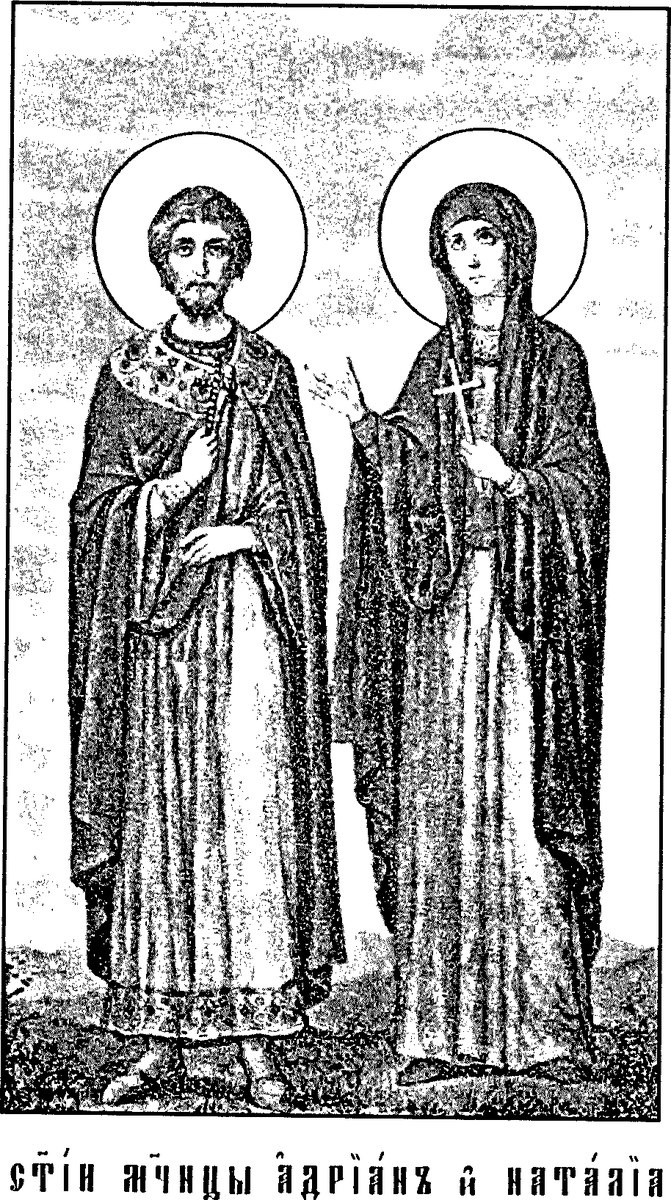
Adrian and Natalia are painted together, standing side by side and turned slightly toward one another — the standard scheme for a married pair of martyrs and the one this entry's image follows. Adrian is a young man, beardless or with the first short dark beard, in the dress of a court officer: a rich tunic with an embroidered collar or loros-like ornament, a cloak over it, and in his right hand the martyr's cross. Natalia wears the long dark maphorion over a light undergarment, her head covered, and carries a cross of her own — the mark that she too is reckoned a martyr, which is the iconographic assertion of the whole question discussed above.
Adrian's proper attribute in the East is the severed hand or, more often, the anvil and hammer set beside the pair or held in the scene of the passion; Western art of the Low Countries makes the anvil so dominant that Adrian is scarcely identifiable without it, and often shows him in full armour with a lion, which is a Flemish accretion of no Orthodox authority. Narrative cycles in the menologia show three moments: the martyrs in the cave, Adrian dictating his own name to the notaries, and the breaking of the limbs, with Natalia kneeling at the block.
The stored image is a plate from the illustrated Lives of the Saints of St Demetrius of Rostov (August volume, Moscow, 1903–1911), reproducing a Russian icon of the pair; it is inscribed in Church Slavonic СТЇИ МЧНЦЫ АДРІАНЪ И НАТАЛІА — "The Holy Martyrs Adrian and Natalia" — which fixes the identification beyond doubt. Both hold crosses; Adrian is in the ornamented court tunic and mantle, Natalia in the maphorion. It is a halftone print and coarse; no earlier photographable icon of the pair was found in the public domain, and a better plate should replace it if one comes to hand.
Disputed questions
The number of the companions. Twenty-three is the number of the OCA and Slavonic tradition; thirty-three is given by other synaxaria and by OrthodoxWiki's list. No names are transmitted for any of them. The entry keeps twenty-three in the title and records the variant.
A second Adrian at Nicomedia. Several calendars list on this same day, separately from the couple, a "Martyr Adrian at Nicomedia." Whether this is a genuinely distinct martyr or an accidental doubling of the same commemoration in the manuscript tradition — of which the synaxaria furnish many examples — cannot be settled from the sources; no independent passion for him survives. The likelihood is duplication, and no separate entry is made here.
Which Maximian. The passion says only "Maximian." The chronology (305–306, at Nicomedia) points to Galerius, who took the title Maximian and ruled the East after Diocletian's abdication; some Western retellings understand Maximian Herculius instead, which does not fit Nicomedia.
Natalia's martyrdom. She died in peace and is nevertheless titled martyr in every service book. The Church's reasoning is stated openly in the hymnography: she suffered the whole passion in her husband's body, and the disposition, not the wound, is what is crowned. She is the standing Orthodox example of the point.
Not to be confused with three Russian saints of the same name who fall near or on this day: Adrian of Ondrusov (†1549/50), also kept on August 26; Adrian of Uglich (†after 1504), likewise on August 26; and Adrian of Poshekhonye (†1550, feast March 5). Nor with the martyrs Adrian and Eubulus of Caesarea (February 3).