
Agatha of Sicily
The Holy Virgin-Martyr Agatha of Catania in Sicily
Martyr · Virgin · b. c. 231 — d. 251, at Catania
Commemorated 5 February — Martyrdom at Catania under Decius
Agatha of Catania (c. 231–251) is one of the most venerated virgin-martyrs of the ancient Church, put to death in Sicily during the persecution of the emperor Decius. A young noblewoman who had consecrated her virginity to Christ, she rejected the consul Quintianus and, when neither a brothel nor flattery could break her, was cruelly tortured — most famously by the cutting off of her breasts, after which the Apostle Peter appeared in a vision and healed her wounds. Rolled upon burning coals and broken potsherds, she died in prison of her sufferings. A year later, when Mount Etna erupted, the people of Catania stopped the lava with her veil, and she has been invoked ever since against fire, earthquake, and the eruptions of the mountain. Ancient in both East and West, she is named in the Roman Canon and kept universally on February 5.

Origins in Sicily
Agatha was born about the year 231 into a wealthy and noble family of Roman Sicily. Two cities claim her — Catania, under the shadow of Mount Etna, and Palermo (ancient Panormus, the Greek Πάνορμος) — and the tradition is divided over which was her birthplace, though it is agreed that she suffered and died at Catania, whose patroness she has been ever since. The Greek synaxaria, following the eastern Sicily of her cultus, call her simply "the martyr Agathe"; the Latin acts, on which the fuller story rests, give her the consul and the tortures by name. From childhood she was a Christian, and, the acts say, of such beauty and standing that her hand was widely sought; but she had consecrated her virginity to Christ and would hear of no earthly marriage.
The consul Quintianus
The persecution of the emperor Decius (249–251) reached Sicily and gave a man of low birth but high office his opportunity. Quintianus, the consular governor of the province, desired Agatha at once for her wealth, her nobility, and her beauty, and thought to use the imperial edict against the Christians as his instrument: he would compel her either to sacrifice to the gods or to yield to him. Arresting her under colour of the law, he first placed her in the keeping of a woman named Aphrodisia, the mistress of a house of ill fame, together with her daughters, that the corruption of the place and the flattery and threats of its keepers might wear down her resolve. For a month they laboured at her, and could do nothing: Agatha met every enticement with the confession of Christ, and Aphrodisia at last returned her to the governor with the report that she might sooner soften the rocks or bend iron than turn this maiden's heart from her God.
Passion and the vision of the Apostle Peter
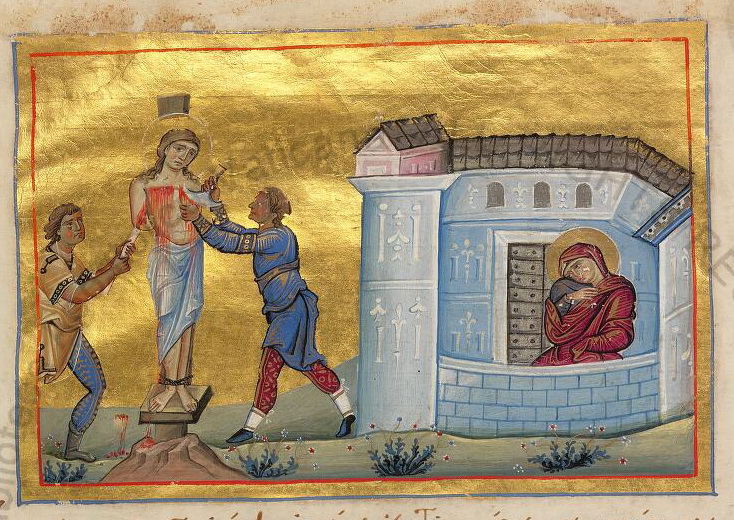
Brought before the judgment seat, Agatha answered Quintianus with a freedom that the acts preserve as a small manifesto of Christian liberty: that true nobility is to be the servant of Christ, and true freedom to belong to him. Enraged, the governor had her struck on the face, imprisoned, and on the following day put to the torture — stretched on the rack and torn. When still she would not yield, he ordered the most notorious of her torments, from which her later veneration and iconography are inseparable: her breasts were cruelly wounded and cut off. "Cruel tyrant," the acts have her say, "are you not ashamed to cut from a woman that which your own mother gave you to suck?" She was cast back into prison without food or care, and forbidden the attendance of any physician.
There, in the night, a vision of the Apostle Peter came to her — an old man of venerable aspect, preceded by a child bearing a light, who said he was sent by the One whom she confessed and offered to heal her. Agatha, who had refused all mortal medicine because she had never in her life used bodily remedies and would not begin now, answered that Christ himself could heal her by a word; and the Apostle, telling her that Christ had sent him and had healed her, filled the prison with light and departed, and her wounds were found whole and her body restored.
Martyrdom and the earthquake
Unmoved by the miracle, Quintianus after some days renewed the torture, and now ordered her rolled naked upon a bed of burning coals mingled with broken potsherds. As she lay in the fire, the acts relate, a great earthquake shook Catania; part of the palace fell and killed two of the governor's counsellors, and the terrified people of the city rose against Quintianus for his cruelty, so that he broke off the torment and had Agatha carried back to prison. There she gave thanks to God, prayed that he would receive her spirit, and reposed — dying of her wounds in the year 251, in the reign of Decius. The Christians of Catania buried her with honour; and the tradition tells that as they laid her in the tomb a young man in silk, unknown to all and attended by a hundred others, set at her head a small tablet inscribed Mentem sanctam, spontaneam, honorem Deo et patriae liberationem — "A holy and willing mind, honour to God, and the deliverance of her homeland" — words the Church has kept in her office ever since.
The veil and Mount Etna
Almost at once Agatha became the guardian of her city against the mountain above it. A year after her death, in 252, Mount Etna erupted, and a torrent of lava rolled down toward Catania. The people — pagan and Christian alike — took the veil (or cloth) from her tomb and carried it in procession against the advancing fire, and the lava, the tradition holds, was stopped and turned aside before it reached the walls. From that deliverance Agatha has been for seventeen centuries the protectress of Catania against fire, earthquake, and the eruptions of Etna, her veil borne out against the lava again and again in the city's history; and from the manner of her martyrdom she became also the patroness of those who suffer diseases of the breast, and — because the bells of the towers were rung to warn of the mountain's fire — of bell-founders. Few saints of the first Christian centuries have kept so unbroken and so local a devotion.
Veneration and cultus
Agatha's cult is among the oldest that can be traced. She was venerated at Catania from the time of her death; by the fifth and sixth centuries her fame had spread through the whole Church, and she was one of the very few women martyrs named in the Canon of the Roman Mass (with Agnes, Cecilia, Lucy, Perpetua, Felicity, and Anastasia). Churches were dedicated to her at Rome — Sant'Agata dei Goti among them — and her name entered the litanies and calendars of East and West alike. The Byzantine synaxaria received her early, and she is kept on the same day, February 5, throughout the Orthodox and the Roman calendars: a rare and complete agreement across the later division of the Churches, testifying to the antiquity of her memory. Her relics rest at Catania, in the cathedral raised over her; portions were carried away and returned across the centuries, and their homecoming is itself commemorated in the city.
Her memory is entwined with that of Lucy of Syracuse, the other great virgin-martyr of Sicily: the tradition of Lucy holds that Lucy's mother was healed of a flow of blood at Agatha's tomb at Catania, and that Agatha appeared to Lucy there and foretold her own martyrdom and Lucy's — so that the elder Sicilian martyr is remembered as the intercessor who set the younger on her road to the crown.
Feast and commemoration
Agatha is kept universally on February 5 (church date; Old Calendar civil February 18), and in the year's reckoning her feast falls within the afterfeast of the Meeting of the Lord (February 2), so that her office in the Menaion is sung together with the festal hymns of the Presentation in the Temple — the virgin-martyr honoured while the Church still keeps the feast of the Virgin who bore the Light to the Temple. The Antiochian, Greek, and Slavic calendars agree on the day, as does the Roman, which has kept her on February 5 from antiquity and names her in the Canon of the Mass; the near-universal agreement on the date is itself a witness to the age of her cult.
Hymns
Troparion — Tone 4
Thy lamb, O Jesus, cries out with a loud voice: "Thee, O my Bridegroom, I long for, and seeking Thee I strive in contest; I am crucified and buried together with Thee in Thy baptism, and I suffer for Thy sake, that I may reign with Thee; I die for Thee, that I may live in Thee. Receive me, then, as a spotless sacrifice offered to Thee with love." By her prayers, O Merciful One, save our souls.
Original translation from the Greek
Appointed readings
Epistle — Hebrews 13:17–21
17Obey them that have the rule over you, and submit yourselves: for they watch for your souls, as they that must give account, that they may do it with joy, and not with grief: for that is unprofitable for you. 18Pray for us: for we trust we have a good conscience, in all things willing to live honestly. 19But I beseech you the rather to do this, that I may be restored to you the sooner. 20Now the God of peace, that brought again from the dead our Lord Jesus, that great shepherd of the sheep, through the blood of the everlasting covenant, 21Make you perfect in every good work to do his will, working in you that which is wellpleasing in his sight, through Jesus Christ; to whom be glory for ever and ever. Amen.
Gospel — Luke 6:17–23
17And he came down with them, and stood in the plain, and the company of his disciples, and a great multitude of people out of all Judæa and Jerusalem, and from the sea coast of Tyre and Sidon, which came to hear him, and to be healed of their diseases; 18And they that were vexed with unclean spirits: and they were healed. 19And the whole multitude sought to touch him: for there went virtue out of him, and healed them all. 20And he lifted up his eyes on his disciples, and said, Blessed be ye poor: for yours is the kingdom of God. 21Blessed are ye that hunger now: for ye shall be filled. Blessed are ye that weep now: for ye shall laugh. 22Blessed are ye, when men shall hate you, and when they shall separate you from their company, and shall reproach you, and cast out your name as evil, for the Son of man’s sake. 23Rejoice ye in that day, and leap for joy: for, behold, your reward is great in heaven: for in the like manner did their fathers unto the prophets.
Iconography
Agatha is depicted as a young woman in the robe and maphorion of a martyr, often crowned and holding the cross of her confession and the palm of victory. Her distinctive attribute in both East and West is drawn from her passion: she is shown bearing her severed breasts upon a dish or a pair of pincers — an attribute so particular that, misread in later Western art, it gave rise to subsidiary customs (the small round loaves and bells blessed on her day). In the narrative miniatures of the menologia she appears in the act of her martyrdom, at the hands of her torturers; and the scene of her veil borne against the lava of Etna is proper to the iconography and processional imagery of Catania.
The stored image is the miniature for February 5 from the Menologion of Basil II (Constantinople, c. 985; Vatican, Vat. gr. 1613), depicting Agatha in the hands of her torturers — the Byzantine narrative type of her martyrdom (source, public domain, pd-old-work).
Disputed questions
- The Acts. The surviving Passio of Agatha is a later composition (fifth or sixth century) and shows the conventional features of its genre — the set dialogue, the doubled tortures, the marvels. The core — a noble Christian virgin of Catania martyred under Decius, whose breasts were cut off and whose veil turned the lava of Etna — is fixed and ancient, attested by the antiquity of her feast and the mention in the Roman Canon; the fuller detail of the acts is honoured as tradition rather than pressed as documentary history.
- Catania or Palermo. Both cities have claimed her as their own daughter, and the sources divide. The martyrdom at Catania, where her tomb and cult are fixed and where she remains patroness, is not in doubt; her birthplace is the contested point, and the entry leaves it open as the tradition does.
- The year. The martyrdom is placed in the persecution of Decius, and so about 251; a minority reckoning under his successors would move it a year or two later. The reign of Decius is the anchor.
- Not to be confused with the several other holy women named Agatha of the later synaxaria, nor — though the two Sicilian virgin-martyrs are often paired — with Lucy of Syracuse (†304, kept December 13), a distinct saint of the next persecution, linked to Agatha by devotion but not the same person. "Of Catania," and the veil against Etna, belong to this Agatha alone.