
Alexander Hotovitzky
The Holy Hieromartyr Alexander Hotovitzky, Protopresbyter, Missionary to America
Hieromartyr · New Martyr · Priest · b. 11 February 1872, Kremenets, Volhynia — d. 1937 (autumn; the exact date unrecorded), Moscow
Commemorated 7 August — Commemoration among the confessors of the Moscow church, 4 December — Glorification among the New Martyrs (1994); his death-date being unrecorded, the Church keeps him this day
Alexander Hotovitzky (1872 – autumn 1937), protopresbyter, was the builder-priest of Orthodox New York and, in his last years, the right hand of Patriarch Tikhon at the cathedral of Christ the Saviour in Moscow — a double service, American and Russian, sealed with a martyr's end in the Terror of 1937. For nineteen years he served the New York parish that became Saint Nicholas Cathedral, which he built; he founded parishes across the eastern states, edited the mission's journal, and was wounded by a fanatic's knife for his preaching. Recalled at last to Moscow, he stood by the Patriarch through the confiscations, was imprisoned and exiled repeatedly, and after a final arrest in the autumn of 1937 disappeared — presumed shot, on a date God alone keeps. The Church of Russia glorified him on 4 December 1994.

Volhynia to New York
Alexander Alexandrovich Hotovitzky was born on 11 February 1872 at Kremenets in Volhynia, where his father was rector of the seminary. From the Volhynia seminary he passed to the Saint Petersburg Theological Academy (master's degree, 1895), and on graduating went straight to the American mission — first as reader at the Saint Nicholas church in New York, then, from his ordination on 25 February 1896, as its priest.
New York became his life's work. He served the city's Russians, Galicians, Carpatho-Russians and Arabs; received converts from the Unia in numbers; founded parishes in Philadelphia, Yonkers, Passaic and beyond; edited the American Orthodox Messenger, the mission's bilingual journal, from its founding; and drove the building of the new Saint Nicholas Cathedral on East 97th Street — begging the funds across two continents (the tsar himself subscribing) — which Bishop Tikhon consecrated in 1902 and which remains the mother church of the Moscow patriarchal parishes in America. A would-be assassin's knife, answered without rancour from the ambo, left him — in Archbishop Platon's words — a living witness for Christ. He was a secretary of the first All-American Sobor (1907) and was elevated protopresbyter.
Helsinki, Moscow, and the Terror
Transferred in 1914 to Helsinki, he served the Finnish flock through the war; in August 1917 he was called to Moscow to the great cathedral of Christ the Saviour, and there was a member of the All-Russian Council that elected his old bishop Patriarch. Through the civil war and the famine he was the Patriarch's helper in the cathedral's administration and in famine relief; in the church-valuables persecution of 1920–22 he was arrested repeatedly, tried in the "second Moscow trial" of 1922, sentenced to ten years, released in 1923, and in 1924 exiled three years to the Turukhansk north. Returning, he served quietly as protopresbyter of the Church of the Deposition of the Robe until the Great Terror. Arrested finally in the autumn of 1937, he vanished into it: the date and place of his death were never recorded, and the Church, glorifying him on 4 December 1994, appointed his memory to the day of his glorification — a martyr whose crown is certain and whose grave is known to God.
Feast and commemoration
December 4 (church date; Old Calendar civil December 17) — the day of his 1994 glorification, kept as his feast because the day of his death is unrecorded — with a secondary commemoration on August 7 among the confessors of the Moscow church, and among the New Martyrs and Confessors of Russia on their movable synaxis. The OCA lectionary appoints him the hieromartyr's readings recorded in the entry's record.
Hymns
Troparion — Tone 4
As a wise builder of churches beyond the sea and a faithful fellow-labourer of the confessor-patriarch, thou wast found worthy at the last of the martyrs' hidden crown, O hieromartyr Alexander: pray to Christ God, whose cathedral thou didst serve and whose cup thou didst drink, that our souls may be saved.
Original translation from the Slavonic
Appointed readings
Epistle — Hebrews 13:7–16
7Remember them which have the rule over you, who have spoken unto you the word of God: whose faith follow, considering the end of their conversation. 8Jesus Christ the same yesterday, and to day, and for ever. 9Be not carried about with divers and strange doctrines. For it is a good thing that the heart be established with grace; not with meats, which have not profited them that have been occupied therein. 10We have an altar, whereof they have no right to eat which serve the tabernacle. 11For the bodies of those beasts, whose blood is brought into the sanctuary by the high priest for sin, are burned without the camp. 12Wherefore Jesus also, that he might sanctify the people with his own blood, suffered without the gate. 13Let us go forth therefore unto him without the camp, bearing his reproach. 14For here have we no continuing city, but we seek one to come. 15By him therefore let us offer the sacrifice of praise to God continually, that is, the fruit of our lips giving thanks to his name. 16But to do good and to communicate forget not: for with such sacrifices God is well pleased.
Gospel — Luke 12:32–40
32Fear not, little flock; for it is your Father’s good pleasure to give you the kingdom. 33Sell that ye have, and give alms; provide yourselves bags which wax not old, a treasure in the heavens that faileth not, where no thief approacheth, neither moth corrupteth. 34For where your treasure is, there will your heart be also. 35Let your loins be girded about, and your lights burning; 36And ye yourselves like unto men that wait for their lord, when he will return from the wedding; that when he cometh and knocketh, they may open unto him immediately. 37Blessed are those servants, whom the lord when he cometh shall find watching: verily I say unto you, that he shall gird himself, and make them to sit down to meat, and will come forth and serve them. 38And if he shall come in the second watch, or come in the third watch, and find them so, blessed are those servants. 39And this know, that if the goodman of the house had known what hour the thief would come, he would have watched, and not have suffered his house to be broken through. 40Be ye therefore ready also: for the Son of man cometh at an hour when ye think not.
Iconography
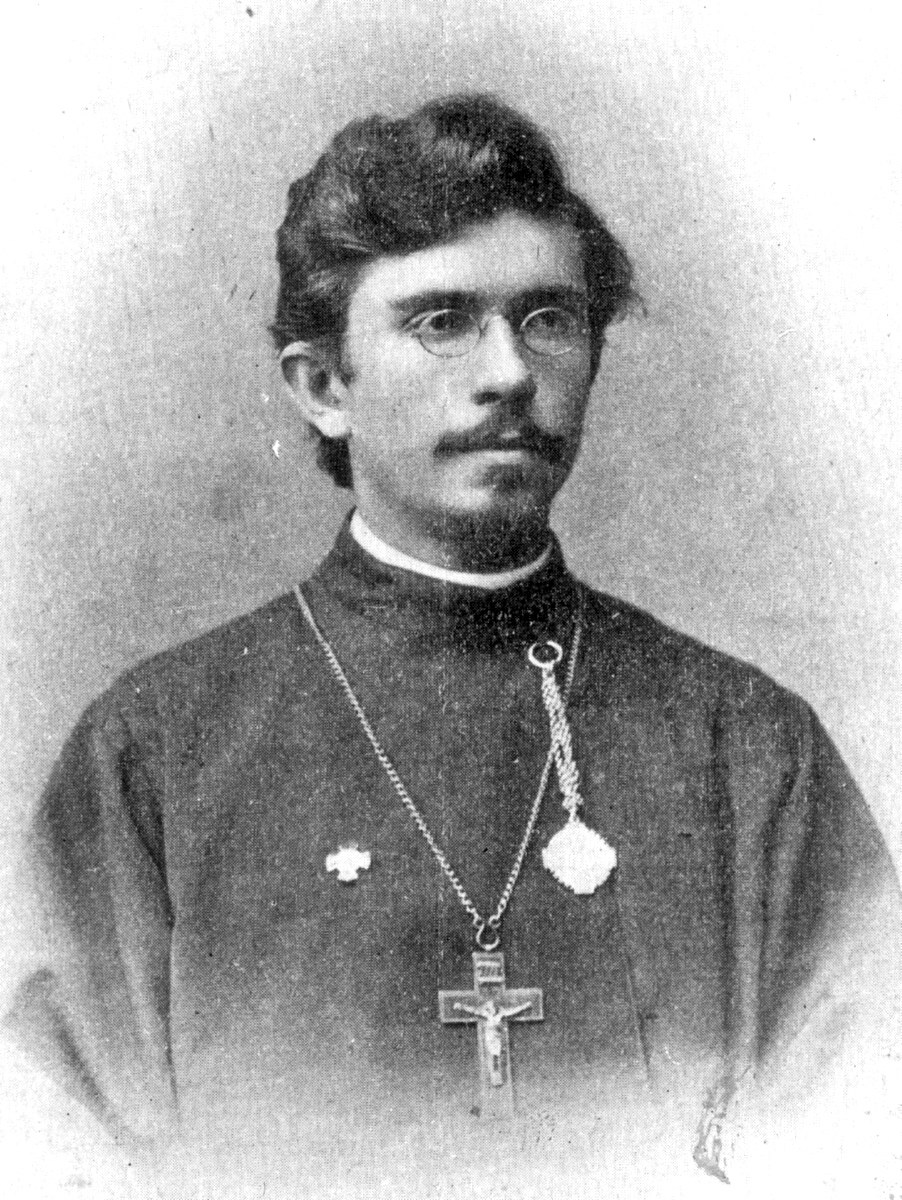
Alexander is painted as a protopresbyter new-martyr: grey-bearded, in phelonion and pectoral cross, holding the cross of martyrdom or a scroll, with Saint Nicholas Cathedral in New York — his building — or Christ the Saviour in Moscow behind him; in the composite icons of the New Martyrs he stands among the priests. As he died in 1937, photographs survive; painted icons are post-1994 works in copyright. The stored image is a photograph of the protopresbyter (before 1909, from his American years), stored per the §50 ruling as a labelled lifetime portrait. A free-licensed painted icon remains the eventual want and is listed among the upgrade-wanted icons.