
Tikhon of Moscow
Saint Tikhon, Patriarch of Moscow and All Russia, Confessor, Enlightener of North America
Patriarch · Bishop · Confessor · b. 19 January 1865, Toropets district, Pskov province — d. 7 April 1925, Moscow
Commemorated 9 February — Uncovering of his relics at the Donskoy monastery (1992), 7 April — Repose of the Patriarch and Confessor (1925, the feast of the Annunciation by the Old Calendar he kept), 26 September — Glorification by the Church of Russia (1989)
Tikhon (Vasily Ivanovich Bellavin, 1865–1925) was the first Patriarch of Moscow after the two-hundred-year synodal captivity of the Russian Church, and before that the builder of Orthodoxy in North America — the hierarch under whom the American mission became a multi-ethnic archdiocese with its cathedral in New York, its seminary, its monastery, and its first church council. Elected Patriarch in November 1917, within days of the Bolshevik seizure of power, he led the Church of Russia into the fire of the persecution: he anathematized the shedders of innocent blood, refused to surrender the Church to the state-sponsored schism of the "Living Church," was imprisoned for a year, and died worn out on the feast of the Annunciation, 7 April 1925. The Church glorified him in 1989 as confessor and enlightener of North America, and his incorrupt relics were uncovered at the Donskoy monastery in 1992.

From Pskov to the Aleutians
Vasily Bellavin was born on 19 January 1865 in the Toropets district of Pskov province, the son of a village priest. He passed through the Pskov seminary and the Saint Petersburg Theological Academy (graduated 1888), where his schoolfellows, with the clairvoyance of schoolboys, nicknamed him "Patriarch." Tonsured in 1891 with the name Tikhon — after Tikhon of Zadonsk, the beloved hierarch of his native north — he taught at the Kholm seminary, and in 1897 was consecrated Bishop of Lublin.
In September 1898 he was appointed Bishop of the Aleutians and Alaska, and crossed the ocean to a scattered missionary diocese of Aleut, Tlingit, Yupik, Russian, Serbian, Greek, Arab and Carpatho-Russian flocks. He re-founded it: in 1900 the see was renamed "the Aleutians and North America"; the cathedral was moved to New York, where he blessed the cornerstone of Saint Nicholas Cathedral in 1901 (built by his priest Alexander Hotovitzky); he consecrated churches from Alaska to Pennsylvania, established the vicariates of Alaska and of Brooklyn — consecrating Raphael of Brooklyn, the first Orthodox bishop consecrated on American soil — blessed the founding of Saint Tikhon's monastery in Pennsylvania (1905), moved the seminary to its side, and in 1907 presided at the first All-American Sobor at Mayfield, which he taught to think of itself as a local church in formation. Elevated to Archbishop in 1905, he left America in 1907 mourned by every nationality of his flock.
Yaroslavl, Vilnius, and the patriarchal cross
He served the sees of Yaroslavl (1907–1913), where the city made him an honorary citizen, and Vilnius (from December 1913), from which the First World War drove him with the relics of the Vilnius martyrs in his keeping. In June 1917 the free vote of the Moscow diocese called him to be its archbishop; the All-Russian Council of 1917–1918 elevated him Metropolitan, and on 5 November 1917 — the guns of the October revolution barely silent — the lot drawn before the Vladimir icon of the Mother of God named him Patriarch of Moscow and All Russia, the first since Adrian died in 1700. He wept, and called the patriarchal cross a scroll on which was written weeping and mourning and woe.
He bore it exactly so. In January 1918 he anathematized those shedding innocent blood; he refused every demand to bless the new power and every temptation to curse it politically, defining the Church's place as with the people and above the parties. When the state, under cover of the 1921–22 famine, ordered the seizure of the consecrated vessels, he blessed the giving of all unconsecrated wealth and refused the chalices; for this he was arrested in April 1922 and held over a year while the state built up the "Living Church" renovationist schism to replace him. Released in June 1923, he spent his last two years gathering the Church back from that schism, serving constantly, watched, harried, and once nearly assassinated — his cell-attendant James Polozov was murdered before his eyes in 1924. Worn out, he reposed on 7 April 1925, the Annunciation by his calendar, with the words, tradition records, "The night will be long and very dark." Nearly a million came to the Donskoy monastery for his burial.
Glorification
The Church of Russia glorified Tikhon on 9 October 1989 (26 September, church date), the feast of the Apostle John the Theologian, whom he had loved; his relics were found incorrupt in the Donskoy monastery on 22 February 1992 after a fire, and lie there openly. He heads the Synaxis of the New Martyrs and Confessors of Russia (movable, the Sunday nearest 25 January) and is honoured in America as enlightener and father of the local Church.
Feast and commemoration
April 7 (church date; Old Calendar civil April 20) — his repose — with secondary commemorations of the glorification (September 26 church date) and the uncovering of the relics (February 9 church date), and among the New Martyrs and Confessors of Russia on their movable synaxis. Kept with particular love by the Orthodox Church in America, whose institutions — cathedral, monastery, seminary, sobor — are his foundations.
Hymns
Troparion — Tone 1
Let us praise Tikhon, the patriarch of all Russia and enlightener of the lands of the West, who bore the cross of the first-hierarch in the day of wrath, and kept the flock of Christ unbowed before the persecutors: for having filled America with the light of Orthodoxy and Russia with the steadfastness of his confession, he intercedes with Christ our God that our souls may be saved.
Original translation from the Slavonic
Appointed readings
Epistle — Hebrews 7:26–8:2
26For such an high priest became us, who is holy, harmless, undefiled, separate from sinners, and made higher than the heavens; 27Who needeth not daily, as those high priests, to offer up sacrifice, first for his own sins, and then for the people’s: for this he did once, when he offered up himself. 28For the law maketh men high priests which have infirmity; but the word of the oath, which was since the law, maketh the Son, who is consecrated for evermore. 1Now of the things which we have spoken this is the sum: We have such an high priest, who is set on the right hand of the throne of the Majesty in the heavens; 2A minister of the sanctuary, and of the true tabernacle, which the Lord pitched, and not man.
Gospel — John 10:9–16
9I am the door: by me if any man enter in, he shall be saved, and shall go in and out, and find pasture. 10The thief cometh not, but for to steal, and to kill, and to destroy: I am come that they might have life, and that they might have it more abundantly. 11I am the good shepherd: the good shepherd giveth his life for the sheep. 12But he that is an hireling, and not the shepherd, whose own the sheep are not, seeth the wolf coming, and leaveth the sheep, and fleeth: and the wolf catcheth them, and scattereth the sheep. 13The hireling fleeth, because he is an hireling, and careth not for the sheep. 14I am the good shepherd, and know my sheep, and am known of mine. 15As the Father knoweth me, even so know I the Father: and I lay down my life for the sheep. 16And other sheep I have, which are not of this fold: them also I must bring, and they shall hear my voice; and there shall be one fold, and one shepherd.
Iconography
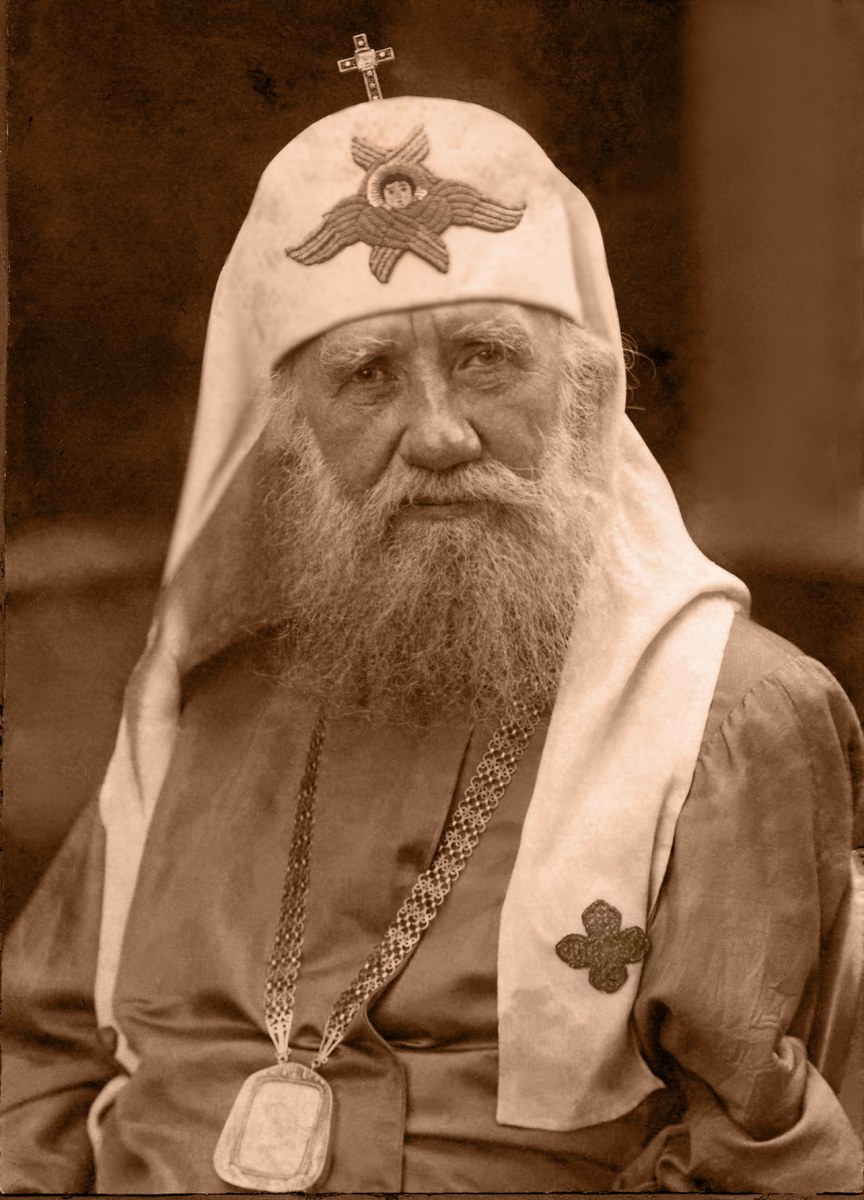
Tikhon is painted as a patriarch of Moscow: white-bearded, in the white patriarchal koukoulion with its seraphim, in sakkos and omophorion, right hand blessing, left holding the Gospel or the patriarchal staff; often with the Donskoy monastery or Saint Nicholas Cathedral in New York behind him, and in American icons with a scroll of his farewell to his American flock. He appears at the head of the composite icons of the New Martyrs and Confessors of Russia. As he reposed in 1925, photographs of him survive in abundance; every painted icon is a work of the post-1989 glorification and in copyright. The stored image is a photograph of the Patriarch himself (1917–1922, at the Trinity metochion), stored per the §50 ruling as a labelled lifetime portrait. A free-licensed painted icon remains the eventual want and is listed among the upgrade-wanted icons.