
Alexander Nevsky
The Holy Right-Believing Great Prince Alexander Nevsky, in schema Alexis
Prince · b. 1220 — d. 1263
Commemorated 30 August — Translation of relics to Saint Petersburg (1724), 23 November — Repose (1263); burial at Vladimir 1263
Alexander Nevsky (1220–1263) was Prince of Novgorod and Great Prince of Vladimir, the pre-eminent prince-saint of medieval Russia. In an age when the Russian lands were crushed between the Mongol Horde from the east and the Catholic military orders from the west, he won two celebrated victories in defence of Orthodox Rus — over the Swedes on the River Neva in 1240 (whence his surname) and over the Teutonic Knights on the ice of Lake Peipus (Chudskoe) in 1242 — while by patient, self-abasing diplomacy with the khans he shielded his people from annihilation and preserved the freedom of the Church. Refusing union with Rome, he held Russia to Orthodoxy. He died returning from the Horde, having received the monastic schema as Alexis, and was glorified by the Church in 1547. He is commemorated on November 23.

Origins and early life
Alexander was born on 30 May 1220 at Pereslavl-Zalessky, the second son of Prince Yaroslav II Vsevolodovich (in baptism Theodore, †1246) and his wife Theodosia, a Ryazan princess. His grandfather was Vsevolod the Big Nest, and through him Alexander belonged to the senior line of the descendants of Vladimir Monomakh. His elder brother, the boy-prince Theodore (†1233, commemorated June 5), died at fifteen on the eve of his wedding; the intended bride, a daughter of Michael of Chernigov, became instead the nun Euphrosyne of Suzdal (September 25). As a child Alexander received the "princely tonsure" — a rite of initiation to knighthood — in the Transfiguration Cathedral of Pereslavl at the hands of Bishop Simon of Suzdal, one of the compilers of the Kiev Caves Paterikon, who blessed him for military service in defence of the Russian Church and land.
From 1236 Alexander ruled as prince of Novgorod the Great, the wealthy northern republic guarding Russia's exposed western frontier. In 1239 he married the daughter of Prince Briacheslav of Polotsk (in baptism Alexandra), receiving from his father at the betrothal the wonderworking Theodore Icon of the Mother of God, before which he prayed thereafter throughout his life.
The Battle of the Neva (1240)
In 1240, while the Mongol invasion under Batu Khan was still ravaging the southern and central Russian principalities, a Swedish force under the command of the king's son-in-law — the sources name a "Birger" — sailed into the Neva to seize the Novgorodian lands and, the chroniclers say, to impose the Latin faith. Their envoy is remembered as sending Alexander the taunt: "Resist me if you can; I am already here, taking your land captive." The prince, not yet twenty, prayed long in the church of Holy Wisdom at Novgorod, received the blessing of Archbishop Spyridon, and went out against the enemy with a small force, exhorting his men with the words that became his motto: "God is not in strength but in truth." A warrior of his named Pelgui (in baptism Philip), keeping watch, is said to have seen at dawn a vision of the Holy Passion-Bearers Boris and Gleb standing in a boat, coming "to help their kinsman Alexander." On 15 July 1240 Alexander fell upon the Swedish camp and routed it, himself wounding the enemy commander in the face with his spear. From this victory on the Neva the people surnamed him Nevsky.
The Battle of the Ice (1242)
The victory did not remove the greater danger from the west. The crusading orders of the Baltic — the Teutonic Knights and the Sword-Brothers — pressed on the Russian marches, and in 1240–1242 they took the fortress of Koporye, then Pskov itself, boasting they would "subdue the whole Slavic people." (Novgorod, having quarrelled with its prince, had for a time driven Alexander out, only to recall him in haste.) In a swift winter campaign Alexander retook Koporye and liberated Pskov, and in the spring of 1242 he met the main force of the Order in a decisive battle on the frozen surface of Lake Peipus. Raising his hands to heaven, he prayed: "Judge me, O God, and plead my cause against an overweening people; help me, O Lord, as of old Thou didst help Moses against Amalek and my forefather Yaroslav against the accursed Svyatopolk." On 5 April 1242 the two armies clashed on the ice; the heavily armoured knights were broken and put to flight, cut down as they fled, and a multitude was led away captive. The Battle of the Ice secured Russia's western border and made Alexander's name famous, the chronicler says, "from the Egyptian Sea to Mount Ararat, and from the Varangian Sea to great Rome."
Diplomacy with the Horde
With the west made safe, the harder task remained: to preserve Russia under the Mongol yoke without provoking its destruction. From 1242 Alexander and his father travelled to the Horde; Metropolitan Cyril blessed the mission, which — in a phrase of the sources — demanded "the meekness of an angel and the wisdom of a serpent," to turn the Tatars from plunderers into tolerable overlords. Yaroslav was summoned onward to distant Mongolia and there poisoned, dying ten days after his kinsman Michael of Chernigov, who was martyred in the Horde for refusing its rites. Alexander inherited both his father's rank and his father's policy of alliance with the Golden Horde. He formed a friendship with Sartak, the son of Batu, who had accepted Christianity; and where other princes — Daniel of Galicia, his own brother Andrew, even Michael of Chernigov — sought Western help and papal alliance against the Mongols, Alexander, remembering the sack of Constantinople by the crusaders in 1204, refused to trust the Latin West. When envoys of Pope Innocent IV came in 1248 offering aid in exchange for submission to Rome, he answered that the Russians held fast to the faith of the Seven Ecumenical Councils: "this we know well, but your teaching we do not accept."
When in 1252 a rising against the Tatars, led by his brother Andrew, threatened a new devastation, Alexander journeyed again to the Horde to avert a punitive campaign; Andrew fled to Sweden, and Alexander became Great Prince of all Rus — of Vladimir, Kiev and Novgorod. In the years that followed he beat back a fresh German assault on Pskov (1253), made peace with Norway (1254), and led a campaign into Finland "through the polar night" (1256), bringing the Gospel into pagan lands. In 1261, through his efforts and those of Metropolitan Cyril, an Orthodox diocese of Sarai was established in the very capital of the Horde. In 1262, when many cities rose against the Tatar tribute-collectors and reprisal threatened, Alexander went a fourth and last time to the Horde and, by his intercession, turned away the danger; the khan Berke ceased sending tribute onward to Mongolia and made the Golden Horde in effect a shield for Russia against the east.
Repose
On the return journey from this last embassy Alexander fell gravely ill. Unable to reach Vladimir, he stopped at the Theophany (Fyodorovsky) Monastery at Gorodets on the Volga, where he received the great monastic schema with the name Alexis and gave up his spirit to God on 14 November 1263. When the news reached Vladimir, Metropolitan Cyril proclaimed in the funeral oration: "My children, know that the sun of the land of Suzdal has set — there will be no other prince like him." His body was borne nine days to Vladimir and remained incorrupt. On 23 November 1263, as he was about to be buried in the church of the Nativity Monastery, a wonder was seen: when the steward Sebastian and the Metropolitan wished to place in his hand the scroll of absolution, the dead prince stretched out his hand of himself and took it, then folded it again — a marvel that filled the beholders with awe.
Relics and translations
Alexander's relics rested at the Nativity Monastery in Vladimir, where his cultus grew and miracles were recorded, especially before national trials; tradition holds that he appeared on the eve of the Battle of Kulikovo (1380), at which point his relics were first uncovered. He was numbered among the saints at the Moscow council of 1547 under Metropolitan Macarius, and the canon to him was composed then by the monk Michael of Vladimir. In 1723–1724 the emperor Peter the Great, who had made the Neva the site of his new capital and taken Alexander as its heavenly patron, translated the relics with great solemnity to the Alexander Nevsky Lavra in Saint Petersburg; the translation is commemorated on August 30, the anniversary of the peace of Nystadt with Sweden. Peter decreed that the saint thereafter be depicted not as a monk but in princely and martial robes. The relics survived Soviet confiscation and museum captivity and were returned to the Lavra in 1989.
Veneration and later cultus
Alexander Nevsky became, and remains, the archetype of the holy warrior-prince of Russia, invoked as a defender of the fatherland and of Orthodoxy. Churches and monasteries without number bear his name; the Imperial Order of Saint Alexander Nevsky (1725) and later Soviet and Russian military decorations carried it into modern times, and Sergei Eisenstein's 1938 film fixed the Battle of the Ice in the national imagination. The Church honours him above all for holding Rus to the Orthodox confession at the price of a lifetime of humiliating journeys to the Horde — a sanctity of self-sacrificing statesmanship rather than of the cloister, though he ended his life a monk.
Feast and commemoration
Alexander is commemorated on November 23 (church date; Old Calendar civil December 6), the day of his burial and of the wonder at Vladimir, as his principal feast; this is the day kept by the Russian Orthodox Church and the OCA. His translation of relics to Saint Petersburg (1724) is kept on August 30. Local Russian calendars also mark the first uncovering of his relics (1380). The feast falls within the Nativity Fast and the afterfeast of the Entry of the Theotokos.
Hymns
Troparion — Tone 4
As a most honoured branch of a godly root wast thou, O blessed Alexander; for Christ revealed thee as a divine treasure of the Russian land, a new wonderworker glorious and well-pleasing to God. And today, gathered in faith and love for thy memory, in psalms and hymns we rejoice and glorify the Lord, who gave thee the grace of healings. Entreat Him to save this city, that the realm of Russia may be pleasing to God, and that the sons of Russia may be saved.
Original translation from the Slavonic
Kontakion — Tone 8
As a most radiant star we honour thee, who didst shine forth from the east and come unto the west; for thou dost enrich all this land with wonders and goodness, and dost enlighten those who with faith honour thy memory, O blessed Alexander. Therefore today we, thy people, keep the feast of thy repose. Pray for the salvation of thy fatherland and of all who draw near to the shrine of thy relics and who faithfully cry to thee: Rejoice, O confirmation of our city.
Original translation from the Slavonic
Magnification
We magnify thee, O right-believing prince Alexander, and we honour thy holy repose, for now thou dost entreat for us Christ our God.
Original translation
Appointed readings
Epistle — Galatians 5:22–6:2
22But the fruit of the Spirit is love, joy, peace, longsuffering, gentleness, goodness, faith, 23Meekness, temperance: against such there is no law. 24And they that are Christ’s have crucified the flesh with the affections and lusts. 25If we live in the Spirit, let us also walk in the Spirit. 26Let us not be desirous of vain glory, provoking one another, envying one another. 1Brethren, if a man be overtaken in a fault, ye which are spiritual, restore such an one in the spirit of meekness; considering thyself, lest thou also be tempted. 2Bear ye one another’s burdens, and so fulfil the law of Christ.
Gospel — Matthew 11:27–30
27All things are delivered unto me of my Father: and no man knoweth the Son, but the Father; neither knoweth any man the Father, save the Son, and he to whomsoever the Son will reveal him. 28Come unto me, all ye that labour and are heavy laden, and I will give you rest. 29Take my yoke upon you, and learn of me; for I am meek and lowly in heart: and ye shall find rest unto your souls. 30For my yoke is easy, and my burden is light.
Iconography
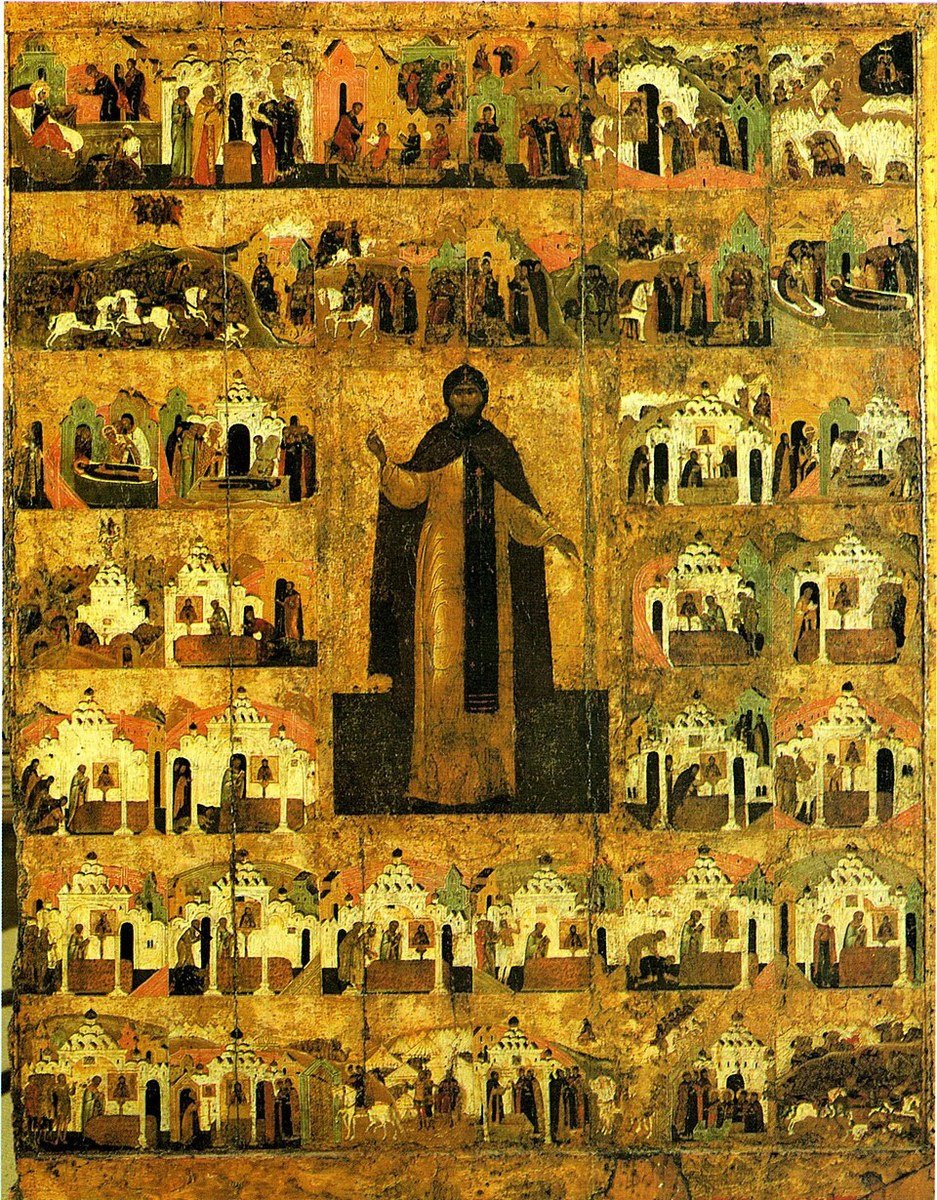
The iconography of Alexander Nevsky changed with his cultus. Before Peter the Great he was most often depicted as a monk — in the schema, with the name Alexis — in keeping with his death as a monastic; from 1724 imperial decree required that he be shown as a prince, in armour and princely mantle, sometimes crowned, holding a sword or a cross, and mounted icons show him as a rider. Vita icons (житийные иконы) surround the central figure with scenes of his life — the Neva battle, the Battle of the Ice, the embassies to the Horde, his repose and the wonder at the tomb. The stored image is a sixteenth-century Russian vita icon (from the collection of Saint Basil's Cathedral, Moscow), showing the saint in the earlier, monastic type with his life in the border scenes.
Disputed questions
- The scale of the western battles. Russian chronicle accounts and the later Life magnify the Neva and Peipus victories; some modern historians, weighing the terse Novgorod and Western (Livonian) sources, judge the engagements smaller than the tradition paints, though not their strategic importance for Orthodox Russia's survival on that frontier.
- The eastern policy. Alexander's cooperation with the Horde has been read both as saintly prudence that saved the Church and as collaboration; the Orthodox tradition, and this entry, follow the former reading, which the sources themselves already advance.
- Not to be confused with the various martyr-companies led by men named Alexander in the ancient calendar; the prince is distinguished by his epithet Nevsky.