
Alexis the Man of God
Our Venerable Father Alexis the Man of God
Venerable · b. late 4th century, at Rome — d. c. 411, at Rome
Commemorated 17 March — Repose at Rome, in his father's house
Alexis the Man of God (died c. 411) is one of the most beloved saints of the undivided Church — a young Roman nobleman who, on his own wedding day, left his bride untouched at the bridal chamber and fled his father's palace to live as a nameless beggar. For seventeen years he begged at the doors of a church in Edessa of Syria, where a vision of the Mother of God revealed him as "the man of God"; when his fame grew unbearable he fled again, and Providence carried him back to Rome and to the very house of his father Euphemianus. There, unknown, he lived seventeen more years as a servant under the stairs of his own home, enduring the mockery of the household slaves and the daily grief of parents and wife who did not know him. Only at his death was he revealed — by a writing found clutched in his hand, which told his whole story — and Rome wept over the beggar it had trampled. He is kept on March 17, honoured as ὅσιος, "the man of God," the pattern of hidden sanctity and voluntary poverty.
_01_by_shakko.jpg)
The legend and its origins
The story of Alexis "the man of God" is among the most widely told of all Christian lives — carried from Syria to Byzantium to the Latin West, translated into more languages than almost any other hagiography, and sung in the medieval vernaculars of half of Europe. It is right to say at the outset what kind of text it is. The tale is a hagiographical romance, whose earliest layer is Syriac and whose historical kernel — if there is one — is a single anonymous ascetic. The oldest form of the legend, current at Edessa by the fifth century, knows only of a nameless holy beggar, "the Man of God," a Roman of senatorial family who forsook a bride and lived in secret poverty at the door of the church of Edessa, his identity disclosed only after his death to the bishop Rabbula (bishop of Edessa 412–435) and the church's sacristan. This Syriac "Man of God" has no name.
The name Alexis (Ἀλέξιος, "defender") and the celebrated second half of the story — the return to Rome, the seventeen years unrecognised under the stairs of his father's house, the writing found in his dead hand — belong to a later, Byzantine expansion of the legend, which fused the anonymous Edessene beggar with a returning son and gave the whole its unforgettable dramatic shape. From Greek the fuller legend passed into Latin (tenth century, at Rome, tied to the church of Sant'Alessio on the Aventine), and thence into the whole of Western literature. The Church, East and West, has received and loved the developed legend as it stands; a faithful account tells it in that form, while noting honestly that its historical substratum is thin and its second half a later growth. What is beyond doubt is the antiquity of the cult of "the Man of God" and the spiritual truth the tale was fashioned to carry.
Flight from the bridal chamber
Alexis, the legend runs, was the only son of Euphemianus, a Christian senator of Rome of great wealth and greater charity — a man who kept three tables spread daily for the poor, the orphan, and the pilgrim — and of his wife Aglaïs. The child, long prayed for and born to them in their old age, was raised in piety and learning. When he came of age his parents chose him a bride of the imperial house and made a great wedding. But Alexis had already given his heart to Christ alone. On the wedding night, in the bridal chamber, he gave his bride back her ring and his belt-buckle wrapped in a cloth, charged her to keep them and to wait upon the Lord, and — while the house slept — slipped away. Taking ship, he sailed east, came at length to Edessa in Syria (where the image of Christ "not made by hands" was venerated), and there distributed the last of the money he had brought, put on the rags of a beggar, and vanished into the anonymous poverty he had chosen.
Seventeen years at the door of the church in Edessa
For seventeen years Alexis lived as one of the beggars at the portico of the church of the Most Holy Theotokos in Edessa. He took each day only what would keep him alive, gave the rest to the other poor, spent his nights in vigil, and communed each Sunday of the Holy Mysteries. No one knew who he was. Meanwhile his father, distraught, had sent servants through the empire to find his lost son; some of them came even to Edessa and gave alms — the legend's most piercing touch — to the very beggar who was their master's son, and he, recognising them, took their charity in silence and thanked God that he was permitted to receive alms in his own household's hand without being known.
His hiddenness was broken by heaven. The icon of the Mother of God in the church spoke — or the sacristan who kept the church was told in a vision — bidding that "the Man of God" be brought in, for he was worthy, and his prayer rose like incense before God. When the people began to seek out and honour the holy beggar thus revealed, Alexis, who had fled fame once, fled it again: he left Edessa secretly, meaning to sail to Tarsus and hide in some other city.
Return to Rome, and the servant under the stairs
But the ship was driven by contrary winds — by the hand of God, the legend says — to the port of Rome. Alexis took this as a sign, and formed a design of a severity that is the heart of the story: he would return to his father's own house and live there unknown, hidden not in a far country but in the midst of those who loved and mourned him. He came to Euphemianus — who did not know the gaunt, weathered beggar for his son — and begged, "for the love of thy own son who is far away," a corner to lodge in and the leavings of the table. The tender-hearted senator, moved by the stranger's mention of his lost boy, gave him a place beneath the staircase of the house and a servant to bring him food.
There Alexis lived seventeen more years. Under the stairs of his own home he heard, day by day, the grief of his father, the weeping of his mother, and the lament of the bride who had kept faith and would not leave her husband's house — "like a turtle-dove that has lost her mate," the legend has her say. The household servants, contemptuous of the ragged pensioner, mocked him, emptied their dishwater over his head, and made him the butt of the kitchen; and Alexis received all of it as from the hand of God, never once betraying himself, keeping his fast and his vigil, and offering his silent endurance for the salvation of those who did not know they tormented their own beloved. It is this second, harder hiddenness — sanctity endured not in the desert but at home, amid the very affections it renounced — that made the legend unforgettable and gave Alexis his enduring place in the Church's imagination.
Repose and the writing in his hand
Foreseeing his death, Alexis asked for paper and ink and wrote out his whole life — his birth, his flight, the tokens left with his bride, his years at Edessa and his years beneath the stairs — and kept the scroll in his hand. He died in his corner; and at the same hour, the legend relates, a voice was heard in the churches of Rome, at the Liturgy attended by the emperors Honorius and Arcadius and by Pope Innocent I, crying, "Seek the Man of God, that he may pray for Rome." The search led at last to the house of Euphemianus, and to the dead beggar under the stairs, his face shining, the scroll gripped fast in his fingers. It could not be prised from his hand until the Pope himself, at the public reading, took it; and as the writing was read aloud, the whole household — father, mother, and bride — knew at once whom they had housed and mourned and scorned, and the city was filled with weeping and wonder. His body, laid in the church, was found to work healings, and a fragrance of myrrh rose from it. He was buried with the honour Rome had denied the living beggar, about the year 411.
Relics and cultus
The developed Latin legend attaches the saint's relics and cult to the church of Santi Bonifacio e Alessio on the Aventine Hill in Rome, where a medieval staircase-relic is shown as "the stairs of Alexis," and where the Greek-speaking monastic community that flourished there in the tenth century did much to spread his fame westward. In the East his memory was kept from early date at Constantinople and throughout the Byzantine world; the Great Synaxaristes and the Slavic Prolog carry his life at March 17, and Russia held him in especial love — Alexis became a favoured baptismal name of the Muscovite house, and Tsar Alexis Mikhailovich (reigned 1645–1676), born on the saint's eve, bore his name and multiplied his icons. The saint's Syriac homeland kept the Man of God as its own; his story, in its anonymous first form, is one of the treasures of Syriac hagiography.
Feast and commemoration
Alexis is kept universally on March 17 (church date; Old Calendar civil March 30), the day of his repose in his father's house at Rome. In the Byzantine calendars — Greek, Antiochian, and Slavic alike — the day belongs to him as its chief commemoration. Because March 17 falls within Great Lent, whose bounds are movable, on the weekdays of the fast the full Liturgy is not served and the readings follow the Lenten cycle; his office is sung at the Lenten services, and where the day falls on a Saturday or Sunday of the fast the proper hymns are joined to those of the resurrection or of the departed. In Russian usage his memory carried a particular civic weight through the sovereigns who bore his name.
Hymns
Troparion — Tone 4
Raised on high unto virtue and having purified thy mind, thou didst attain unto the Desired and Uttermost Good, O our father Alexis; adorning thy soul with the graces of dispassion, and taking up unceasing prayer as a shield, thou didst live as one of the bodiless powers. Intercede with Christ our God that our souls may be saved.
Original translation from the Slavonic
Kontakion — Tone 2
Regarding thy parents' house as a stranger's, thou didst dwell therein in the guise of a beggar; and at thy departure from this life, receiving a crown of glory, thou wast shown wondrous upon the earth, O Alexis, man of God, thou joy of the angels and of men.
Original translation from the Slavonic
Iconography
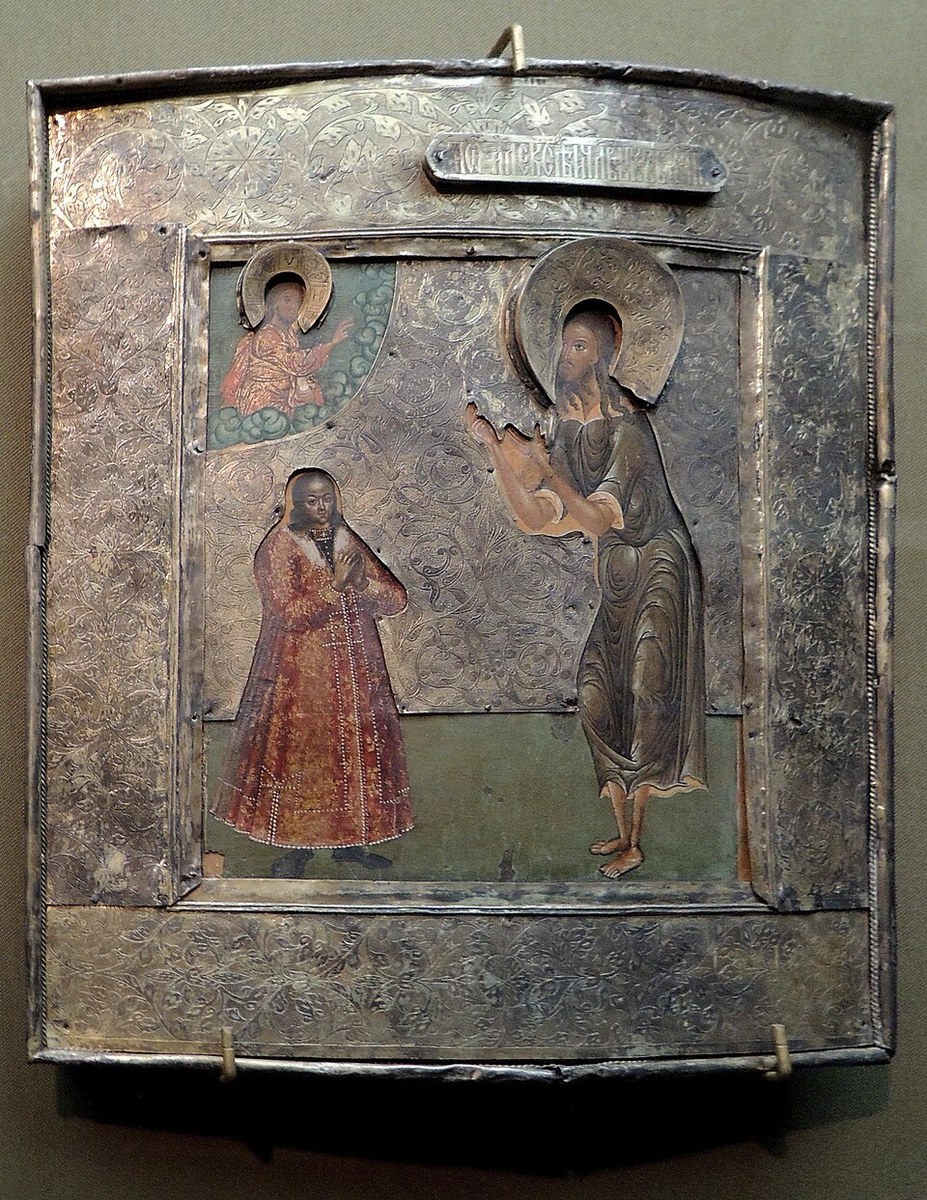
Alexis is depicted as a young ascetic — beardless or with a thin youthful beard, his hair unkempt, wasted by fasting — in the poor tunic of a beggar, often holding a scroll, the writing found in his hand that told his story; the scroll is his sure attribute, and its unfurled text names him. His most characteristic narrative image is the death scene: the beggar lying dead beneath the staircase of a great house, the scroll gripped in his fingers, while his father, mother, and bride, and the Pope with the emperors, gather about in grief and wonder — the whole drama of the legend compressed into one panel, common in Russian vita-icons (icons with the life told in surrounding scenes) and in Western art alike, where the "stairs of Alexis" became a standing motif.
The stored image is a second-half-of-the-17th-century Moscow panel icon of the saint held in the Tretyakov Gallery: Alexis the Man of God standing in prayer, in the settled portrait type of the young ascetic (source, public domain as a faithful reproduction of a pre-1900 work, pd-old-work).
Disputed questions
- History and legend. No independent historical source attests Alexis as an individual. The Syriac "Man of God" of Edessa (fifth century, connected with Bishop Rabbula) is the oldest kernel; the name Alexis and the Roman "return" are a Byzantine development, and the Latin cult on the Aventine is later still. Scholars accordingly treat the vita as a hagiographical romance built on the memory of an anonymous ascetic, not as biography. The Church commemorates the saint the tradition transmits; this entry relates the received legend and marks its layers rather than asserting a documentary life.
- Dating and reign. The legend synchronises the saint's death with the emperors Honorius and Arcadius and Pope Innocent I (all of the years around 400–417), yielding the conventional date c. 411; the Wikidata record gives 412. These are the dates of the legend's frame, not of an attested repose, and are given with "c."
- His classification as "venerable." Both the Greek (ὅσιος) and the Slavic (преподобный) calendars style Alexis a venerable, the term proper to monastic saints — yet he took no monastic vows and lived his whole ascesis in the world, as a beggar and a household servant. The Church applies the title to his hidden, monastic-like life of poverty, chastity, and unceasing prayer; the entry follows that usage (see TAXONOMY, usage rule 3), while noting that his state of life was that of a lay ascetic, not a professed monk.
- Not to be confused with Alexis, Metropolitan of Moscow (†1378, kept February 12), the wonderworking hierarch and statesman of medieval Russia — a wholly different saint of a wholly different age. "The Man of God" belongs to the Roman ascetic alone.