
Alexis of Moscow
Our Father among the Saints Alexis, Metropolitan of Kiev and All Russia, Wonderworker
Bishop · Wonderworker · b. c. 1292–1305, at Moscow (baptised Eleutherius) — d. February 12, 1378, at Moscow
Commemorated 12 February — Repose at Moscow, 1378, 20 May — Uncovering of his relics at the Chudov Monastery, 1431
Alexis (c. 1292/1305 – 1378) was Metropolitan of Kiev and All Russia and one of the great architects of Muscovite Russia — a saint remembered equally as a wonderworking hierarch and as a statesman who held the Russian land together in a perilous age. Born Eleutherius, of a boyar family of Chernigov settled at Moscow, he was a monk of the Theophany monastery for over twenty years before his elevation, and Metropolitan from 1354. Twice he journeyed to the Golden Horde; there, at the Khan's summons, he healed Taidula, the mother of the Khan, of blindness, and won by it protection and privileges for the Church. As guardian and regent for the boy-prince Demetrius Donskoy, he steadied the throne of Moscow and reconciled its warring princes. He founded the Chudov (Miracle) Monastery in the Kremlin and other houses, and reposed on February 12, 1378. His relics, uncovered incorrupt in 1431, made him one of the beloved wonderworkers of Russia and one of the Hierarchs of Moscow.

Origins and monastic years
The future metropolitan was born at Moscow, of the noble Byakont family, boyars of Chernigov who had removed to the rising city of Moscow and stood high in the service of its princes; his father Theodore was a leading man of the court, and the grand prince himself, it is said, was his godfather. He was baptised Eleutherius. The tradition tells that as a boy, snaring birds in a field, he fell asleep and heard a voice: "Alexis, why dost thou labour in vain? Thou shalt be a fisher of men" — a word that turned his heart to God and gave him, in prophecy, the name he would bear. About the age of twenty he entered the Theophany (Bogoyavlensky) monastery at Moscow and received the tonsure with the name Alexis; there for some twenty years and more he lived in strict ascetic obedience, under teachers among whom was Stephen, the elder brother of Sergius of Radonezh, so that Alexis and the great abbot of the Trinity were bound in a lifelong friendship that shaped the whole age.
Bishop, and Metropolitan of All Russia
His gifts could not stay hidden. The Metropolitan Theognostus drew him from the monastery, placed him over the ecclesiastical courts of the metropolia — the office of namestnik — for a dozen years, and about 1352 consecrated him Bishop of Vladimir, designating him his successor. On the death of Theognostus in 1353 Alexis was chosen metropolitan, and in 1354 travelled to Constantinople, where the Patriarch Philotheus (in a later journey; the earlier confirmation was under Patriarch Kallistos) confirmed him as Metropolitan of Kiev and All Russia, with his seat at Vladimir and Moscow. He thus became the chief hierarch of the whole Russian Church at the moment when the primacy among the Russian principalities was passing decisively to Moscow, and his own labours did much to fix it there.
The Horde, and the healing of Taidula
Russia in the fourteenth century lay under the Tatar yoke, and the metropolitan, as the natural intercessor of his people, had perforce to deal with the Golden Horde. The most famous event of Alexis's life belongs to this necessity. The Khan's mother (in the sources his wife or mother-queen), Taidula, had been struck blind; hearing the fame of the Russian metropolitan's holiness, the Khan Djanibek sent to Moscow demanding that Alexis come and heal her, with veiled threats against the Russian land should he fail. Alexis went, humbling himself before God, unsure of so great a thing; and the tradition relates that at his departure a candle by the tomb of Metropolitan Peter lit of itself, a sign of favour. Coming to the Horde, he prayed over Taidula, sprinkled her with holy water, and she received her sight. The Khan and his court were filled with wonder, and Taidula loaded the metropolitan with gifts and granted the Russian Church renewed privileges and protection — and, the tradition holds, the very plot of land in the Moscow Kremlin on which Alexis would raise his monastery. The healing set the seal on his authority, Tatar and Russian alike.
Regent of Moscow
When the grand prince Ivan II died in 1359, leaving his son Demetrius (the future Demetrius Donskoy) a child of nine, it was Alexis who became in effect the regent and guardian of the Muscovite state — the head not only of the Church but of the government during the prince's minority. In those years he held the young principality together against rival claimants and the intrigues of Tver, Suzdal, and Lithuania, using the weight of his office (and, at need, the censures of the Church) to reconcile the princes and bind them to Moscow. It was under his tutelage that Demetrius grew to the ruler who would break the Horde's terror at Kulikovo in 1380 — two years after the metropolitan's death. Alexis's work of forming, in the person of the boy-prince and the institutions of the Church, the coming greatness of Moscow is why he is honoured as a father of the Russian nation as well as a saint.
Monastic foundations, and repose
Alexis was a great founder of monasteries. On the ground given him at the Horde he raised within the Kremlin the Chudov (Miracle) Monastery, dedicated to the Miracle of the Archangel Michael at Chonae, in thanksgiving for the healing of Taidula; he founded the Savior "Not-Made-by-Hands" (Spaso-Andronikov) monastery about 1361, in fulfilment of a vow made in a storm at sea on his return from Constantinople (he had vowed to build a church to whatever the Church commemorated on the day of his safe landing — August 16, the Icon Not-Made-by-Hands); and he established women's cenobitic communities as well. He governed the Church for twenty-four years, into great old age. He reposed on February 12, 1378, and was buried, as he had asked, in his own Chudov Monastery in the Kremlin.
Relics and cultus
Some fifty years later, about 1431, the wooden church over his tomb having fallen, his relics were found incorrupt; from their uncovering the veneration of Alexis as a wonderworker grew, and his feast was established. His relics remained one of the treasures of the Kremlin — carried out and preserved through the destruction of the Chudov Monastery under the Soviet regime, and now enshrined in the Theophany (Yelokhovo) Cathedral at Moscow. He was numbered among the great First Hierarchs of Moscow — Peter, Alexis, and Jonah — whose joint feast Patriarch Job established in 1596 (and to whom Philip and Hermogenes were later joined); the Synaxis of the Moscow Hierarchs is kept on October 5.
Feast and commemoration
Alexis is kept on February 12 (church date; Old Calendar civil February 25), the day of his repose, and on May 20 (Old Calendar civil June 2) for the uncovering of his relics in 1431. He is further commemorated among the Hierarchs of Moscow in their synaxis on October 5, and among the synaxes of the saints of Moscow and of Russia. His feasts are kept in the Russian Orthodox Church and by the Orthodox Church in America; he is not generally on the Greek calendar. Russian usage keeps his day with the blue vestments of a hierarch's feast.
He is not to be confused with Alexis the Man of God (†c. 411, kept March 17), the Roman ascetic who lived hidden as a beggar — a wholly different saint of a far earlier age, though he shares this hierarch's name.
Hymns
Troparion — Tone 8
As one enthroned together with the Apostles, a most excellent physician and a well-pleasing servant, we run to thy precious shrine, O God-wise hierarch Alexis, O wonderworker; gathered together in love, we keep thy memory in brightness, rejoicing in psalms and hymns and glorifying Christ, who hath given thee such grace of healings, and to thy city a great confirmation.
Original translation from the Slavonic
Kontakion — Tone 8
Let us all the faithful people faithfully hymn, and with love call blessed, the divine and most honoured hierarch of Christ, the new wonderworker Alexis, as a great shepherd, a servant, and a most wise teacher of the land of Russia. Today, running together to his memory, let us joyfully cry out a song to the God-bearer: since thou hast boldness before God, deliver us from manifold afflictions, that we may cry to thee: Rejoice, O confirmation of our city.
Original translation from the Slavonic
Iconography
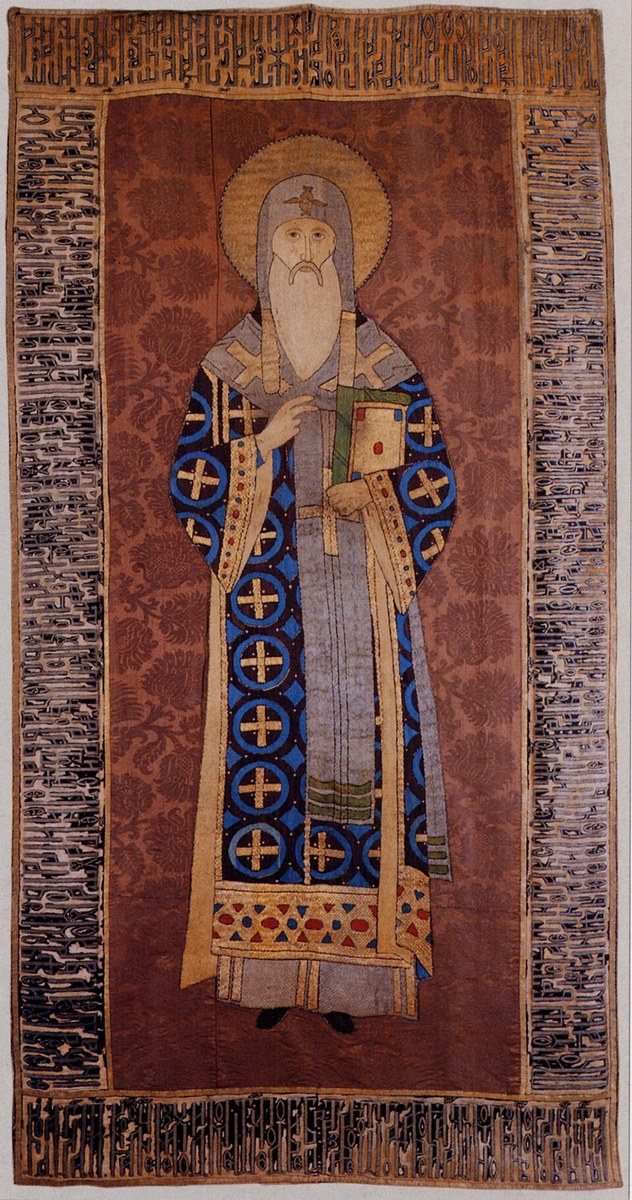
Alexis is depicted as a Russian metropolitan of the fourteenth century: an aged, white-bearded hierarch, vested in the sakkos or phelonion and the great cross-figured omophorion, wearing the white metropolitan's klobuk, his right hand raised in blessing and his left holding the Gospel. He is often paired with the Metropolitan Peter of Moscow, or with Sergius of Radonezh his friend; a distinct hagiographic type shows his figure surrounded by border-scenes of his Life — the vision of the birds, the healing of Taidula, the founding of the Chudov monastery, his repose, and the finding of his relics. The stored image is an embroidered figure of the saint of the sixteenth century, from the workshop of Grand Duchess Elena Glinskaya, an example of the Muscovite art of the "painting with the needle" (source, public domain, pd-old-work — a faithful reproduction of the pre-1900 embroidery).