
Alexis Toth
Saint Alexis Toth, Confessor and Defender of Orthodoxy in America
Confessor · Priest · b. 18 March 1854, in the Carpathian lands of Austria-Hungary — d. 7 May 1909, at Wilkes-Barre, Pennsylvania
Commemorated 7 May — Repose at Wilkes-Barre
Alexis Toth (1854–1909) was a Carpatho-Russian priest of the Greek Catholic (Uniate) Church who came to Minneapolis in 1889, was refused recognition by the Roman Catholic archbishop of the place, and in consequence returned with his congregation to the Orthodox faith of his ancestors — the beginning of the largest single movement of return to Orthodoxy in the history of the American Church. For eighteen years he travelled the mining and mill towns of Pennsylvania and the Midwest, teaching the difference between Orthodoxy and the Union, and brought some seventeen parishes and many thousands of Carpatho-Russian and Galician immigrants into the Orthodox Church. He died at Wilkes-Barre on 7 May 1909, worn out and poor, and was glorified in 1994; his relics rest at Saint Tikhon's Monastery in South Canaan, Pennsylvania. He is styled Confessor and Defender of Orthodoxy in America.

Origins and formation
He was born on 18 March 1854, in the Carpathian lands of the Hungarian kingdom, into a poor Carpatho-Russian clerical family: his father and his brother were Greek Catholic priests and his uncle a Uniate bishop. He was well educated by the standards of any clergy of his day, taking his studies at Uzhhorod, at the seminary of Presov, and in a Latin faculty besides, and he read and spoke Carpatho-Russian, Hungarian, Russian, German and Latin, with Greek enough to use.
He was ordained on 18 April 1878, having married Rosalie Mihalich; his wife and their infant child died soon afterwards, and he did not marry again. He served as secretary to his bishop, as director of an orphanage, and then as professor of Church History and Canon Law in the seminary at Presov — an appointment that mattered greatly for what followed, since he came to America already knowing, in detail and from the sources, how the Union of his people had been made and what it had cost them.
Minneapolis and Archbishop Ireland
In 1889 he was assigned to the Greek Catholic parish of Saint Mary in Minneapolis, arriving among a congregation of Carpatho-Russian immigrant workers. Following the discipline then expected, he presented himself in December of that year to John Ireland, the Roman Catholic Archbishop of Saint Paul, to ask for faculties in the diocese.
Ireland refused him. The archbishop was the leading advocate of the "Americanisation" of Catholic immigrants — one Latin church, one language, one discipline — and had no wish to see an Eastern rite, a Slavonic liturgy, or a clergy drawn from a married priesthood established in his territory; he held besides that Toth, as a widower who had been married, was irregular. He declined to recognise him as a priest, forbade his people to attend his services, and let it be understood that the parish should conform. Toth, deprived of standing and under threat even of removal from the country, did the thing that the archbishop had not imagined: he put the question to his parishioners, and proposed that they seek out the Russian Orthodox bishop.
The return to Orthodoxy
There was such a bishop, far off in San Francisco: Vladimir (Sokolovsky), of the Russian diocese of the Aleutians and Alaska. Toth wrote, was answered, and on 25 March 1891 — the feast of the Annunciation — the bishop received Father Alexis and 361 of his parishioners into the Orthodox Church. It was not a conversion in their own understanding of it but a homecoming: the argument Toth put to his people, and afterwards to thousands of others, was that the Union had been an arrangement imposed on their grandfathers, that the faith of the Carpathian Rus' before it had been Orthodox, and that they were returning to what was theirs.
The mission
The Russian bishops in America recognised at once what they had been given: a learned, tireless, plain-speaking priest who came from exactly the people they could not otherwise reach. He was sent out to preach through the immigrant settlements — the anthracite towns of eastern Pennsylvania, the mills of the Midwest — where the Carpatho-Russian and Galician Uniates had come in tens of thousands and where the same conflicts with the Latin hierarchy were repeating themselves parish by parish. He had already, in 1890, presided at a meeting of Uniate priests at Wilkes-Barre called to consider their position; from 1891 he was the acknowledged leader of the movement.
His method was catechetical rather than agitational. He wrote and spoke about the history of the Union, about the differences between Orthodoxy, Roman Catholicism and the Protestantism the immigrants also met in America, and about what a parish owed to its bishop; and he insisted on the ordinary means — schools, brotherhoods, the Slavonic services properly sung. By his death some seventeen parishes had come over through his labours, and with them many thousands of people; the Orthodox Church in America's Carpatho-Russian and Galician character dates substantially from this work. It was supported financially from Russia, by the Holy Synod and by imperial subvention — a fact his opponents used against him and which he never concealed.
He served latterly in Pennsylvania, at Wilkes-Barre and at Mayfield, and gave what he had, including his own savings, to the founding of monastic life and of a seminary for the American mission. He lived poorly, worked past his strength, and reposed on 7 May 1909, having been for some time in failing health.
Glorification and relics
His grave became a place of pilgrimage among the Carpatho-Russian faithful almost at once, and the memory of "Father Alexis Toth" was preserved in the parishes he had brought over long before any official act. Miracles were reported at his intercession, one of them in January 1993, and the Orthodox Church in America glorified him in 1994 with the title Confessor and Defender of Orthodoxy in America. His relics rest at Saint Tikhon's Monastery, South Canaan, Pennsylvania, the house he had helped to found.
Feast and commemoration
7 May (church date; Old Calendar civil 20 May), the day of his repose, kept by the Orthodox Church in America, in whose calendar he stands among the North American saints, and honoured particularly in the Carpatho-Russian parishes of Pennsylvania and in the Midwest. His principal shrine is Saint Tikhon's Monastery at South Canaan. He is not on the Greek or Slavonic universal calendars. On the same day the Church keeps the Sign of the Cross which appeared over Jerusalem, the martyr Acacius the Centurion and Nilus of Sora.
Hymns
Troparion — Tone 4 (common of a confessor)
O righteous father Alexis, thou wast an unshaken pillar of the Church in a strange land, and by thy teaching thou didst lead a scattered people home to the faith of their fathers; enduring reproach and poverty for the truth, thou didst gather the flock of Christ in the new world. Wherefore intercede with Christ God that our souls may be saved.
Original translation from the Greek
Appointed readings
Epistle — Galatians 1:11–19
11But I certify you, brethren, that the gospel which was preached of me is not after man. 12For I neither received it of man, neither was I taught it, but by the revelation of Jesus Christ. 13For ye have heard of my conversation in time past in the Jews’ religion, how that beyond measure I persecuted the church of God, and wasted it: 14And profited in the Jews’ religion above many my equals in mine own nation, being more exceedingly zealous of the traditions of my fathers. 15But when it pleased God, who separated me from my mother’s womb, and called me by his grace, 16To reveal his Son in me, that I might preach him among the heathen; immediately I conferred not with flesh and blood: 17Neither went I up to Jerusalem to them which were apostles before me; but I went into Arabia, and returned again unto Damascus. 18Then after three years I went up to Jerusalem to see Peter, and abode with him fifteen days. 19But other of the apostles saw I none, save James the Lord’s brother.
Gospel — John 10:1–9
1Verily, verily, I say unto you, He that entereth not by the door into the sheepfold, but climbeth up some other way, the same is a thief and a robber. 2But he that entereth in by the door is the shepherd of the sheep. 3To him the porter openeth; and the sheep hear his voice: and he calleth his own sheep by name, and leadeth them out. 4And when he putteth forth his own sheep, he goeth before them, and the sheep follow him: for they know his voice. 5And a stranger will they not follow, but will flee from him: for they know not the voice of strangers. 6This parable spake Jesus unto them: but they understood not what things they were which he spake unto them. 7Then said Jesus unto them again, Verily, verily, I say unto you, I am the door of the sheep. 8All that ever came before me are thieves and robbers: but the sheep did not hear them. 9I am the door: by me if any man enter in, he shall be saved, and shall go in and out, and find pasture.
Iconography
Saint Alexis is painted in the manner developed for the modern confessor-priests: a middle-aged man of broad face and full dark beard, in priestly vesting — phelonion and stole, with the pectoral cross — the right hand raised in blessing and the left holding the Gospel or a scroll; where a scroll is given it commonly carries a phrase from his preaching on the return to the faith of the fathers. Because he lived into the age of photography, the icon painters have worked from portraits, and the likeness is deliberate: he is one of the American saints whose icons are recognisably of a particular person rather than of a type. Distinguishing attributes are the church he served shown in miniature at his side, and, in some compositions, a group of his people behind him. Icons of him hang in the Carpatho- Russian parishes of Pennsylvania and at his shrine at South Canaan.
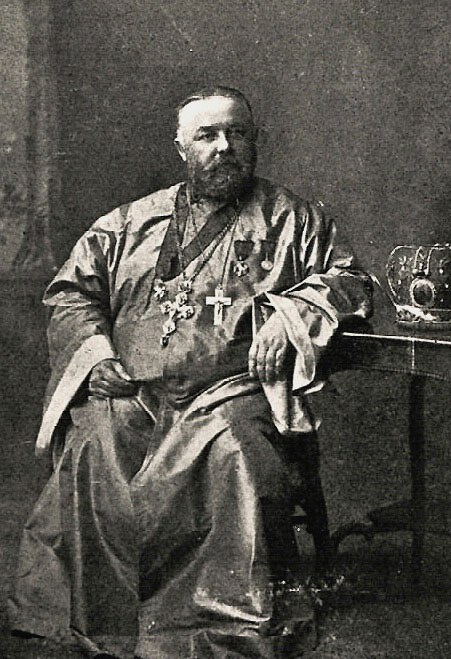
All such images are the work of living or recently living painters and are under copyright; nothing storable under this collection's icon policy exists for him, since his cultus begins in the twentieth century. Photographs of him survive from the 1890s and are of historical value; the §50 ruling now admits one below, labelled a portrait and not an icon — resolving this entry's earlier refusal.
The stored image is a photograph of the saint (before 1909), seated with the mitre of his elevation at his side — stored per the §50 ruling, which resolved this entry's earlier refusal. A free-licensed painted icon remains the eventual want and is listed among the upgrade-wanted icons.
Disputed questions
- "Confessor" and not "martyr." He suffered no violence and died in his bed; the title is used in the strict sense defined for this corpus — one who suffered for the faith in obstruction, poverty, litigation and public abuse without dying of it. Contemporary polemic against him was severe, and much of the difficulty of his mission was legal and financial: parishes were fought over in the civil courts.
- The reading of the Minneapolis affair. Orthodox accounts present Archbishop Ireland's refusal as the immediate cause of the return, and it was; Roman Catholic historians have stressed the wider canonical confusion about Eastern clergy in America in those years, which Rome only regulated later. Both are true, and the entry records the disagreement rather than resolving it.
- Numbers. The figures usually given — 361 received in 1891, seventeen parishes and some tens of thousands of people by 1909 — come from the mission's own reporting and from later commemorative literature, and should be read as good orders of magnitude rather than as a census.