
Nilus of Sora
Our Venerable Father Nilus, Abbot of Sora, the Wilderness-dweller
Venerable · b. c. 1433 — d. 7 May 1508, at his skete on the river Sora
Commemorated 7 May — Repose at the Sora skete
Nilus of Sora (c. 1433–1508), called in Russian Nil Sorsky, is the greatest representative of the contemplative tradition in the Russian Church and the founder of the skete life in Rus. Born of the Moscow gentry, tonsured at the monastery of Saint Cyril of White Lake, he spent years on Mount Athos and in the Christian East learning hesychasm at its source, and returned to build in the marshes of the river Sora a settlement of a few silent monks living apart in their cells under a written Rule of his own composition — the first sustained treatise on inward prayer written in Slavonic. He taught the guarding of the heart, the prayer of the mind, and the discernment of thoughts; he refused for his monastery all landed property, peasants, adornment and endowment; and as the acknowledged head of the "non-possessors" he stood at the Council of 1503 against monastic landholding. He asked in his testament that his body be thrown out into the wilderness for the beasts, since he had done nothing in this life worth honour.

Origins and early life
He was born about 1433, most probably at Moscow, and bore in the world the family name Maykov; his baptismal name is given by some accounts as Nicholas. His people belonged to the service gentry rather than the great boyar houses: his brother Andrei Fyodorovich Maykov rose to be a d'yak — a state secretary — in the chancery of the Grand Prince Ivan III, and Nilus himself is thought to have been trained as a copyist or clerk before he left the world, which would account both for his professional hand and for the ease with which he later handled manuscripts. In one of his letters he calls himself an unlearned rustic; the phrase is the conventional self-abasement of a monastic writer, and everything else about him — his Greek reading, his textual care, his mastery of the ascetic corpus — contradicts it.
He was tonsured at the great northern house of Kirillo-Belozersk, the monastery of Cyril of White Lake (Kirill Belozersky, 9 June — not yet entered in this repository), then the intellectual centre of the Russian north and a place where the Athonite and Sinaite writings were being read and copied. There he came under the influence of the elder Paisios Yaroslavov, later abbot of the Trinity–Sergius house, a monk of the same contemplative and reforming mind; the two remained associated for life and appear together in the ecclesiastical affairs of the next thirty years.
The journey to the East
At some point in the 1460s or 1470s Nilus left Kirillov for a long pilgrimage into the Christian East, taking with him his disciple Innocent of Komel, of the Okhlyabinin family. They went to Constantinople, to Mount Athos, and to the holy places of Palestine. The Athonite years were decisive. Nilus did not travel as a tourist of the shrines but as a student of a living discipline: he sought out the hesychast elders, observed the arrangement of the Athonite sketes — small settlements of two or three monks grouped loosely around a central church, neither the crowded coenobium nor the total solitude of the hermit — and read and copied the Greek fathers of inward prayer. Gregory of Sinai, Symeon the New Theologian, Philotheos of Sinai, John Climacus, Isaac the Syrian, Nilus of Sinai, Barsanuphius and John Cassian are the authorities he cites, and he cites them with the accuracy of a man who had the texts in front of him.
The skete on the Sora
Returning to Rus, he lived for a time at Kirillov, then withdrew — with the abbot's blessing but away from the monastery — some fifteen versts off into an unpromising tract of marsh and pine forest on the little river Sora (Sorka), in the Vologda land. There he raised a cross, dug a well, built himself a cell and a chapel, and later a small church of the Meeting of the Lord; monks came, and he allowed a few to settle, each in his own cell set out of earshot of the others. This was the Sora skete, the first deliberate transplanting of the Athonite skete into Russia, and it never grew large: Nilus held that a dozen was already too many, and that the settlement should be small enough for the brethren to keep silence.
The arrangement he devised he called the middle way — "the royal road" — between the community and the desert. The brethren lived and prayed alone through the week, supporting themselves by the work of their own hands, and came together only for the all-night vigil of Saturday and of the eves of feasts, and for the Liturgy; those vigils were long, with extended readings from the Fathers between the odes, and were the chief corporate instruction of the skete. There were to be no silver-gilt icons, no ornamented vessels, no embroidered cloths: the beauty of a church, he said, is not its furniture. Food and clothing were kept at the level of bare need; the brethren were not to beg, and alms were to be received only in genuine necessity, and then only what was needed; excess was to be given away. Above all — and this was the point that would make his name a party banner — the skete was to hold no villages, no estates and no peasants, and was to live by no revenue but its own labour. Women were not admitted, nor boys received. He would take a disciple only if he judged himself able to help him, and he told those who came that he had nothing to teach but what the Fathers had written.
The Rule and the writings
Nilus's works are few, short, and unlike anything written in Slavonic before him.
The Tradition to my Disciples who wish to live in the Wilderness is the constitution of the skete: brief, practical, concerned with silence, labour, poverty and obedience to the Fathers rather than to a superior's will.
The Rule (Ustav o zhitelstve skitskom, "the Rule of the skete life"), in eleven chapters, is his masterwork and the first Russian treatise on the inner life. It is a manual of the prayer of the mind — the noetic work, umnoe delanie — teaching the descent of the mind into the heart, the guarding of the heart against the entry of thoughts, the invocation of the Name of Jesus with the breath, the place of the body's posture and of tears, and the danger of imagination and of self-induced experience. The centre of the treatise is a patient anatomy of the eight passionate thoughts — gluttony, fornication, avarice, anger, grief, despondency, vainglory and pride — traced through their stages from the first suggestion to full consent, each with the remedies the Fathers prescribe. He insists throughout on discernment: measure according to the person, no imitation of feats beyond one's strength, and no bodily austerity valued for itself.
Four letters survive, to Gury Tushin, to the prince-monk Vassian Patrikeyev, to German Podolny and to an unnamed brother; and a short Testament, in which he directs that his body be cast out into the wilderness for beasts and birds, or else buried without any honour, "for I have sinned greatly before God and am worthy of nothing." He forbade any feast or commemoration at his grave beyond the plainest.
Less famous but historically remarkable is his work as an editor of texts. He copied and re-edited a great collection of saints' lives in several volumes, comparing the copies available to him, marking corrupt readings, and noting where the exemplars disagreed and where he could not decide — a critical instinct almost without parallel in fifteenth-century Rus, and a direct fruit of his Athonite training.
The non-possessors and the Council of 1503
Nilus's insistence on monastic poverty was not merely domestic. The Russian monasteries of his century had become the greatest landowners in the country, with villages, peasants and revenues on a princely scale, and the question of whether this was compatible with the monastic vow had become the central controversy of Russian church life. At the Council of 1503 at Moscow the proposal was put that monasteries surrender their landed estates; the tradition identifies Nilus as the mover of it, supported by the Kirillov elders and by Paisios Yaroslavov, and Joseph of Volotsk (of Volokolamsk, 9 September — not yet entered in this repository) as the leader of the opposition, who argued that monastic estates were the necessary basis of charity, hospitality, learning and the supply of bishops to the Church. The council rejected the proposal and confirmed the monasteries in their possessions.
From this contest the two names descend: the "non-possessors" (nestyazhateli), whose party after Nilus's death fell to Vassian Patrikeyev, Maximus the Greek's Russian friends and the Trans-Volga elders, and the "possessors" of the Volokolamsk tradition. The struggle went hard against the non-possessors in the next generation: Vassian was condemned in 1531, the elder Artemy in 1554, and Maximus the Greek suffered years of imprisonment for convictions close to theirs. But Nilus himself was never accused of anything, and his writings passed unmolested into the manuscript tradition, where they were read and copied for three centuries.
Nilus and Paisios were also present at the council of 1490 which dealt with the Novgorod heresy of the Judaizers, and the two are commonly numbered among those who resisted the use of the executioner against heretics; the evidence for their personal position, as for much else in the controversy, is indirect.
Repose and relics
He reposed at his skete on 7 May 1508, aged about seventy-five, having appointed no successor and left nothing but his cell, his books and his Rule. His disciples could not bring themselves to obey the Testament literally; they buried him at the skete, and — with a fidelity to his mind that is itself a kind of obedience — his relics were never uncovered, translated or exposed for veneration, but have remained where they were laid, beneath the church of the hermitage that took his name.
The Nilo-Sorsky Hermitage survived as a small and poor house, at times used by the state as a place of confinement for exiles; it was closed after the revolution and its buildings put to secular use, and monastic life has only lately begun to return to the site. His teaching, however, had a second life: Paisius Velichkovsky and the eighteenth-century revival of hesychasm sent readers back to him, the elders of Optina printed his works in the nineteenth century, and the Russian religious renaissance made him a symbol — sometimes an over-simplified one — of an interior, unpolitical, and voluntarily poor Christianity.
Feast and commemoration
7 May (church date; Old Calendar civil 20 May), the day of his repose, kept by the Russian Church and by the Orthodox Church in America. He is also commemorated among the Saints of Vologda and among the Saints of Novgorod in the local synaxes, and his name stands in the general commemoration of the Russian ascetics of the North. On the same date the Church keeps the Sign of the Cross which appeared over Jerusalem, which in the Greek books is the day's principal commemoration, and — in Russian and Athonite usage — the uncovering of the relics of Nilus the Myrrh-gusher in 1815; the crowding of the day with two Niluses is a standing source of confusion in calendars and iconography alike. His memory is honoured in a special way at the Kirillo-Belozersk monastery, where he was tonsured, and at the site of his own hermitage on the Sora.
Hymns
Troparion — Tone 4
Withdrawing and fleeing from the world as David did, and counting all that is in it as refuse, thou didst make thy dwelling in a place of silence and wast filled with spiritual gladness, O our father Nilus; and choosing to serve God alone, thou didst flourish like a palm tree, and like a fruitful vine didst multiply the children of the wilderness. Therefore we cry aloud in thanksgiving: Glory to Him who strengthened thee in the struggle of the desert life; glory to Him who chose thee to be for the hermits of Russia an excellent lawgiver of their rule; glory to Him who by thy prayers saveth us also.
Original translation from the Slavonic
Kontakion — Tone 8
For the love of Christ thou didst withdraw from the turmoils of the world, and with a joyful soul didst make thy dwelling in the wilderness; and struggling nobly therein, O father Nilus, thou didst live as an angel upon the earth, for by vigil and by fasting thou didst wear away thy body for the sake of life eternal.
Original translation from the Slavonic
Iconography
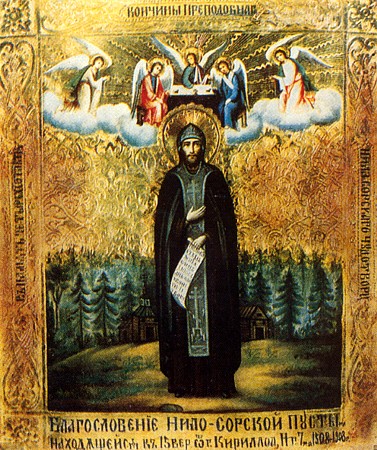
Nilus of Sora is painted as a Russian monastic elder: a lean, ageing man in the black mantle and cowl, with a long tapering beard, most often standing at full length in three-quarter or frontal pose, the right hand raised in blessing or laid on the breast and the left holding an unrolled scroll — the attribute proper to a monastic writer and lawgiver, and in his case usually inscribed with the opening of his Rule or with a counsel to the brethren. Behind or beneath him the skete is shown in the northern manner: log cells set apart among fir trees, the little wooden church with its shingled roof, the river and the marsh — a landscape rather than an architectural backdrop, and one of the more attractive inventions of late Russian icon-painting. Where the composition is expanded, the Holy Trinity or an altar with angels appears in the segment of heaven above, and inscriptions along the borders name the hermitage.
The stored image is a Russian icon of 1908 of the type known as the Blessing of the Nilo-Sorsky Hermitage: the saint stands full-length in the black mantle, holding an inscribed scroll, before the fir forest and the log buildings of the skete on the Sora, with angels around a heavenly altar above and Slavonic inscriptions in the border naming him and his hermitage. Its author is unknown and the work is in the public domain in its country of origin. Because he is not shown in the Menologion tradition and his cultus is late and local, earlier identity-certain images of him are hard to come by; an older undated Russian icon of the skete, showing the saint small among the log buildings, was examined and set aside as too indistinct for identification.
Disputed questions
- Not to be confused with the three other saints named Nilus with whom he is constantly conflated: Nilus the Faster of Sinai and Ancyra (†c. 430, 12 November), one of the very authors Nilus of Sora quotes; Nilus the Myrrh-gusher of Mount Athos (c. 1601–1651, 12 November, with the uncovering of his relics also kept on 7 May, the same day as this saint); and above all Nilus of Stolobny of Lake Seliger (†1554, 7 December, with the uncovering of his relics on 27 May), a Russian ascetic of nearly the same period and almost the same name. The distinction is easily kept in mind: Nilus of Stolobny was an unlettered hermit famous for extreme solitude and for wonders, who left no writings; Nilus of Sora was a learned skete-elder and the author of the first Russian treatise on prayer. The coincidence of 7 May for both this saint and the Athonite Nilus's relics is the trap most likely to catch a reader of the calendar.
- The Council of 1503. That Nilus personally raised the question of monastic estates at the council is the received account, but it rests on sixteenth-century polemical writing — chiefly the so-called Letter on the disagreements between the elders of Kirillov and Joseph of Volokolamsk — composed a generation later by partisans of the cause. Historians therefore differ over how far the "non-possessor party" of the textbooks corresponds to anything Nilus himself organised, as against a movement that gathered around his name and his writings after his death. Nothing in his own surviving works is a political programme; they are addressed to monks about prayer, and their poverty is ascetic before it is economic.
- His glorification. No act of formal canonisation survives. His veneration is attested locally from the sixteenth century, grew with the fame of his writings, and was long settled by usage before the printed calendars fixed it; his troparion and kontakion belong to a later office. The absence of any translation of his relics, unusual for a Russian saint of his standing, follows directly from his own Testament.
- His birth date and family name. The date c. 1433 and the surname Maykov are both inferences — the first from the statement that he was about seventy-five at his death, the second from the identification of his brother the d'yak Andrei Maykov. Neither is given in a document of his own.