
Alexius of Bortsurmany
The Holy Righteous Alexius Gnevushev, Presbyter of Bortsurmany
Righteous · Priest · b. 13 May 1762, Bortsurmany — d. 21 April 1848
Commemorated 21 April — Repose on Great Thursday, 1848, 4 August — Uncovering and translation of the relics at Bortsurmany
Alexius Gnevushev (1762–1848) was a village priest of the Volga country who served one parish, the church of the Dormition at Bortsurmany in the Kurmysh district of Simbirsk province, for some sixty years and never held any other. Shaken in 1796 by having let a parishioner die without the Mysteries, he took upon himself a rule of life that belonged to the desert rather than to a parish house — daily Liturgy, the full monastic office, fifteen hundred prostrations a day with the Jesus Prayer, one meal, a hair shirt — and became one of the great clairvoyant elders of the Russian nineteenth century, in the same spiritual country as Seraphim of Sarov, who is remembered to have sent pilgrims on to him. He died on Great Thursday, 21 April 1848, in his eighty-sixth year, blessing the people from the window of his cell, and was glorified by the Russian Church in 2000; the uncovering of his relics is kept on August 4.

Origins and the sixty-year parish
He was born on 13 May 1762 in the village of Bortsurmany, in the Kurmysh district of Simbirsk province — country on the right bank of the Sura, in what is now the Pilna district of the Nizhny Novgorod region. His father was the priest of the village, and the son followed him: Alexius finished the Nizhny Novgorod seminary in 1784 and was ordained deacon to his own home church, and about thirteen years later presbyter of the same parish. He served it until his death. He never took another appointment, never travelled to a monastery to be formed, and, so far as the record goes, never went far from Bortsurmany at all — the whole of his ascetic life was lived inside the ordinary machinery of a Russian rural parish, which is the particular reason the Church remembers him.
The first twelve years of his priesthood were, by his own later account, unremarkable and worse than unremarkable. He was a competent parish priest with a taste for company and a lack of urgency, and it is the honesty of the tradition on this point — his conversion is dated and is dated late — that gives his Life its shape.
The night of 1796
In 1796 a parishioner lay dying and sent for the priest. Alexius, not judging the case urgent, delayed; when he came at last, the man was dead and unhouseled. That night, keeping vigil over the body out of remorse, he saw — the tradition transmits it as a vision, not as a dream — an angel standing at the head of the dead man with the holy Chalice in his hands, and understood that the Mysteries he had withheld had been offered by another hand and that the fault was his alone.
He never afterwards refused or delayed a sick call, and he never afterwards lived as he had. From that year he served the Divine Liturgy every day that the rubrics allowed; he kept the full monastic cycle of prayer in his house; he made fifteen hundred prostrations daily with the Jesus Prayer; he ate once a day, and refused oil and fish even on the days the Typikon permits them; he wore a hair shirt under his cassock and for the last thirty years of his life did not wash. He slept little, and what sleep he took he took on the floor. He kept, over decades, a private diary of his sins and his struggle, which survived him and is the reason the interior history of his conversion is known at all.
The elder of Bortsurmany
What followed the change of life was the ordinary Russian sequel: people came. The parish priest of an obscure Sura village became a spiritual father to thousands, of every rank, who came to Bortsurmany to confess to him, to be prayed for, and to be told what to do. The tradition credits him with the discernment of hearts — he named to penitents the sins they had come intending to conceal — with healings of the sick brought to him, and, in the boldest of the received accounts, with having raised a dead child by prayer. He gave away what came to him, kept nothing, and lived and died poor in a house that visitors described as bare.
The strongest witness to him is external and comes from Sarov. Seraphim of Sarov, asked for direction by pilgrims from the Simbirsk side, is remembered to have sent them home again to their own priest, saying of Alexius that he is a candle lit before the throne of God and that he shines like a star on the Christian horizon. The two men are exact contemporaries — Seraphim died in 1833, Alexius outlived him by fifteen years — and the Russian tradition sets them together as the monastic and the parochial forms of one thing.
Repose
He died on 21 April 1848, which fell that year on Great Thursday, in his eighty-sixth year. He had been unable to leave his cell for some time; the account has him blessing, to the last, the people who gathered under his window. He was buried beside the altar of his own Dormition church at Bortsurmany, and the grave was venerated locally without interruption — through the Soviet period, when the church was closed — for a century and a half.
Relics and glorification
His relics were uncovered at Bortsurmany and translated into the restored church of the Dormition, and the Church keeps that translation on 4/17 August. He was numbered among the saints of the Nizhny Novgorod diocese, and then glorified for general veneration by the Jubilee Council of Bishops of the Russian Orthodox Church in August 2000, in the same act that glorified the New Martyrs and Confessors of Russia. He is named in the synaxis of the Saints of Nizhny Novgorod.
Feast and commemoration
His principal feast is his repose, April 21 (church date; Old Calendar civil May 4). August 4 (Old Calendar civil August 17) keeps the uncovering and translation of his relics, and is the day on which he appears in the Russian calendar beside the Seven Youths of Ephesus; that day falls within the Dormition Fast (August 1–14). He is also commemorated in the Synaxis of the Saints of Nizhny Novgorod. The commemoration is Russian: the Greek Menaion and the Antiochian calendar do not carry him, and neither day is universal.
Hymns
Troparion — Tone 4 (common of a righteous man)
O righteous father Alexius, thou didst stand before the altar of God with fear and burning love, and offering the bloodless sacrifice day by day thou didst become thyself an offering acceptable unto Him; wherefore, having received the grace of healing and of discernment, intercede with Christ our God that our souls may be saved.
Original translation from the Slavonic
Iconography
Alexius is painted in the received type of a righteous married priest: bald above, with a long white beard reaching to the breast, in phelonion and epitrachelion, blessing with the right hand and holding a scroll or a cross in the left; where the setting is shown it is his own Dormition church at Bortsurmany, and the pairing with Seraphim of Sarov occurs in Nizhny Novgorod diocesan icons of the local synaxis. All painted icons of him are post-2000 and are living iconographers' work; none is storable here.
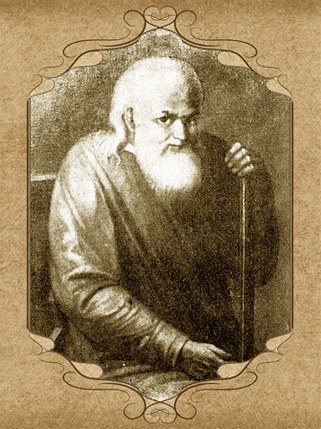
The stored image is therefore not an icon but a pre-revolutionary portrait — a photographic reproduction of a painted or lithographed likeness, dated on Wikimedia Commons only as "before 1917," author unknown, released under the Public Domain Mark, and taken from a Simbirsk regional library collection. It shows an old man, bald, with a long white beard, in a plain cassock and leaning on a staff, within a drawn cartouche; there is no halo and no inscription, so the identification rests on the file's own description and provenance rather than on anything legible in the image. It is stored on that footing, described honestly, and an upgrade is wanted: either a documented pre-revolutionary parish image, or nothing.
Disputed questions
- The year of the uncovering of the relics. The Russian calendar entry for August 4 attaches the year 2000, the year of the general glorification; the fuller life published on the same source dates the uncovering and solemn translation of the relics into the Dormition church to 17 August 1993, seven years earlier. Both readings are transmitted and neither is asserted here. The likeliest reconciliation is that the relics were uncovered in 1993 at the local glorification and that the calendar has attached to the day the year in which the commemoration became general; but that is a reconstruction, and the entry records the discrepancy instead of resolving it.
- The date of the vision. The year 1796 is given in the received life; the interval "about thirteen years" between his diaconal and priestly ordinations, also from the received life, would put his ordination to the priesthood at about 1797, i.e. after the vision, whereas the narrative presents the vision as an event of his priesthood. One of the two figures is approximate. The entry keeps both as transmitted.
- The church date of the repose. He died on the Julian 21 April 1848, whose modern civil equivalent is 4 May; Russian-language sources cite him under both, and the civil date must not be mistaken for the church date (compare the class of error recorded in this collection's open questions). The frontmatter carries church date 04-21 with old calendar civil 05-04.