
Seraphim of Sarov
Our Venerable and God-bearing Father Seraphim, Wonderworker of Sarov
Venerable · Wonderworker · b. July 19, 1754 (or 1759), Kursk — d. January 2, 1833, Sarov
Commemorated 2 January — Repose at Sarov (1833), 19 July — Glorification and the uncovering of his relics (1903)
Seraphim of Sarov (1754–1833), born Prochorus Moshnin of Kursk, is among the most beloved saints of the modern Orthodox world — a hieromonk of the Sarov monastery who became the archetype of the Russian starets, the Spirit-bearing elder. After years as a hermit in the forest, in which the tradition sets his thousand nights of prayer upon a rock and his near-murder by robbers, whom he forgave and refused to prosecute, he passed through a long silence and reclusion into an eldership of overflowing joy: he greeted all who came, in every season, with "My joy! Christ is risen!" His conversation with Nicholas Motovilov on the acquisition of the Holy Spirit — and the counsel "Acquire the Spirit of Peace, and thousands around you will be saved" — distilled the whole of his teaching. He guided the women's community at Diveyevo, reposed on his knees before an icon of the Mother of God on January 2, 1833, and was glorified by the Russian Church in 1903.
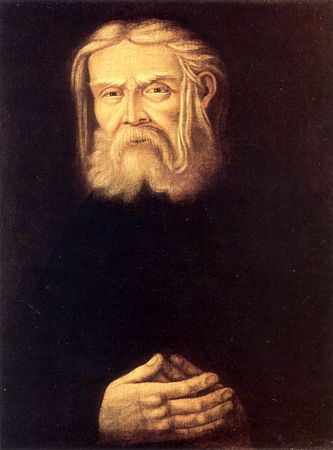
.jpg)
Origins and early life
He was born on July 19, 1754, at Kursk, and named Prochorus (Prokhor) at his baptism. His family, the Moshnins (Mashnins), were merchants and builders; his father Isidor had undertaken the construction of churches in the city, among them the great cathedral of Saint Sergius (later the Kazan cathedral), and died while Prochorus was still a small child, leaving the boy to be raised by his devout mother, Agathia. Two events of his childhood are told as signs of what he would become. Once, when his mother took him up the scaffolding of the rising cathedral tower, the boy fell from the height to the ground and was found unhurt. And in his tenth year, gravely ill and despaired of, he saw in a dream the Mother of God, who promised to heal him; soon after, the wonderworking Kursk-Root Icon "of the Sign" (a Znamenie-type icon of the Mother of God, distinct from the Novgorod Sign Icon) was carried in procession past the house, and his mother bore him out to venerate it — from that day he recovered. From boyhood he loved the church services, the reading of Scripture, and the lives of the saints, and resolved early to give himself wholly to God.
The call to the monastic life
At about the age of seventeen Prochorus determined to become a monk. With his mother's blessing — she gave him a copper crucifix, which he wore on his breast to the end of his life — he set out on foot for Kiev, to venerate the relics of the fathers of the Caves and to seek counsel. There the recluse Dosithea of the Kitaev hermitage (a woman who lived as a hidden ascetic) directed him not to remain at Kiev but to go to the Sarov monastery, in the forests of the Tambov country, and there to work out his salvation. On November 20, 1778 he was received at Sarov as a novice, and placed under the elder Joseph; he served in the bakery, the carpentry shop, and as attendant, and gave himself to obedience, fasting, and long prayer, keeping a rule of the Jesus Prayer through his labours.
Tonsure, priesthood, and a vision at the altar
After eight years of the novitiate he was tonsured a monk on August 13, 1786, and given the name Seraphim — "the fiery one," "the burning" — for the ardour of his love of God; soon he was ordained hierodeacon, and in 1793 hieromonk. During his diaconate, the tradition holds, while he served the Divine Liturgy on a Holy Thursday, he beheld the Lord Jesus Christ entering the church in glory amid the hosts of angels and blessing the worshippers — a vision that left him unable to move or speak for a time, and marked him for the rest of his days. Of the abbots under whom he was formed — Pachomius and Isaiah — he kept a grateful memory, and at the death of Pachomius he resolved on a stricter solitude.
The wilderness and ascetic struggle
About 1794 Seraphim withdrew, with the blessing of his superior, to a hermit's cell in the forest some miles from the monastery — the "far hermitage" (dal'nyaya pustyn'ka) — and there lived the life of an anchorite for many years. He kept a vegetable garden and a beehive, wore a single coarse white garment summer and winter, carried always a heavy sack filled with stones and the Gospels ("I am tormenting him that torments me," he said of his body), and ate so sparingly that for a long season he lived chiefly on a wild pot-herb, the goutweed (snyt') that grew about his cell. He read the whole of the New Testament through in the course of each week. The wild creatures of the forest came to him unafraid — the tradition loves the image of the great bear that he fed from his hand — and pilgrims who found him spoke of the peace that surrounded him.
The thousand nights upon the rock
To this period the tradition assigns his most celebrated ascetic feat. Assailed by the spirits of darkness, Seraphim took up a labour of stylite-like prayer without a pillar: for a thousand nights he prayed upon a great stone in the depth of the forest, kneeling or standing with his hands raised to heaven, repeating the prayer of the publican — "God, be merciful to me a sinner" — and by day he prayed upon another stone within his cell, so that for some three years his prayer upon the rock scarcely ceased. He spoke of it rarely and only under obedience, attributing the strength for it to the grace of God; the tradition holds it up as the very pattern of the ascetic's warfare, the whole man poured out in prayer.
The attack of the robbers
In 1804 a band of peasants, believing that the pilgrims' offerings had made the hermit rich, came upon him in the forest as he was cutting wood and demanded his money. Though he was strong and held an axe in his hands, Seraphim would not lift it against them; he let it fall and folded his arms upon his breast. They beat him savagely with the butt of his own axe and with a club, fractured his skull, broke his ribs, and left him for dead, ransacking his cell to find nothing but the icons and a few potatoes. He dragged himself to the monastery; the physicians despaired of him, but in the night the Mother of God appeared to him, as once in his childhood, with the Apostles Peter and John, and said — pointing to him — "This one is of our kind," and he began to recover. He never regained his former uprightness, and walked bent and leaning on a staff for the rest of his life. When the robbers were found and brought to justice, Seraphim interceded that they not be punished, and warned that he would leave the monastery if they were; they were released, and later, the tradition adds, came to repentance.
Silence and reclusion
After the attack, and after the death of the abbot Isaiah whom he had loved, Seraphim entered upon years of utter silence (molchal'nichestvo): meeting no one, speaking to no one, given wholly to inward prayer. In 1810, no longer able to walk the distance to the monastery for the Sunday Liturgy, he returned to a cell within its walls and there took up a strict reclusion (zatvor), receiving no visitors and admitting no one, communing of the Holy Mysteries which were brought to his door. This hidden life of prayer lasted some fifteen years, and in it — the tradition holds — the gifts for which he is remembered were ripened.
The eldership: "My joy, Christ is risen"
About 1825 the Mother of God appeared to him once more and bade him open his door and receive those who sought him. From that year until his death Seraphim gave himself, without reserve, to the ministry of the elder — the spiritual father who reads the heart and heals it. Crowds came to his cell and to the near hermitage: the sick, the grieving, the perplexed, peasants and nobles alike. He met each one, in every season of the year, with the Paschal greeting — "My joy! Christ is risen!" — calling every visitor "my joy," for he had passed beyond the reach of gloom into an unbroken Paschal gladness. He had the gift of clairvoyance, answering questions before they were asked and naming the hidden burdens of those who came; and the gift of healing, so that many were cured of body and soul at his word and by the water of his little spring. His counsel was gentle and practical: patience, the frequent remembrance of God, the Jesus Prayer, communion of the Mysteries, and above all a peaceful spirit.
The acquisition of the Holy Spirit
The heart of his teaching he gave to a landowner and disciple, Nicholas Motovilov, whom he had healed, in a conversation held in the snow of the forest in November 1831 and later written down: "On the Aim of the Christian Life." The aim of the Christian life, Seraphim taught, is not fasting or vigil or prayer or almsgiving for their own sake — these are only the means — but the acquisition of the Holy Spirit of God (styazhanie Dukha Svyatago), the true end for which all the labours are undertaken, as a merchant acquires capital. When Motovilov asked how one could know that he was in the Spirit, Seraphim took him by the shoulders and said, "We are both now, my friend, in the Spirit of God"; and Motovilov saw the elder's face shining like the sun, too bright to look upon, and felt an inexpressible warmth, sweetness, and peace though they sat in the falling snow — a foretaste, Seraphim said, of the joy of the saints. To this teaching belongs his most quoted saying: "Acquire the Spirit of Peace, and thousands around you will be saved" (Styazhi dukh miren, i tysyachi vokrug tebya spasutsya).
Diveyevo
Seraphim gave the last strength of his life to the women's community at Diveyevo, a short way from Sarov, which he governed as its spiritual father and enlarged by the express direction — he insisted — of the Mother of God, who (he said) appeared to him and marked out the ground for a new "mill community" of maidens and traced the line of the holy ditch (kanavka) that her own feet had trodden, which the sisters were to dig as the boundary of her domain. He surrounded the community with prophecies and instructions, provided for it materially, and foretold its trials and its glory in the last days. The Serafimo-Diveyevo convent grew into one of the great houses of Russian monasticism and remains the chief centre of his veneration.
Repose
Foreseeing his end and taking leave of the sisters and of his friends, Seraphim reposed at Sarov on the morning of January 2, 1833. He was found kneeling in his cell before his beloved icon of the Mother of God "Tenderness" (Umilenie) — the "Joy of All Joys," as he called it — his hands crossed upon his breast, having died at prayer; a candle had fallen and smouldered among his books. He was seventy-eight years old. He was buried by the wall of the Dormition cathedral at Sarov, and his grave at once became a place of pilgrimage.
Relics, glorification, and later cultus
Veneration of Seraphim spread through Russia in the decades after his death, carried by the reminiscences of Diveyevo and by the many miracles reported at his grave. In 1903, at the strong wish of the Emperor Nicholas II, the Russian Church glorified him: on July 19 — the day of his birth — his relics were solemnly uncovered, and an immense multitude, with the Emperor and the imperial family, gathered at Sarov for the canonisation, one of the great religious events of the last years of Imperial Russia. After the Revolution the relics were seized (in the 1920s) and disappeared from view; they were rediscovered in 1990–1991, in the store-rooms of the former Museum of the History of Religion in Leningrad (the Kazan cathedral), identified, and in 1991 carried in triumphant procession across Russia to Diveyevo, where they now rest — the "second uncovering" of the relics commemorated in the Russian calendar. Seraphim is today venerated throughout the Orthodox world; churches, monasteries, and countless faithful bear his name, and his image — the stooped elder in white, leaning on his staff — is among the most familiar in Orthodoxy.
Feast and commemoration
Seraphim is kept universally on January 2 (church date; Old Calendar civil January 15), the day of his repose in 1833, which falls within the forefeast of the Theophany; his office is sung together with the forefeast hymns of the coming feast of the Lord's Baptism. A second feast, on July 19 (Old Calendar civil August 1), keeps his glorification and the uncovering of his relics in 1903, on the day of his birth. The Russian calendar also marks the second uncovering of the relics and their translation to Diveyevo (1991), and Diveyevo keeps a synaxis of the saints of the convent about his feast. His veneration, first Russian, is now pan-Orthodox, and the Greek and Antiochian calendars keep him on January 2 as well.
Hymns
Troparion — Tone 4
From thy youth thou didst love Christ, O blessed one, and ardently longing to serve him alone, thou didst struggle in the wilderness with unceasing prayer and labour; and having gained the love of Christ with a compunctionate heart, thou wast shown to be the beloved chosen one of the Mother of God. Therefore we cry to thee: Save us by thy prayers, O Seraphim our venerable father.
Original translation from the Slavonic
Kontakion — Tone 2
Having forsaken the beauty of the world and the corruptible things that are in it, O venerable one, thou didst settle in the monastery of Sarov; and living there like an angel, thou wast a way of salvation to many. Therefore Christ also glorified thee, O father Seraphim, and enriched thee with the gift of healings and of wonders. Wherefore we cry to thee: Rejoice, O Seraphim our venerable father.
Original translation from the Slavonic
Magnification
We call thee blessed, O venerable father Seraphim, and we honour thy holy memory, O instructor of monks and companion of the angels.
Original translation from the Slavonic
Appointed readings
Epistle — Galatians 5:22–6:2
22But the fruit of the Spirit is love, joy, peace, longsuffering, gentleness, goodness, faith, 23Meekness, temperance: against such there is no law. 24And they that are Christ’s have crucified the flesh with the affections and lusts. 25If we live in the Spirit, let us also walk in the Spirit. 26Let us not be desirous of vain glory, provoking one another, envying one another. 1Brethren, if a man be overtaken in a fault, ye which are spiritual, restore such an one in the spirit of meekness; considering thyself, lest thou also be tempted. 2Bear ye one another’s burdens, and so fulfil the law of Christ.
Gospel — Luke 6:17–23
17And he came down with them, and stood in the plain, and the company of his disciples, and a great multitude of people out of all Judæa and Jerusalem, and from the sea coast of Tyre and Sidon, which came to hear him, and to be healed of their diseases; 18And they that were vexed with unclean spirits: and they were healed. 19And the whole multitude sought to touch him: for there went virtue out of him, and healed them all. 20And he lifted up his eyes on his disciples, and said, Blessed be ye poor: for yours is the kingdom of God. 21Blessed are ye that hunger now: for ye shall be filled. Blessed are ye that weep now: for ye shall laugh. 22Blessed are ye, when men shall hate you, and when they shall separate you from their company, and shall reproach you, and cast out your name as evil, for the Son of man’s sake. 23Rejoice ye in that day, and leap for joy: for, behold, your reward is great in heaven: for in the like manner did their fathers unto the prophets.
Iconography
Seraphim is depicted, uniquely among the great saints, very near to life, for his image was fixed within living memory: a bent old man of gentle face, with long thinning hair and a soft white beard, in the plain white cassock of his hermitage, a stole (epitrachelion) sometimes shown for his priesthood, leaning on a staff or a small axe, and often with his hand raised in blessing or holding a prayer-rope. Narrative icons show him feeding the bear from his hand, kneeling in prayer upon the rock with arms raised, or standing bowed before the icon of the Mother of God "Tenderness" at his repose. Because his cultus is modern, the great majority of his painted icons are twentieth- and twenty-first-century works and are under copyright; they are not reproduced here.
The stored image is an anonymous Russian portrait of the mid-nineteenth century (before 1900), showing the elder in his white garment, stooped and leaning forward, in the settled likeness that all his later iconography follows — a public-domain work by age (source, pd-old-work).
Disputed questions
- The year of his birth. The older accounts, and much of the tradition, give 1759; the research of later biographers, weighing the family and monastery records, favours 1754, which is now the more usual reckoning and is followed here. The day, July 19, and the place, Kursk, are constant.
- The dating of the ascetic feats. The sources do not always agree on the exact years of the thousand nights on the rock, the silence, and the reclusion, and the hagiographic tradition orders them somewhat schematically; the sequence given above — hermitage, prayer on the rock, the robbers' attack (1804), silence, reclusion (to 1825), eldership — follows the common account without pressing the precise chronology the record cannot bear.
- Not to be confused with the several later Russian saints named Seraphim — among them the new-hieromartyrs Seraphim (Chichagov) of Petrograd (†1937) and Seraphim (Zvezdinsky), and Seraphim of Vyritsa (†1949): "the Wonderworker of Sarov" belongs to this Seraphim alone, the elder of the early nineteenth century.