
Alypius the Iconographer
Our Venerable Father Alypius the Iconographer, of the Near Caves of Kiev
Venerable · Priest · Wonderworker · b. c. 1065, at Kiev — d. 17 August 1114
Commemorated 17 August — Repose at the Kiev Caves Monastery, 28 September — Synaxis of the Venerable Fathers of the Near Caves
Alypius (†17 August 1114) is the first icon-painter of the Russian Church whose name is known, and the founder of its whole tradition of painting understood as an ascetic craft rather than a trade. A boy of Kiev given by his parents to the Monastery of the Caves, he was apprenticed to the Greek masters who came from Constantinople to decorate the Dormition church in 1083, was tonsured by the igumen Nikon, and was afterwards ordained priest. He painted without payment for the rest of his life, dividing what he was given into three parts — materials, the poor, and his own necessity — and never allowed the work to displace the services. The Kiev Caves Paterikon preserves a cycle of wonders around him: icons of his hand that survived a fire unmarked, a leper cured with the paint from his brushes, and, on his deathbed, an angel who finished the icon he had been unable to paint and then received his soul.

The boy given to the Caves
Alypius was born at Kiev about the middle of the eleventh century, of parents who — in the formula of the Paterikon — "gave him to be taught the sacred books" and then brought him to the Monastery of the Caves, the house founded by Anthony and Theodosius which was by then the spiritual centre of the Rus'. He entered as a boy and never left it.
His formation as a painter was accidental in the way that vocations often are. In 1083 a company of mosaicists and icon-painters from Constantinople arrived at the monastery to decorate the newly built stone church of the Dormition — the Velikaya tserkov', the Great Church of the Caves. Alypius, still a youth, was set to serve them and to watch, and so learned the whole Byzantine craft at first hand: the preparation of the board, the gesso, the gold, the ordered laying of the colours, and the mosaic-work of the sanctuary. He was, in the exact sense, the pupil of the Greeks, and through him the Constantinopolitan manner passed into native hands.
The Paterikon fixes the moment of his calling with a wonder. As the Greek masters worked at the altar-mosaic, an image of the Theotokos imprinted itself upon the wall of its own accord and shone out brighter than the sun, so that the workmen fell down; and from the mouth of the image a dove flew, which circled the church and vanished behind the icon of the Saviour. Alypius saw it, and it settled his life. He was tonsured by the igumen Nikon (†23 March 1088), and was afterwards ordained hieromonk.
The rule of a painter
What the tradition principally preserves is not the style of his icons but the rule he kept over his work, and it is this that made him the pattern for every Russian iconographer after him:
- He took nothing for painting. Icons were made for the churches of Kiev without charge. Where a donor pressed money on him, he divided it into three: one part for boards, colours and gold; one part given away to the poor; one part for his own bare necessity.
- He never let the work displace the services. He painted only in the hours between the offices; when the semantron sounded he laid down the brush, whatever stage the work had reached.
- He sought out neglected icons. The Paterikon says that if he learned of an icon in a church of the city that had grown dark or damaged, he would fetch it, restore it, and return it without being asked and without fee.
He is credited with the mosaic and fresco work of the Great Church alongside his Greek masters, and with a number of icons that became objects of veneration; the tradition attaches his name in particular to the Svenskaya (Pechersk) Icon of the Mother of God, which is kept on this same day, and which shows the Theotokos enthroned between Anthony and Theodosius of the Caves — although the surviving panel is of the later thirteenth century and cannot be his hand.
The wonders of the Paterikon
The Kiev Caves Paterikon, compiled in the thirteenth century out of the letters of Bishop Simon of Vladimir and the monk Polycarp, gathers the miracles told of him:
The leper. A citizen of Kiev, eaten with leprosy, had gone the round of physicians and sorcerers and got nothing but worse. At last he came to the Caves, was anointed and communed, and Alypius painted his face with the colours from his own brushes, laying them on the sores as an ointment; the man washed, and the disease came away with the water. The point of the story, as the Paterikon tells it, is not the cure but its instrument: the pigments of the sacred art heal because they are consecrated by the use to which they are put.
The two monks and the seven icons. A man of Kiev, building a church, sent money by two monks of the monastery for seven great icons. The two kept the money and, on three separate occasions, told the donor that Alypius demanded more; and then reported to him that Alypius had refused the work altogether. Summoned before the igumen, Alypius answered truthfully that he had never been asked. But when the boards were fetched, the seven icons were found finished upon them, of surpassing beauty — painted, the Paterikon says, by an angel, in the night. The two thieves were expelled.
The fire. When the church for which those icons had been made burned to the ground, the seven icons were found whole in the ashes, untouched by the fire; Vladimir Monomakh sent one of them to Rostov, where it survived the fall of two successive churches.
The angel at his death. In his last illness Alypius was unable to finish an icon of the Dormition of the Theotokos commissioned for the feast. A young man came, took up the brushes, and completed it in a single evening, working — the tradition insists — with a speed and delicacy no human hand could equal; and when the saint asked who he was, he was not to be found. Three days later, at the hour of Alypius's repose, the same figure was seen beside him and received his soul. He died on 17 August 1114 and was buried in the Near Caves, where his relics rest.
Legacy
Alypius stands at the head of the Russian iconographic tradition, and the Paterikon's portrait of him — unpaid, obedient to the bell, and attended by angels at the board — set the terms in which the Russian Church would afterwards think about the painter's craft: it is a form of prayer done with the hands, and its fruit is not a picture but a presence. Every later Russian master, down to Andrei Rublev, works inside the frame Alypius was remembered as having established.
Feast and commemoration
August 17 (church date; New Calendar civil August 17, Old Calendar civil August 30), within the afterfeast of the Dormition of the Theotokos — a fitting coincidence for a painter whose last work, according to the tradition, was an icon of that very feast. He is kept universally by the Slavic Churches and by the OCA; the Greek calendars do not carry him. He is commemorated again on September 28 with the Synaxis of the Venerable Fathers of the Near Caves, and on the Second Sunday of Great Lent with the Synaxis of All the Venerable Fathers of the Caves. The Svenskaya (Pechersk) Icon of the Mother of God and the Icon of the Mother of God of the Kiev Caves are both kept on this same day, and both are attached by tradition to his name.
Hymns
Troparion — Tone 8 (common of a venerable father)
In thee, O father, was preserved unfailingly that which is according to the image; for taking up the cross thou didst follow Christ, and by thy deeds thou didst teach us to despise the flesh, which passes away, and to care for the soul, a thing immortal. Wherefore, O venerable Alypius, thy spirit rejoices with the angels.
Original translation from the Slavonic
Kontakion — Tone 2
Thou didst take the colours of earth and make of them a window upon heaven, asking no price for what thou hadst freely received; wherefore an angel finished thy last labour and bore away thy soul, O father Alypius, first of the painters of our land.
Original translation from the Slavonic
Iconography
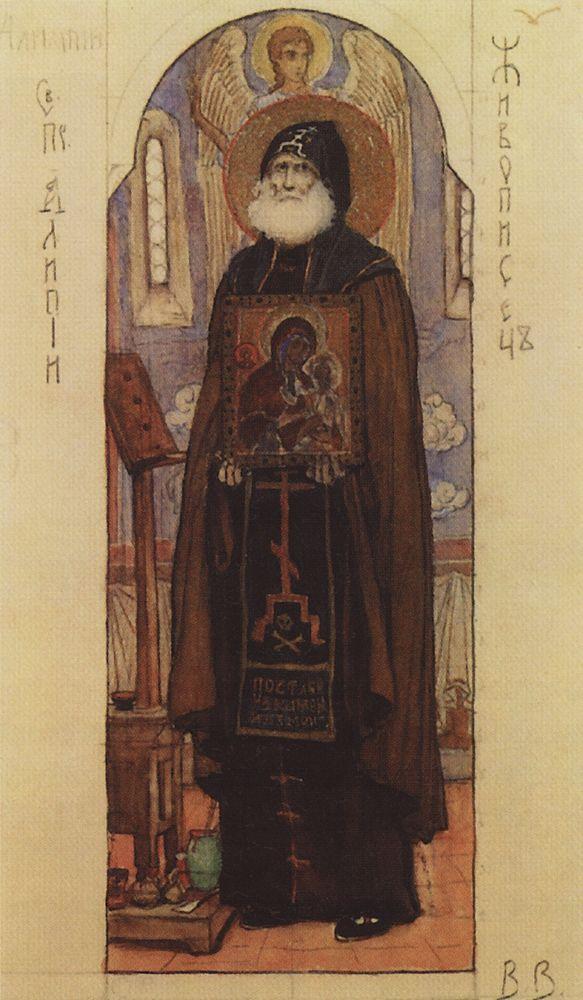
Alypius is written as a monk of the Caves in the great schema or in mantle and klobuk — grey- or white-bearded, of middle height — and is distinguished from every other Caves father by his attribute: he holds an icon of the Theotokos, usually the Eleousa type or the Svenskaya composition, presented frontally toward the viewer as though newly finished; in fuller versions a brush is in his right hand and the painter's board, grinding-stone and paint-pots stand at his feet. He appears in every version of the great composite Synaxis of the Fathers of the Caves, ranged with the other Near Caves fathers, and beside his companion in the craft Gregory the Iconographer. The narrative scenes are three: the angel painting the icon while he lies dying, the healing of the leper with the brush, and the seven icons standing unburnt in the ashes.
The stored image is Viktor Vasnetsov's design of 1885–1893 for the Cathedral of St Vladimir at Kiev, inscribed СВ. ПР. АЛIПIЙ ЖИВОПИСЕЦЪ ("Holy Venerable Alypius the Painter"): the saint stands full-length in the dark monastic mantle and klobuk, holding before him a gold-bordered icon of the Mother of God with the Child, the painter's tools and paint-pots on the floor at his left and an easel behind, with an angel standing over him within the arch — the whole iconographic programme of the Paterikon compressed into a single figure. It is a work of the historicist revival rather than a medieval panel, but it is pre-1900, public domain, and the most widely reproduced depiction of the saint; no medieval icon of Alypius alone has been located for this collection.
Disputed questions
- Not to be confused with Alypius the Stylite of Adrianopolis (†c. 640, feast November 26), the pillar-dweller of Paphlagonia who stood fifty-three years on his column. The names are identical in Greek (Ἀλύπιος), and the two are frequently conflated in indexes and in icon-captioning. They share nothing else: a seventh-century Byzantine ascetic of Asia Minor and a twelfth-century Kievan monk-painter, five centuries and two thousand miles apart, kept on different days.
- The Svenskaya icon. The attribution to Alypius of the Svenskaya (Pechersk) Icon of the Mother of God is traditional and old, but the surviving panel at Bryansk is dated by art historians to the later thirteenth century — a hundred and fifty years after his death. The tradition most likely preserves the memory of a lost original of his hand, or simply attaches the greatest name available to a venerated image. Neither the attribution nor its refutation affects his cultus.
- Which icons are his? No panel now surviving can be securely assigned to him. The mosaics and frescoes of the Great Church of the Caves, on which he certainly worked alongside the Greeks, perished with the church itself in 1941. His œuvre is, in the strict sense, lost; what survives is the record of how he worked.
- The name. Slavonic sources give both Алипий (Alipy) and Алимпий (Alimpy); the latter is the older form in the Paterikon manuscripts, and both are in current use.