
Alypius the Stylite
Our Venerable Father Alypius the Stylite of Adrianopolis
Venerable · b. c. 522 — d. c. 640
Commemorated 26 November — Repose; falls within the Nativity Fast
Alypius the Stylite (c. 522–640) was the great pillar-saint of Adrianopolis in Paphlagonia, who is said to have stood upon his column for more than six decades until his repose at a very great age. A deacon of his native city, he founded a church over a haunted pagan burial-ground and there raised his pillar, driving off the demons of the place by his endurance and drawing to himself two monasteries — one of men, one of women — which he governed from the column. The foremost stylite of the middle Byzantine period, he continued in his own person the way of life inaugurated by Symeon the Stylite, and is commemorated on November 26 within the Nativity Fast.
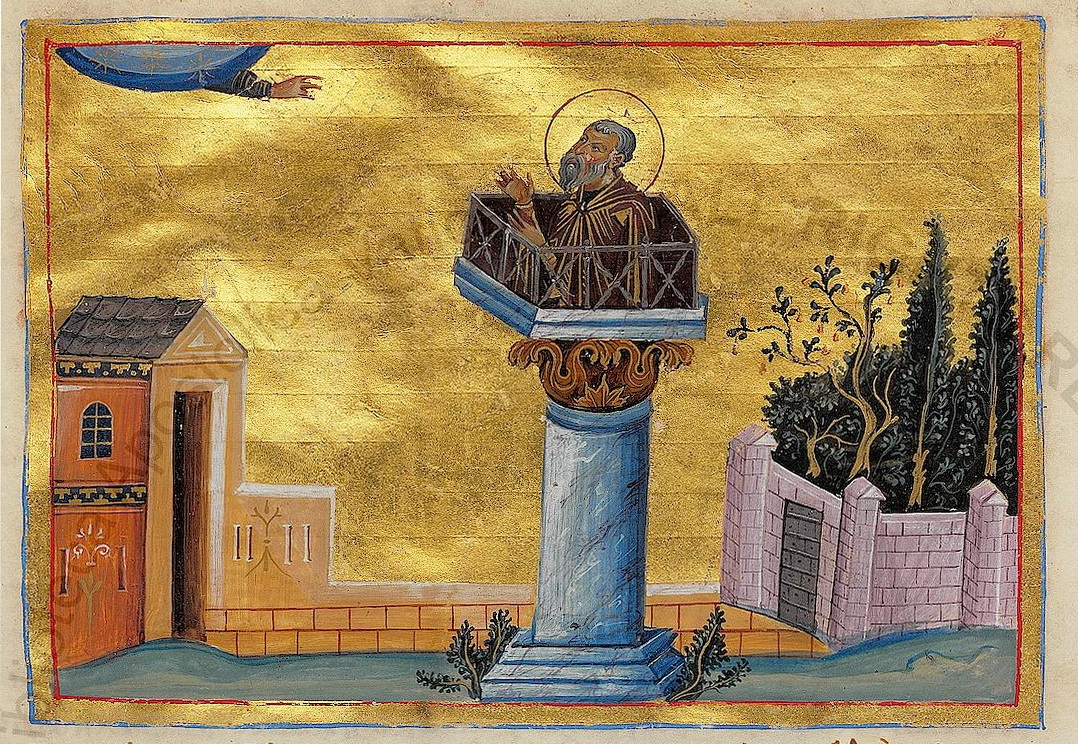
.jpg)
Origins and early life
Alypius was born about the year 522 at Adrianopolis in Paphlagonia, on the Black Sea coast of Asia Minor. His mother, a devout Christian, was widowed early; knowing her son to be marked for God — the tradition relates that at his birth the room was filled with a divine light — she placed him under the care of Theodore, bishop of Adrianopolis, for his education, and herself distributed her substance to the poor and took up the ascetic life near the church as a deaconess. The bishop, valuing the young man's piety, ordained him deacon and would not release him to the solitary life for which he yearned.
The decisive moment came, according to his Life, while Alypius was accompanying his bishop on a journey to Constantinople. The holy Great-Martyr Euphemia appeared to him in a vision, bidding him return to his homeland and build a church in her name. Alypius obeyed. With the offerings of the faithful of Adrianopolis he raised a church of the Martyr Euphemia upon the site of a ruined pagan temple and cemetery reputed to swarm with evil spirits.
Ascetic struggle
Beside the church, in the open air and directly over one of the pagan tombs, Alypius erected a pillar and mounted it, beginning the ascetic labour that would occupy the rest of his long life. The demons that were believed to infest the burial-ground fell upon him by night, pelting him with stones. Rather than seek shelter from them, Alypius tore away even the boards that had served him as a roof against sun and rain, exposing himself wholly to the elements and to the assaults of the spirits, until — overcome by his steadfastness — they abandoned the place for ever, which his voluntary endurance had thus sanctified. For this struggle he received the gifts of prophecy, of casting out demons, and of healing the sick who were brought to the foot of his column.
For fifty-three years Alypius stood upright upon the pillar in unceasing prayer, teaching and counselling the many who came to him. Only in the last fourteen years of his life, when his legs failed him, was he compelled to lie upon his side; and this too he bore with humble thanksgiving, enduring grievous sufferings without complaint — some sixty-six years in all spent upon the column. About the pillar there grew up in time two monasteries, one of men on the one side and one of women on the other, for both of which Alypius laid down a strict rule and which he directed until his death.
Repose and relics
Alypius reposed about the year 640, the sources agreeing that he had reached the extraordinary age of one hundred and eighteen. His body was buried in the church of the Martyr Euphemia which he had founded, and the tradition records that many who came to his relics in faith were healed.
Feast and commemoration
November 26 (church date; Old Calendar civil December 9), his repose, kept universally in the Byzantine rite within the Nativity Fast. On the same day the Church commemorates Nikon Metanoeite, the preacher of repentance, and Stylianos of Paphlagonia, Alypius's countryman; the Greek Menaion joins the services of Alypius and Nikon.
Hymns
Troparion — Tone 1
Thou didst become a pillar of patience, O venerable one, rivalling the forefathers: Job in his sufferings, Joseph in his temptations, and the life of the bodiless powers while yet in the body. O Alypius our father, entreat Christ God that our souls may be saved.
Original translation from the Greek
Kontakion — Tone 4
As a ground of the virtues and an adornment of ascetics, the Church glorifies thee this day and hymns thee, O Alypius; by thy prayers grant unto those who honour with longing thy noble deeds and thy struggles deliverance from grievous transgressions, O thou who art free of grief, true to thy very name.
Original translation from the Greek
Iconography
Alypius is depicted as an aged monk or deacon standing within the capital of his tall pillar, blessing or with hands raised in prayer, often with his two monasteries or a group of the faithful shown below. The stored image is the miniature for November 26 from the Menologion of Basil II (Constantinople, c. 985), the standard middle-Byzantine portrait of the saint, showing him upon his column.
Disputed questions
- Dates and length of the ascesis. The received Greek and Slavonic Lives place his birth in 522 and his repose in 640, at the age of 118, with fifty-three years standing upon the pillar and fourteen more lying upon his side. Some accounts round the total time on the column differently; the essential witness is of an ascesis of unparalleled duration, well over half a century upon the pillar.
- Not to be confused with the earlier and greater Symeon the Stylite (d. 459), founder of the stylite life, whom Alypius followed and with whom he shares the common troparion of the pillar-saints.
- Not to be confused, further, with Alypius the Iconographer of the Kiev Caves (†17 August 1114, feast August 17) — the first named icon-painter of the Russian Church. The two bear the same name (Ἀλύπιος / Алипий) and are regularly conflated in indexes and icon-captioning, but they share nothing else: a seventh-century Byzantine pillar-dweller of Paphlagonia and a twelfth-century Kievan monk-painter, kept on different days.