
Ambrose of Milan
Our Father among the Saints Ambrose, Bishop of Milan
Bishop · b. c. 339 — d. 397
Commemorated 7 December — Repose; in the East his feast falls on the day of his episcopal consecration (7 December 374)
Ambrose of Milan (c. 339–397) was one of the four great Latin Doctors of the Western Church and, with Augustine, Jerome and Gregory the Great, a pillar of Latin Christianity — yet he is venerated equally in the East as one of the universal teachers of the faith. A Roman provincial governor acclaimed bishop by the people of Milan while still an unbaptised catechumen, he became the foremost champion of Nicene orthodoxy against Arianism in the West, the spiritual father who baptised Augustine, a pioneer of Latin hymnody and antiphonal chant, and the bishop who compelled the emperor Theodosius the Great to do public penance for the massacre at Thessalonica — asserting that the emperor stands within the Church, not above it. His feast is December 7, the day of his consecration.

Origins and early life
Ambrose was born about the year 339 (the sources allow 339 or 340) at Augusta Treverorum (Trier), where his father, also named Ambrosius, held the great office of praetorian prefect of Gaul — one of the highest posts in the Western Empire. The family was of the Roman senatorial aristocracy and Christian; his sister Marcellina consecrated herself to virginity and is herself venerated as a saint, and his brother Satyrus, who died before him and over whom Ambrose preached a famous funeral oration, is likewise remembered among the saints. The hagiographers preserve a portent of his infancy: as the child slept in the courtyard, a swarm of bees settled on his face and passed in and out of his open mouth without harming him, leaving (it was said) a trace of honey — an omen his father read as promising the future eloquence of the "honey-tongued" doctor.
After his father's death the family returned to Rome, where Ambrose and Satyrus received a full education in grammar, rhetoric and law, the training of the Roman governing class. Ambrose entered public life as an advocate and rose quickly; about 370 the praetorian prefect Probus appointed him consularis — governor — of Aemilia and Liguria, the north-Italian province whose seat was Mediolanum (Milan), then an imperial capital.
Elevation to the episcopate
In 374 Auxentius, the Arian bishop who had long held the see of Milan, died, and the city was thrown into contention between the Nicene and Arian parties, each determined to secure the vacant throne for its own candidate. As governor, Ambrose went to the basilica to keep the peace; and while he addressed the divided assembly a voice — the tradition says a child's — cried out "Ambrose bishop!", and the whole crowd, Nicene and Arian alike, took up the acclamation.
Ambrose was appalled. He was still only a catechumen, not yet baptised, and he resisted with every means at his disposal — pleading unworthiness, and (the Lives relate) even attempting to flee the city by night, only to find himself back at its gate by morning. When his flight failed and the emperor Valentinian I confirmed the people's choice, he yielded as to the will of God. He was baptised, and in a single week — on 7 December 374 — was carried through all the grades of the ministry and consecrated bishop of Milan. This consecration day, not the day of his death, is the date on which the Byzantine East keeps his feast.
He at once gave away his gold and silver to the poor and his estates to the Church, retaining only a provision for Marcellina, and set himself to master the theology his sudden elevation had outrun, studying Scripture and the Greek Fathers — Origen, Basil the Great, Athanasius — under the guidance of the priest Simplician. Out of this study came the biblical, moral and dogmatic works that made him a teacher of the whole Latin Church.
Defender of Nicaea against Arianism
Ambrose's episcopate was consumed by the long struggle to secure the Nicene faith in the West against a resurgent and imperially favoured Arianism. He wrote the treatise On the Faith (De Fide) for the young emperor Gratian, and On the Holy Spirit, drawing heavily on the Greek Cappadocians to defend the full divinity of the Son and the Spirit. In 379 he travelled to Sirmium to secure the appointment of a Nicene bishop against the Arian empress Justina's party, and at the Council of Aquileia in 381 he led the deposition of the Arian bishops Palladius and Secundianus.
The confrontation came to a head at Milan itself. In 385–386 the imperial court, dominated by Justina, the mother of the boy-emperor Valentinian II, demanded that Ambrose surrender one of the city's basilicas for Arian worship. He refused outright — "the emperor is within the Church, not above it" — and when imperial troops surrounded the basilica, he and his congregation occupied it and held vigil through the days of the siege. It was to keep up the spirits of the people through those long nights, Augustine tells us, that Ambrose had them sing hymns and psalms antiphonally, in the "Eastern manner"; the court gave way, and the practice took permanent root in the West.
Ambrose and Augustine
Among those drawn to Milan by the fame of Ambrose's preaching was the young African rhetorician Augustine, who came to the city in 384 as professor of rhetoric, still entangled in Manichaeism and unbelief. In the Confessions Augustine records how he first went to hear Ambrose only for the beauty of his Latin, and found himself won by the substance; how Ambrose's allegorical reading of the Old Testament dissolved the objections that had held him back; and how the bishop, always busy and besieged by callers, was yet the instrument of his conversion. Ambrose baptised Augustine — the greatest theologian of the Latin Church — at the Easter vigil of 387. That the teacher of Augustine is himself a saint of the undivided Church binds East and West together in a single lineage of doctors.
The penance of Theodosius
The most celebrated act of Ambrose's life was his confrontation with Theodosius I, the emperor who had restored Nicene orthodoxy as the religion of the Empire. In 390, after a riot in Thessalonica in which the imperial garrison commander was killed, Theodosius ordered a reprisal: the population was lured into the hippodrome and some thousands — the sources say seven thousand — were massacred. Ambrose, in a letter written with grave courtesy but absolute firmness, withdrew from communion with the emperor and refused to celebrate the Eucharist in his presence until he should do public penance. Theodosius — master of the Roman world — submitted, laying aside his imperial insignia and doing penance openly among the people before he was readmitted to the mysteries. The scene became for all later ages the archetype of the Church's freedom to call even the mightiest to repentance, and of the principle that no man, however exalted, stands above the moral law of Christ.
Earlier, in 388, Ambrose had already checked the same emperor over the affair of the synagogue at Callinicum. His relations with the imperial house were constant: he had removed, through Gratian, the pagan Altar of Victory from the Senate house at Rome against the eloquent plea of the prefect Symmachus, and he preached at the obsequies of both Valentinian II and Theodosius.
Repose
Ambrose died at Milan on the night of Holy Saturday, 4 April 397, having served the Church there for twenty-three years; he was attended in his last hours by his deacon and successor, and his body was buried in the basilica that bears his name, where it was afterwards found laid between the two martyrs he had himself enshrined. The Western churches keep his memory on 4 April, but Milan and the Byzantine East commemorate him on 7 December, the anniversary of his consecration.
Relics and translations
In 386, at the height of the basilica crisis, Ambrose was granted the discovery of the relics of the martyrs Gervasius and Protasius, long-forgotten witnesses of the Milanese church, whose translation and the miracles that accompanied it (including the healing of a blind man, attested by Augustine) greatly strengthened the Nicene cause. Ambrose directed that when he died he should be laid at their side. His own relics rest to this day in the crypt of the Basilica of Sant'Ambrogio in Milan, where he lies vested between Gervasius and Protasius — one of the very few bodies of the great Fathers to survive and to be venerated in place.
Hymnographic and literary legacy
Ambrose is the father of Latin hymnody. He composed metrical hymns in simple iambic dimeter — Aeterne rerum conditor, Deus creator omnium, Veni redemptor gentium, and others — designed to be sung by the whole congregation, and gave his name to the "Ambrosian" hymn form and to the distinct Ambrosian rite and chant of the church of Milan, which survive to the present. (The Te Deum was long ascribed to him and Augustine together, though its authorship is now placed elsewhere.) His prose works — On the Duties of the Clergy (De Officiis), modelled on Cicero; the treatises on virginity that made him the great Western advocate of consecrated celibacy; the exegetical Hexaemeron and commentaries; the dogmatic On the Faith and On the Holy Spirit; and his letters — carried the theology of the Greek Fathers into Latin and shaped the mind of the Western Church for a millennium. He is numbered among the four great Doctors of the Latin West and, in the East, among the teachers of the whole Church.
Feast and commemoration
December 7 (church date; Old Calendar civil December 20). The Byzantine calendar keeps Ambrose on the day of his episcopal consecration in 374; the Roman and other Western calendars commemorate him on 4 April, the day of his repose. His service in the Greek Menaion styles him "our venerable father Ambrose, bishop of Mediolanum," and the day falls within the Nativity Fast.
Hymns
Troparion — Tone 4
A rule of faith and an image of meekness, a teacher of temperance, thy manner of life hath shown thee to thy flock; therefore by humility thou didst gain the heights, and by poverty riches. O father and hierarch Ambrose, entreat Christ God that our souls be saved.
Original translation from the Greek
Kontakion — Tone 3
Blazing with divine doctrines, thou didst darken the delusion of Arius, O initiate of the mysteries and shepherd Ambrose; and working wonders by the power of the Spirit, thou didst plainly heal afflictions of every kind. O venerable father, entreat Christ God to grant us great mercy.
Original translation from the Greek
Iconography
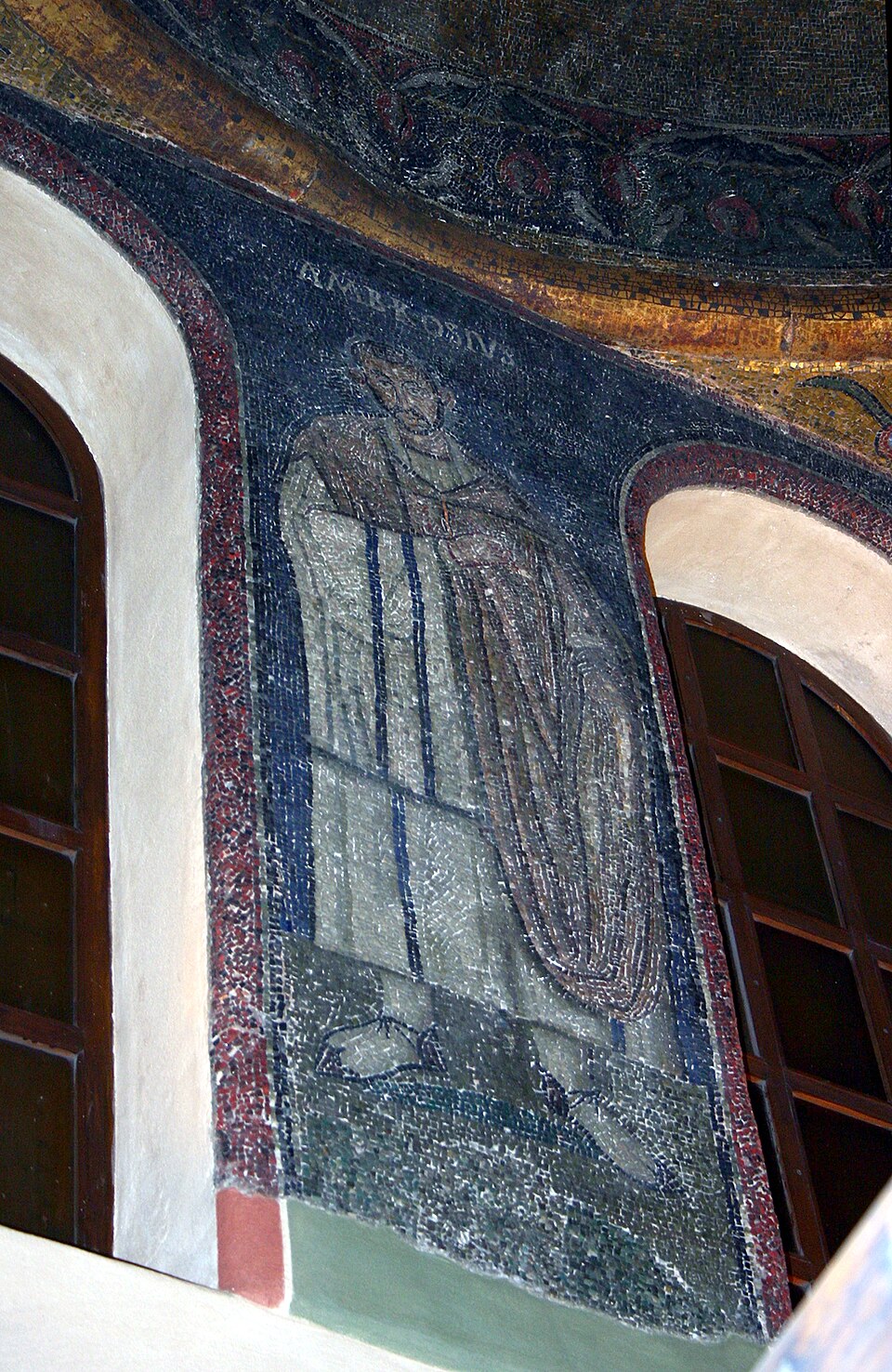
In Byzantine and Slavic iconography Ambrose is depicted as a bishop in the omophorion, vested in the polystavrion or a plain phelonion, holding the Gospel book and blessing, with a short rounded or slightly pointed dark beard. The stored image is not a later icon but the contemporary portrait: a mosaic of about the fifth century in the chapel of San Vittore in Ciel d'Oro, within the Basilica of Sant'Ambrogio at Milan, made within living memory of the saint and believed to preserve his actual features — a spare, ascetic face with large eyes and a high forehead. It is one of the earliest surviving likenesses of any Father of the Church.