
Nazarius, Gervasius, Protasius and Celsius
The Holy Martyrs Nazarius, Gervasius, Protasius and Celsius of Mediolanum
Martyr · Child Martyr · d. traditionally 54–68 (under Nero)
Commemorated 14 October — The joint Byzantine commemoration of the four martyrs of Milan
Nazarius, Gervasius, Protasius and Celsius are the four martyrs of Milan whom the Byzantine calendar commemorates together on October 14: by tradition sufferers under Nero (54–68) — Nazarius a Roman preacher of the Gospel, Gervasius and Protasius twin brothers of Milan, Celsius the boy whom Nazarius baptized in Gaul and raised as his disciple. Historically they are the most famous relic-saints of the early West: in 386 Ambrose of Milan uncovered the bodies of Gervasius and Protasius — the healing of the blind Severus at their bier, witnessed by the young Augustine, resounded through the Christian world — and about 395 he uncovered Nazarius and Celsius also. The traditional Acts, however, are late, and the chronology of their deaths is a recognised problem.
.jpg)
The traditional account
The narrative transmitted by the synaxaria and the Slavic Lives runs thus. Nazarius was born at Rome, the son of Africanus, a Jew, and of the Christian Perpetua — whom the Roman tradition makes a convert of the apostle Peter himself — and was baptized by Linus, Peter's successor in the Roman see. He resolved from youth to give his life to preaching Christ and to the care of persecuted Christians, and with this intent left Rome for Mediolanum (Milan).
Gervasius and Protasius were twin brothers of Milan, sons of the wealthy Roman citizens Vitalis and Valeria — themselves venerated as martyrs in the Western tradition, and Vitalis in the Byzantine calendar also, on July 23; this parentage belongs to the same passio and is traditional rather than established. On inheriting their parents' estate they distributed it to the poor, freed their slaves, and gave themselves to fasting and prayer, for which they were denounced as Christians and imprisoned. Nazarius, visiting the confessors in the Milan prison, came to love the twins and desired to suffer with them; for his ministry to the prisoners he was beaten with rods and driven from the city.
He went on into Gaul and preached with great success. At Cemelium (the tradition's "Kimel," the ancient town by modern Nice), a Christian woman brought him her son Celsius to be baptized and entrusted the child to him; Nazarius raised the boy in piety and gained in him a disciple and fellow-labourer. Seized in the persecution, master and disciple were thrown to wild beasts, which would not touch them, and then cast into the sea, upon which — the Acts relate — they walked as on dry land, so that the soldiers charged with the execution believed and released them. Returning at last to Milan, they visited Gervasius and Protasius in prison, were arrested, and were brought before Nero, at whose command Nazarius and Celsius were beheaded; soon afterwards the twin brothers were executed in Milan. A Christian named Philip recovered the bodies and buried them privately — in his house, says the account the OCA transmits; in his garden, the Western tradition — where they lay hidden for three centuries.
The uncovering of the relics under Ambrose
Here legend gives way to some of the best-documented events of the fourth-century Church. In June 386, when Ambrose was about to consecrate his new basilica at Milan and the people asked for relics, he had excavations made in the church of Felix and Nabor and uncovered two skeletons of great size with the head separated — identified as the martyrs Gervasius and Protasius, whose names the Milanese church remembered though nothing else was known of them. As the relics were borne to the Ambrosian basilica, a blind butcher named Severus touched the pall with a kerchief and received his sight — a miracle recounted by Ambrose himself in his letter to his sister Marcellina, and confirmed by Augustine, then present in Milan, in the Confessions and the City of God. Ambrose laid the relics beneath the altar with the words that victims of Christ belong where Christ the Victim is offered — a moment that did much to fix the enduring practice of enshrining martyrs' relics in altars. The discovery, coming at the height of Ambrose's confrontation with the Arian court, was received as a divine vindication of the Nicene cause.
About 395, in the reign of Arcadius and Honorius, Ambrose likewise uncovered the bodies of Nazarius and Celsius in a garden outside the city; his biographer Paulinus, an eyewitness, records that the martyr's blood was found still fresh in the tomb. Ambrose translated Nazarius's relics to the Basilica of the Apostles. From Milan the cultus of the four spread through the West — Gervasius and Protasius became patrons of countless churches in Italy and Gaul — and to the East: the canon of the Byzantine service sings that "Rome of old proclaims thy contests, O Nazarius, and Constantinople, holding thy sacred relic in faith, sings thy wonders."
Feast and commemoration
October 14 (church date; Old Calendar civil October 27), the four together — the leading commemoration of the day in the Greek Menaion, which appoints their service jointly with that of Cosmas of Maiuma, and in the Russian calendar, which lists them at the day's head with the traditional dating 54–68. In the West, Gervasius and Protasius are kept on June 19 and Nazarius and Celsus on July 28. The canon of the Byzantine service is the work of Joseph the Hymnographer (acrostic "In faith I hymn the crown-bearing martyrs"), and the doxastikon at Vespers is ascribed to Byzantios.
Hymns
Troparion — Tone 4 (common of martyrs)
Thy martyrs, O Lord, in their contest received crowns of incorruption from thee, our God; for possessing thy strength they cast down the tyrants and shattered the powerless insolence of the demons. By their supplications, O Christ God, save our souls.
Original translation from the Greek
Kontakion — Tone 1
Come, ye faithful, with songs of praise let us hymn the four-numbered glory of the martyrs of Christ — Nazarius, Protasius, Gervasius and Celsius; for they contended even to beheading and death, and having received the crown of incorruption, they entreat that we may be saved.
Original translation from the Greek
Iconography
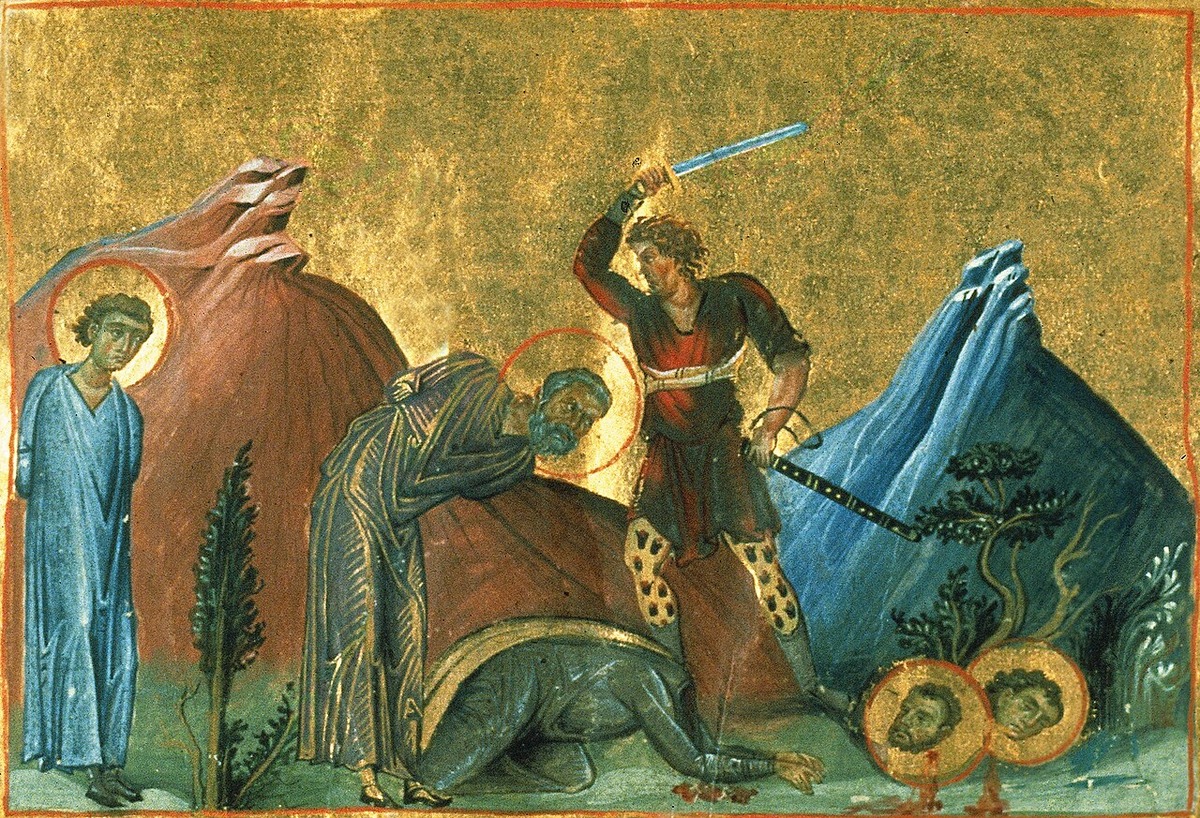
The four are painted as a company of varied ages: Nazarius dark-bearded and mature, Gervasius and Protasius as younger men (in the West often as twins), and Celsius beardless, a boy. The stored image is the miniature of the Menologion of Basil II (c. 985; Vat. gr. 1613) for October 14: the executioner raises his sword over the kneeling elder martyr, two haloed severed heads already lie at the mountain's foot, and the young Celsius in a blue chiton stands at the left awaiting his own end — the manuscript's own placement at this date securing the identification.
Disputed questions
- Chronology. The tradition places the deaths under Nero (54–68), and this entry's dating follows the calendars; but the Acts of the four martyrs are late compositions, written after (and prompted by) the Ambrosian discoveries, and carry the familiar marks of legend (the sea-miracle, the personal sentence by Nero). Ambrose himself, the nearest witness, knew the martyrs' names and their Milanese graves but transmitted no acts and no date; even the antiquity of the "great size" of the twins' skeletons was his only clue to their era. Scholarship therefore regards the persecution in which the four actually died — Neronian or later — as unknown; only the fourth-century cultus is certain.
- The OCA's emperor. The OCA's notice dates Ambrose's discovery of Gervasius and Protasius "during the reign of the holy Emperor Theodosius (408–450)" — the regnal years of Theodosius II, under whom Ambrose (†397) was long dead. The discovery is securely dated June 386, under Theodosius I, by Ambrose's own letter; the divergence is recorded as found.
- East and West. The Byzantine books keep the four together on October 14; the Roman calendar divides them into the two pairs of the relic-discoveries — Gervasius and Protasius on June 19, Nazarius and Celsus on July 28. Wikidata likewise carries no single item for the four but two pair-items (verified live; see Sources).
- Celsius. The boy-martyr's name appears as Celsus in the Latin tradition and Κέλσιος in the Greek; the child-martyr classification of this group file belongs to him alone, the tradition presenting him as a child or youth at his death.