
Ammon of Egypt
Our Venerable Father Ammon of Nitria
Venerable · b. c. 290 — d. c. 350
Commemorated 4 October
Ammon of Egypt (Amun of Nitria, c. 290–c. 350) was the founder of the great monastic settlement of the Nitrian desert, the first of the ascetic republics south-west of the Nile Delta that made fourth-century Egypt the wonder of the Christian world. Married against his will as a young man, he persuaded his bride to a life of continence, lived with her as brother and sister for eighteen years, and then withdrew to the mountain of Nitria, where thousands of monks eventually gathered in his wake. A friend and correspondent of Anthony the Great — who, thirteen days' journey away, saw Ammon's soul borne up to heaven at the hour of his death — he is commemorated on October 4.
.jpg)
Origins and enforced marriage
Ammon was born about 290 into a prosperous Egyptian family. Orphaned young, he was pressed into marriage at about the age of twenty-two by an uncle who would not be refused. The tradition, going back to Palladius — who had it in Egypt within living memory of the saint — relates that on the wedding night Ammon read to his bride from the apostle Paul on virginity and marriage, and persuaded her that they should live together in secret continence. For eighteen years (so Palladius; other accounts round the figure to twenty) the two shared a house as brother and sister while Ammon worked their balsam plantation in the Delta, labouring with his hands by day and keeping vigil by night.
At length — the sources say at the wife's own urging, since she thought it wrong that such a man's virtue be hidden in a household — they separated by agreement: she remained in the house, which became the nucleus of a community of consecrated women, and Ammon withdrew about the year 320 to the desert of Nitria, the low ridge south of Lake Mareotis some forty miles from Alexandria, taking its name from the natron deposits of the neighbouring valley. Twice a year, the tradition adds, he returned to visit her.
Father of Nitria
Ammon was the first monk to settle Nitria, and his renown drew others until the mountain became one of the two or three greatest monastic centres on earth. The Nitrian pattern was neither the strict solitude of Anthony's disciples nor the walled common life of Pachomius, but a middle way: monks lived alone or in small clusters, near enough to gather on Saturday and Sunday for common worship. Within two generations the settlement numbered thousands — Palladius, who lived there in the 390s, found some five thousand monks — with its own bakeries, its guest-house, and its physicians.
The overflow of Nitria produced a second foundation in Ammon's own lifetime. The tradition preserved in the sayings of the fathers relates that when Nitria grew crowded, Ammon consulted Anthony the Great, and the two walked into the desert until sunset, prayed, and planted a cross to mark the site of the new settlement — Kellia, "the Cells," a day's walk deeper into the wilderness, where those seeking stricter stillness withdrew. The friendship between the two fathers is among the best attested things about Ammon: Athanasius records that Ammon "often" came to Anthony, and the desert tradition preserves their exchanges.
Miracles and traditions
Athanasius, in the Life of Anthony, preserves the miracle for which Ammon was best remembered. Travelling with the monk Theodore, Ammon came to the flooded channel called the Lycus and, ashamed to be seen naked in crossing — he had never, the accounts say, seen himself unclothed — he lingered on the bank; and he was found transported to the far side dry-shod, a thing Theodore attested and the elder, pressed, admitted with the plea that it not be repeated in his lifetime. The History of the Monks in Egypt adds further traditions: that he set a pair of desert serpents to guard his cell against robbers, and healed a boy bitten by a mad dog.
Repose
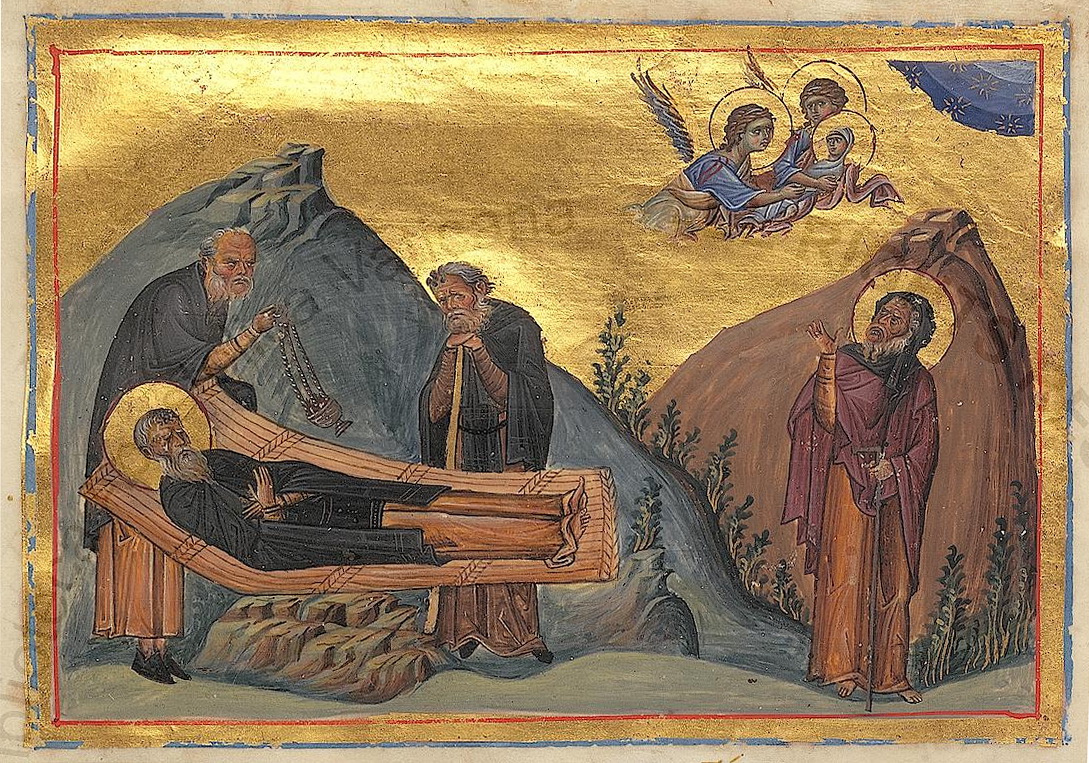
Ammon died about the year 350 — Palladius says at the age of sixty-two — after some twenty-two years in the desert. Athanasius records the manner in which his death became known: Anthony, on his own mountain by the Red Sea a thirteen days' journey from Nitria, was seen by his disciples to gaze into the air and then say that Ammon had just died, for he had seen his soul carried up to heaven by angels; visitors from Nitria a month later confirmed the day and the hour. It is the classic instance, cited ever since, of the vision of a soul's ascent granted to a living saint.
Feast and commemoration
October 4 (church date; Old Calendar civil October 17), in both the Greek and the Slavic calendars, on the same day as Hierotheus of Athens. The coincidence with the Kiev Caves recluse Ammon (see above) means the Russian calendar commemorates two saints of the name on this day; the books distinguish them as "of Nitria" (Нитрийский) and "of the Caves" (Печерский).
Hymns
Troparion — Tone 8 (from the common of a venerable)
In thee, O Father, that which is according to the image was preserved exactly; for taking up the cross, thou didst follow Christ, and by thy deeds didst teach us to overlook the flesh, for it passeth away, but to care for the soul, a thing immortal; wherefore thy spirit rejoiceth with the angels, O venerable Ammon.
Original translation from the Greek
Iconography
Ammon is depicted as a desert elder in monastic habit and mantle, with a rounded grey beard, his hand raised in blessing or holding a scroll; he is not readily told apart from the other Egyptian fathers except by inscription. The stored image is the miniature of the Menologion of Basil II (c. 985), which shows him standing in orant composure between the columns of an architectural frame.
Disputed questions
- Chronology. The dates are approximate throughout: the sources agree on the shape of the life (marriage at about 22; eighteen — or twenty — years of continent marriage; about twenty-two years in Nitria; death at about 62, while Anthony still lived, hence before 356). Death is conventionally placed c. 350, with some scholars preferring c. 345–353.
- Not to be confused with several namesakes: the deacon and martyr Ammoun of Heraclea, teacher of the Forty Virgin-Martyrs of Thrace (September 1); Ammonas the disciple and successor of Anthony the Great, later a bishop, under whose name a corpus of letters survives (kept January 26) — with whom Ammon of Nitria is frequently conflated even in reference works; and the much later Ammon the recluse of the Kiev Far Caves (13th century), commemorated this same October 4 in the Russian calendar.