
Amphilochius of Iconium
Our Father among the Saints Amphilochius, Bishop of Iconium
Bishop · b. c. 340 — d. c. 394
Commemorated 23 November — Repose
Amphilochius of Iconium (c. 340–c. 394) was a bishop of the Cappadocian circle, kinsman of Gregory the Theologian and intimate friend of Basil the Great, who from about 373 governed the church of Iconium as the first metropolitan of the new province of Lycaonia. A trained rhetorician turned pastor, he took a leading part at the Second Ecumenical Council of Constantinople in 381 and was among the foremost defenders of the full divinity of the Holy Spirit against the Pneumatomachi (Macedonians); he also convened the Council of Side against the Messalians. Basil dedicated his treatise On the Holy Spirit to him. He is commemorated on November 23.
.jpg)
Origins and early life
Amphilochius was born around 340, most probably at Caesarea in Cappadocia, into a family already bound to the great Cappadocian Fathers: he was a first cousin of Gregory the Theologian (Gregory of Nazianzus), whose letters to him survive, and a close friend and spiritual son of Basil the Great. Like the other men of that circle he received a thorough education in rhetoric and law, and for a time practised as an advocate — some accounts say at Constantinople — before the pull of the ascetic life drew him away from the courts. He withdrew into retirement, living quietly with his aged father in the Cappadocian countryside and devoting himself to prayer, so that his eventual elevation to the episcopate came, as with so many of his contemporaries, against his own inclination.
Ministry as bishop
About the year 373 Amphilochius was chosen bishop of Iconium, the chief city of Lycaonia, which had lately been raised to the rank of a separate ecclesiastical province. He thus became its first metropolitan. The choice was warmly welcomed by Basil, who from neighbouring Caesarea had watched over the young man and now made him a constant correspondent and counsellor; several of Basil's most important letters — including the three canonical epistles that entered the body of Orthodox canon law — are addressed to Amphilochius in answer to his questions on discipline and practice. It was to Amphilochius, too, that Basil dedicated in 375 his classic treatise On the Holy Spirit, composed at Amphilochius's own request to vindicate the doxology "Glory to the Father with the Son together with the Holy Spirit." In that work Basil not only demonstrated the Spirit's equality with the Father and the Son but defended the Church's unwritten apostolic traditions — the sign of the Cross, praying toward the East, standing (not kneeling) on Sundays and in Paschaltide.
Amphilochius made these convictions the programme of his own episcopate. He laboured against the Arians and the Eunomians, and above all against the Pneumatomachi or "Macedonians," who confessed the Son but denied the Godhead of the Holy Spirit. At the Second Ecumenical Council, gathered at Constantinople in 381 under Theodosius I — the council that completed the Creed with its clauses on the Spirit — Amphilochius was a leading voice, and imperial legislation of that year named him among the bishops communion with whom was the test of orthodoxy in the East. Later, about 390, he presided over a synod at Side in Pamphylia that condemned the Messalians (Euchites), an enthusiast sect that despised the sacraments in favour of ceaseless prayer alone; his firmness against them is one of the earliest official reactions of the Church to that movement.
The most celebrated story of his pastorate concerns his zeal for the divinity of the Son. Petitioning the emperor Theodosius to expel the Arians from the cities, and finding the request coldly received, Amphilochius is said to have entered the palace, saluted the emperor with all honour, but pointedly ignored his son Arcadius, whom Theodosius had lately made co-emperor. When the angry Theodosius protested at the slight to his son, the bishop answered that if the emperor could not bear to see his own son deprived of due honour, neither could the God and Father of all endure to see the Son blasphemed by the Arians — an object lesson that is said to have moved the emperor to act against the heresy.
Repose
After many years of guiding the flock of Iconium, and after prayers so fervent that he was believed to obtain of God the healing of his people's bodily and spiritual ills, Amphilochius reposed in peace, about the year 394. He was a gifted preacher and writer; only a small part of his output survives, chiefly some eight homilies — among them the oldest extant sermon on the feast of the Meeting of the Lord (the Presentation, February 2) — together with fragments and the verse Iambics to Seleucus, long transmitted under Gregory the Theologian's name.
Relics and later cultus
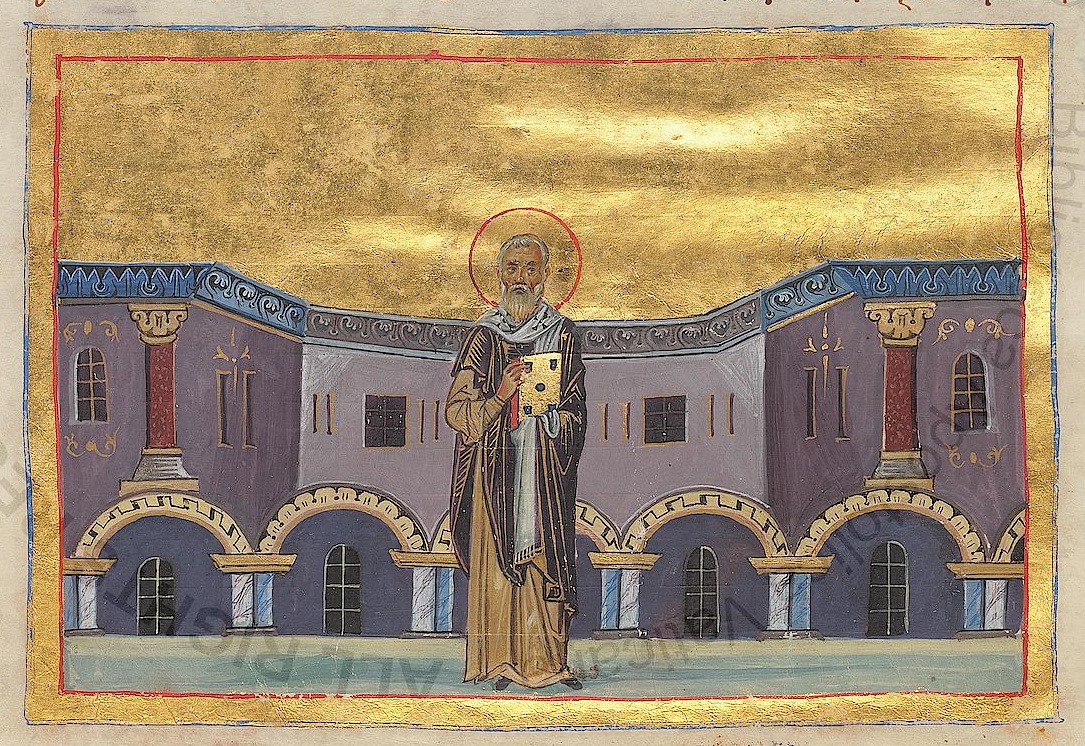
Portions of his relics are venerated in the Orthodox world today, notably at the Russian monastery of Saint Panteleimon on Mount Athos, at the Kykkos Monastery in Cyprus, and at the Benaki Museum in Athens. His memory has been kept on November 23 since early times; the Byzantine synaxaria and menaia appoint him with Gregory of Agrigentum, and the tenth-century Menologion of Basil II gives him his own illustrated notice.
Feast and commemoration
November 23 (church date; Old Calendar civil December 6). The feast falls within the Nativity Fast and during the afterfeast of the Entry of the Theotokos into the Temple. In the Menaion his service is combined with that of Gregory of Agrigentum, the two hierarchs sharing the day and a common apolytikion; the propers proper to each saint (a kontakion and canon apiece) are sung within that joint office.
Hymns
Troparion — Tone 4
O God of our Fathers, who dealest with us ever according to Thy gentleness: take not Thy mercy from us, but by their supplications govern our life in peace.
Original translation from the Greek
Kontakion — Tone 2
O divine thunder, O trumpet of the Spirit, planter of the faithful and axe that fells the heresies: O hierarch Amphilochius, greatest servant of the Trinity, ever standing among the angels, cease not to intercede for us all.
Original translation from the Greek
Appointed readings
Epistle — Hebrews 7:26–8:2
26For such an high priest became us, who is holy, harmless, undefiled, separate from sinners, and made higher than the heavens; 27Who needeth not daily, as those high priests, to offer up sacrifice, first for his own sins, and then for the people’s: for this he did once, when he offered up himself. 28For the law maketh men high priests which have infirmity; but the word of the oath, which was since the law, maketh the Son, who is consecrated for evermore. 1Now of the things which we have spoken this is the sum: We have such an high priest, who is set on the right hand of the throne of the Majesty in the heavens; 2A minister of the sanctuary, and of the true tabernacle, which the Lord pitched, and not man.
Gospel — John 10:9–16
9I am the door: by me if any man enter in, he shall be saved, and shall go in and out, and find pasture. 10The thief cometh not, but for to steal, and to kill, and to destroy: I am come that they might have life, and that they might have it more abundantly. 11I am the good shepherd: the good shepherd giveth his life for the sheep. 12But he that is an hireling, and not the shepherd, whose own the sheep are not, seeth the wolf coming, and leaveth the sheep, and fleeth: and the wolf catcheth them, and scattereth the sheep. 13The hireling fleeth, because he is an hireling, and careth not for the sheep. 14I am the good shepherd, and know my sheep, and am known of mine. 15As the Father knoweth me, even so know I the Father: and I lay down my life for the sheep. 16And other sheep I have, which are not of this fold: them also I must bring, and they shall hear my voice; and there shall be one fold, and one shepherd.
Iconography
Amphilochius is depicted as an aged bishop in the classic hierarch's vesture — a polystavrion or phelonion and omophorion — with a short rounded beard, blessing with his right hand and holding a Gospel book in his left. He is often shown paired with Gregory of Agrigentum, the co-celebrant of his day. The stored image is his miniature from the Menologion of Basil II (c. 985, Constantinople; Vatican, Cod. Vat. gr. 1613), the oldest illustrated witness of his feast.
Disputed questions
- Not to be confused with several later namesakes venerated in the Slavic churches: Amphilochius, bishop of Vladimir-Volhynia (†1122), and the venerable Amphilochius, abbot of Glushitsa (†1452). The Iconium hierarch is the ancient Cappadocian bishop and friend of Basil.