
Ananias, Azarias and Misael
The Three Holy Youths Ananias, Azarias and Misael
Prophet · d. traditionally in old age, at Babylon
Commemorated 17 December — Commemorated with the Prophet Daniel; falls within the Nativity Fast
Ananias, Azarias and Misael — by their Hebrew names Hananiah, Mishael and Azariah, and by the Babylonian names given them in exile Shadrach, Meshach and Abednego — were three youths of the royal house of Judah, companions of the prophet Daniel in the Babylonian captivity. Refusing to worship the golden image set up by Nebuchadnezzar, they were cast into a furnace heated sevenfold, and were preserved unburnt by an angel, "the fourth… like a son of God," walking with them in the flame. Their hymn of praise from the fire — the Song of the Three Youths — became one of the biblical canticles of the Church and the foundation of the seventh and eighth odes of every canon. The furnace that could not consume them is read as an image of the Virgin Womb that bore the fire of the Godhead unconsumed, and their feast on December 17 stands with Daniel's at the gate of the Nativity.
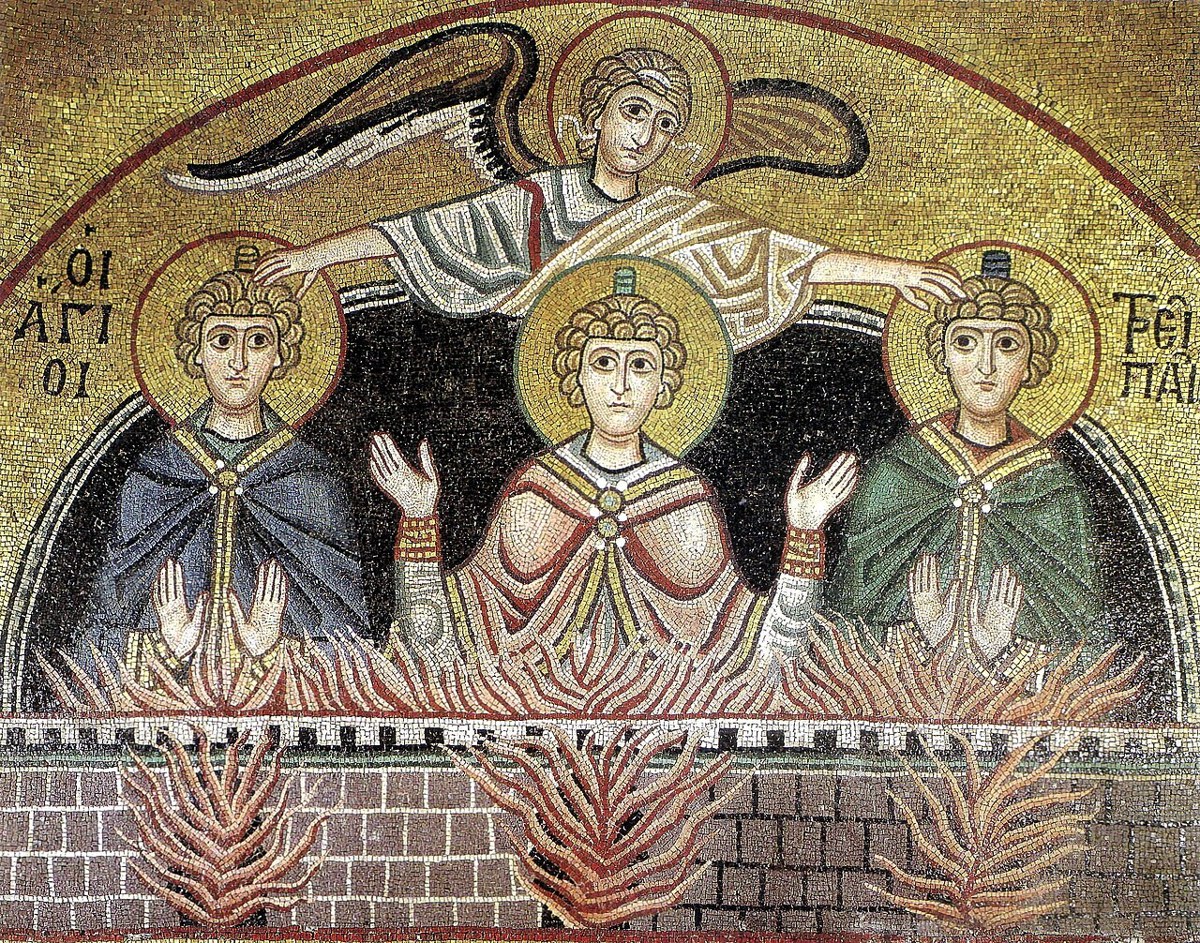
_-_Fiery_furnace_01.jpg)
The four youths in exile
With Daniel, the three were carried from Jerusalem to Babylon in the deportation under Nebuchadnezzar (c. 605 BC), chosen as noble youths "well favoured, and skilful in all wisdom" to be trained for the king's court and educated in the learning of the Chaldeans (Daniel 1). The chief of the eunuchs renamed them after the gods of Babylon — Hananiah ("the Lord is gracious") became Shadrach, Mishael ("who is what God is") became Meshach, and Azariah ("the Lord has helped") became Abednego — but they kept the faith of their fathers, sharing with Daniel the ten-day trial of the plain diet of pulse and water rather than defile themselves with the king's food, and with him receiving from God knowledge and skill in all learning.
The golden image and the furnace
The story on which their whole veneration rests is told in the third chapter of Daniel. Nebuchadnezzar set up a golden image sixty cubits high on the plain of Dura and commanded that at the sound of every kind of music all peoples should fall down and worship it, on pain of being cast into a burning fiery furnace. The three, holding office in the province of Babylon, would not bow. Denounced by the Chaldeans, they were brought before the enraged king, and gave the answer that has echoed through the Church ever since: "Our God whom we serve is able to deliver us from the burning fiery furnace, and he will deliver us out of thine hand, O king. But if not, be it known unto thee, O king, that we will not serve thy gods, nor worship the golden image which thou hast set up" (Daniel 3:17–18).
The king commanded the furnace heated seven times more than usual, and the flame leaping out slew the strong men who cast them in bound. But the three walked in the midst of the fire unharmed; and Nebuchadnezzar rose astonished: "Did not we cast three men bound into the midst of the fire?… Lo, I see four men loose, walking in the midst of the fire, and they have no hurt; and the form of the fourth is like a son of God." He called them out; the fire had had no power over their bodies, nor was a hair singed, nor the smell of fire upon them. And the king blessed the God of Shadrach, Meshach and Abednego, "who hath sent his angel, and delivered his servants that trusted in him."
The Song of the Three Youths
In the heart of the Greek text of the chapter stand two of the Church's most beloved liturgical texts: the Prayer of Azariah, confessing the sins of the people from the midst of the flame, and the Song of the Three Youths — the Benedicite, "Blessed art thou, O Lord God of our fathers… Bless the Lord, all ye works of the Lord" — in which the whole creation, sun and moon, fire and heat, frost and snow, whales and cattle and the children of men, is summoned to praise. The angel of the Lord, the text adds, came down and made the midst of the furnace "as it had been a moist whistling wind," so that the fire touched them not. This canticle is the seventh and eighth of the nine biblical odes sung at Matins, and every canon in the Byzantine rite therefore builds its seventh and eighth odes upon it, taking up again and again the refrain "Blessed art Thou" and "praise and exalt Him above all for ever."
Later life and repose
Scripture records nothing further of the three after the furnace. Like Daniel, they are held by tradition to have lived out their days in Babylon in old age and died in peace; some accounts have them return with the exiles or be put to death under a later king, but these are not harmonised in the sources. Their memory lives wholly in the one great confession and the canticle it gave the Church.
Feast and commemoration
December 17 (church date; Old Calendar civil December 30), kept with the Prophet Daniel. The placement is charged with meaning: the Church sets the three who stood unconsumed in the fire at the threshold of the Nativity, because the furnace is read as the supreme Old Testament type of the Incarnation. As the fire did not consume the youths, so the fire of the Godhead did not consume the Virgin who bore it; the very irmoi of the Nativity canon (the katavasiae "The dew-bearing furnace…") are built on their song, so that at the Feast itself the Church sings the furnace of Babylon as the figure of Bethlehem. The three are also numbered among the Holy Forefathers and Holy Fathers commemorated on the two Sundays before the Nativity.
The received calendars style them "the Three Holy Youths" or "Holy Children" and commemorate them liturgically among the prophets, alongside Daniel and on the strength of their canonical canticle; they are so classified here, though they are not, individually, called prophets in the manner of Daniel.
Hymns
Troparion — Tone 2
Great are the achievements of faith! In the fountain of flame, as by the waters of rest, the three holy Youths rejoiced; and the Prophet Daniel was shown to be a shepherd of lions as though of sheep. By their intercessions, O Christ God, save our souls.
Original translation from the Greek
Kontakion — Tone 6
You would not worship the image made by hands, but, armed with the Being that no hand can portray, O thrice-blessed ones, you were glorified in the contest of fire; and standing in the midst of the unmastered flame you called upon God: Hasten, O compassionate One, and speed, O merciful One, to our help, for Thou canst do all that Thou willest.
Original translation from the Greek
Iconography
The three are shown as youths in Persian court dress — belted tunics, soft peaked caps — standing frontally with hands raised in prayer amid tongues of red flame, the winged angel of the Lord descending among or above them, and often the figures of the king and the men who kindled the furnace to one side. The scene is among the oldest in Christian art, painted in the catacombs and carved on sarcophagi as an image of deliverance and resurrection, and it becomes a fixed subject of Byzantine and later iconography, frequently paired with Daniel in the lions' den. The stored image is the eleventh-century mosaic of the fiery furnace in the monastery church of Hosios Loukas in Greece.
Disputed questions
- Names. The three are commemorated by their Hebrew names (Ananias/Hananiah, Azarias/Azariah, Misael/Mishael); the Babylonian names Shadrach, Meshach and Abednego are those imposed at court (Daniel 1:7).
- Not to be confused with the several other saints named Ananias: Ananias of Damascus, the Apostle of the Seventy (October 1), or Ananias the Persian, martyr (December 1). The Ananias of this feast is the youth of the furnace.
- Azarias distinct from the prophet Azariah. The Azarias of this feast is not to be confused with the Old-Testament Prophet Azariah son of Oded, who prophesied to King Asa of Judah (2 Chronicles 15) and is commemorated on February 3 — a different figure of an earlier age, sharing only the common Hebrew name.
- Classification. Their liturgical grouping among the prophets follows the usage of the Menaion and rests on their canonical canticle; see Feast and commemoration below.