
Ananias of Damascus
The Holy Apostle Ananias of the Seventy, First Bishop of Damascus, Hieromartyr
Apostle of the Seventy · Apostle · Hieromartyr · Bishop
Commemorated 4 January — Synaxis of the Seventy Apostles, 1 October — Martyrdom by stoning at Eleutheropolis
Ananias of Damascus, numbered among the Seventy Apostles, is the disciple to whom the Lord appeared in a vision after the conversion of Saul on the Damascus road, sending him to the street called Straight to lay hands on the persecutor and baptise him (Acts 9): it was through Ananias that Saul received his sight and became Paul. The tradition makes him the first bishop of Damascus — the city that is today the seat of the Patriarchate of Antioch — and a hieromartyr: having preached in Damascus and at Eleutheropolis in Palestine, he was tortured under the governor Lucian and stoned outside the city. He is commemorated on October 1.
.jpg)
The disciple at Damascus
Everything certainly known of Ananias comes from the Acts of the Apostles, where he enters the story at its hinge. There was already a community of disciples at Damascus within a few years of the Resurrection, and Ananias belonged to it; Paul himself, retelling his conversion to the Jerusalem crowd, describes him as "a devout man according to the law, having a good report of all the Jews which dwelt there" (Acts 22:12) — a man, that is, whose holiness even the synagogue acknowledged. The later tradition counts him among the Seventy sent out by the Lord (Luke 10), and makes him the head of the Damascus church from the beginning.
The baptism of Paul
When Saul of Tarsus, struck blind by the light on the Damascus road, lay fasting in the house of Judas, the Lord spoke to Ananias in a vision: "Arise, and go into the street which is called Straight, and enquire in the house of Judas for one called Saul, of Tarsus: for, behold, he prayeth" (Acts 9:11). Ananias's answer is one of the most human moments in Acts — he had heard from many about this man, "how much evil he hath done to thy saints at Jerusalem," and knew that Saul carried authority from the chief priests to bind all who called on the Name. The Lord's reply overrode the fear with the whole future of the Gentile mission: "Go thy way: for he is a chosen vessel unto me, to bear my name before the Gentiles, and kings, and the children of Israel." Ananias went, entered the house, laid his hands on the persecutor, and addressed him — first of all the Church — as "Brother Saul." Immediately something like scales fell from Saul's eyes; he received his sight, arose, and was baptised by Ananias. In Paul's own retelling, Ananias's words at the baptism ring like a commission: "The God of our fathers hath chosen thee… for thou shalt be his witness unto all men of what thou hast seen and heard. And now why tarriest thou? arise, and be baptised, and wash away thy sins, calling on the name of the Lord" (Acts 22:14–16). Thus the apostle of the nations entered the Church through the hands of Ananias, and the tradition has always honoured him as Paul's baptiser and, in that sense, the godfather of the Gentile mission.
Bishop of Damascus and martyrdom
The hagiographic tradition, carried by the Synaxarion of Constantinople and the later Greek and Slavic compilations, continues the story where Acts leaves off. Ananias governed the church of Damascus as its first bishop, preached the Gospel boldly in that city and its territory, and worked healings; he then carried his preaching south into Palestine, to Eleutheropolis, the city of the Shephelah between Jerusalem and Gaza. There the governor Lucian (the sources style him a hegemon under the Roman authority), unable to turn him from the faith either by persuasion or by threats, had him tormented — the accounts speak of scourging with raw hides and the raking of his sides, and some add the burning of his wounds with torches — and, when the old man remained immovable, had him led outside the city and stoned to death. The Greek synaxarion verses for October 1 seal the account with a grim symmetry: because he refused to render worship to stones, the impious made stones his death — "Stoned was Ananias on the first day of October." He is thus commemorated as a hieromartyr, an apostle of the Seventy who died a bishop, in his blood.
Veneration
At Damascus the memory of Ananias has never left the street called Straight. At its eastern end, near the Bab Sharqi gate of the old city, an ancient underground chapel — a cellar-church held by long tradition to be the house of Ananias — has drawn Christian pilgrims for many centuries and still does; for the Orthodox of the Patriarchate of Antioch, whose patriarch has his seat in Damascus, Ananias stands at the head of their own church's story, the first bishop of the city where the disciples' faith first conquered its fiercest enemy. In the West he is commemorated in the Roman Martyrology on January 25, in connection with the feast of the Conversion of Paul; the Byzantine calendar keeps October 1, and gathers him again with his fellows of the Seventy at their synaxis on January 4.
Feast and commemoration
October 1 (church date; Old Calendar civil October 14) is his primary feast, kept universally in the Byzantine rite; the Greek Menaion joins his service with that of Romanus the Melodist, and in the Slavic books both are sung under the feast of the Protection of the Theotokos, which rules the day in Russian usage. He is also commemorated with the Seventy at their synaxis on January 4, and in the Roman Martyrology on January 25.
Hymns
Kontakion — Tone 2
Thou most fervent helper in intercessions, who dost most swiftly hear them that ask: receive our supplication, O Ananias, and importune Christ to have mercy on us, who alone is glorified in the saints.
Original translation from the Greek
Troparion — Tone 3
O holy Apostle Ananias, intercede with the merciful God, that he grant unto our souls forgiveness of offences.
Original translation from the Greek
Iconography
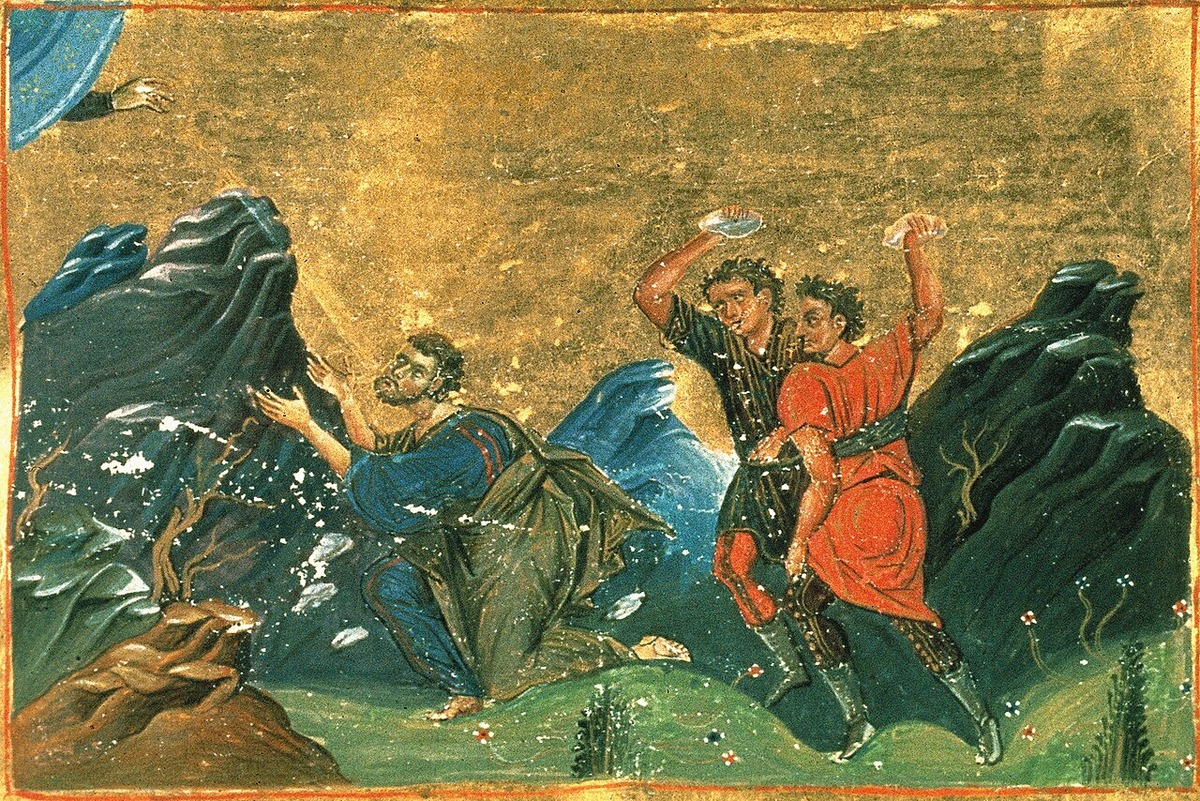
Ananias is painted as an aged apostle-bishop, in phelonion and omophorion, with the Gospel book; scenes of his life show him laying his hands on the blinded Saul or baptising him. The Menologion of Basil II gives his martyrdom instead: the stored miniature (c. 985) shows the old man kneeling in prayer among the rocks outside Eleutheropolis, the hand of God appearing from heaven to receive him, while two executioners cast their stones.
Disputed questions
- No year of death is transmitted; the martyrdom is placed generically in the first century, within the first persecutions.
- The details of the passion (the torments, the governor's name) rest on the synaxarion tradition, not on Acts; the manuscripts vary in small points, though the stoning at Eleutheropolis is constant.
- Later claims concerning the resting place of his relics are various and poorly attested, and no single tradition commands agreement; they are therefore not asserted here.
- Not to be confused with the Ananias of the Old Testament — one of the Three Holy Youths of the Babylonian furnace (Hananiah/Shadrach), commemorated December 17 — nor with Ananias the Persian, martyr (December 1).