
Anastasia the Roman
The Holy Venerable-Martyr Anastasia the Roman
Venerable Martyr · Virgin · b. c. 236 — d. c. 256
Commemorated 29 October — Martyrdom
Anastasia the Roman (died c. 256) was an orphan raised from infancy in a community of consecrated virgins near Rome under an abbess named Sophia, and put to death for Christ while still a young woman during the third-century persecutions — the sources name the emperor Decius or Valerian and the city-prefect Probus. Refusing either to sacrifice to the idols or to renounce her virginity, she endured a succession of savage tortures and was at last beheaded. Because she was both a nun and a martyr, the calendars style her a venerable-martyr; she is one of several early virgin-martyrs surnamed "the Roman," and is commemorated on October 29.
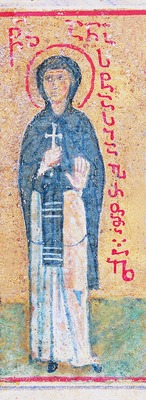
.jpg)
Origins and formation
Anastasia's Life, transmitted in the Greek synaxaria and read in the Byzantine menologia from an early date, opens with a childhood already given wholly to God. Orphaned of both parents at the age of three, she was taken in and raised not by kin but by a woman named Sophia — in the received account the abbess of a small community of ascetic virgins established outside the walls of Rome. Sophia, herself renowned for holiness, brought the child up in the fear of God, in the study of the Scriptures, and in the discipline of the monastic life, so that Anastasia grew to womanhood knowing no other manner of living than prayer, fasting, and the confession of Christ. By the age of about twenty she was, the synaxarion says, of striking beauty and of a settled and fearless faith.
The confession and arrest
The community's very seclusion could not hide it from a persecution that sought out Christians in every quarter. Denounced as a Christian and as the head — young though she was — of a household of women who would not sacrifice, Anastasia was seized by the soldiers of the local authority and brought before the prefect, whom the sources name Probus. Sophia, according to the Life, sent her spiritual daughter out to the contest with words of encouragement rather than restraint, arming her against the two things the persecutor would demand: the offering of incense to the gods, and the surrender of her virginity to dishonour. Anastasia refused both. Brought to the tribunal, she confessed Christ openly, declaring — in the words her office puts on her lips — that Christ was her riches and her boast, and that she desired to die for him in order to live with him.
Martyrdom
The tortures that followed are described in the tradition, and echoed in her hymns, with unusual specificity. Stripped and beaten, she was stretched out and scourged; her body was burned and cut; the accounts speak of her teeth being struck out, her nails torn away, and her breasts, hands, and feet severed. Her tongue, in some recensions, was cut out, yet she is said to have continued to confess Christ. Through it all she reviled the idols and would not yield. Sentence of death was at last passed, and she was beheaded, receiving the martyr's crown while still a young woman. The tradition adds that a priest named Cyril, who out of compassion had given the tormented saint water to drink, was himself put to death for the act and is remembered with her; and that her body, cast out unburied, was recovered and interred by Sophia, who had raised her.
Veneration
Anastasia was received into the calendar of the Great Church of Constantinople and stands in the classical synaxaria under October 29, whence her feast passed into the Greek, Slavonic, and Antiochian usage alike. Her cult belongs to the wider Roman and Byzantine veneration of the early virgin-martyrs; her relics and a share of her memory were long honoured at Constantinople and at Rome, and she is invoked in her office as a healer of the sick who come to her "from the heart."
Feast and commemoration
October 29 (church date; Old Calendar civil November 11), her martyrdom, kept universally in the Byzantine rite. She is the principal commemoration of the day, sharing it chiefly with the venerable Abraham the Recluse of Mesopotamia and his niece Mary. Her service in the Menaion is that of a venerable-martyr, joining the office of a nun to that of a virgin-martyr.
Hymns
Troparion — Tone 4
Thy lamb Anastasia, O Jesus, cries out with a loud voice: "Thee, O my Bridegroom, I love, and seeking Thee I endure the contest; I am crucified and buried with Thee in Thy baptism, and I suffer for Thy sake, that I may reign with Thee; I die for Thee that I may live in Thee. Accept me as a spotless sacrifice, offered to Thee in love." At her entreaties, as Thou art merciful, save our souls.
Original translation from the Greek
Kontakion — Tone 3
Cleansed by the waters of virginity, O venerable one, and crowned by the blood of martyrdom, O Anastasia, thou grantest to those beset by illness healing and salvation, to all who draw near thee from the heart; for Christ gives thee strength, pouring forth ever-flowing grace.
Original translation from the Slavonic
Iconography
Anastasia is depicted as a young nun-martyr: in the dark tunic and veil of the monastic habit, holding the cross of martyrdom, sometimes with the palm of victory; scenes of her passion show her before the prefect or amid the instruments of her torture. The stored image is a fragment of her miniature from a fifteenth-century Greek-Georgian menologion manuscript now in the National Library of Russia, St. Petersburg, where she is inscribed as the venerable-martyr Anastasia the Roman.
Disputed questions
- Emperor and date. The Greek tradition most often sets her passion under Decius (reigned 249–251); other witnesses, and the Wikidata identification, name Valerian (253–260). The conventional date c. 256 followed here suits Valerian; if Decius is preferred the death falls c. 250–251. The prefect is named Probus in the Life. The discrepancy is recorded, not resolved, and is flagged for verification against a fuller critical synaxarion.
- "The Roman" and the several Anastasias. She is not to be confused with the great-martyr Anastasia the Deliverer-from-Bonds (Pharmakolytria, the "Younger"; †c. 304 under Diocletian, of Sirmium and Rome), commemorated December 22 — a married woman and reliever of prisoners, a wholly distinct saint; nor with Anastasia of Sirmium, with whom that December saint is herself sometimes merged. Our Anastasia, the virgin raised by Sophia and martyred young, is the one the tradition calls "the Elder." A martyr "Anastasia the Virgin" is also listed by some Greek books on October 12; whether that entry is a doublet of this feast or a separate saint is unsettled, and is flagged here for resolution when the October 12 commemoration is authored.
- Distinct also from the venerable Anastasia the Patrician. She is not to be confused with the venerable Anastasia the Patrician (March 10), the sixth-century patrician of Constantinople who fled the court of Justinian and died a hidden ascetic at Scetis — a monastic saint who reposed in peace, not a martyr.
- Byname "of Thessalonica." Some Slavonic calendars add the epithet Солунская (of Thessalonica) to her name; the primary tradition places her formation and passion at Rome, and the added byname is not universally kept.
- Distinct from the first-century Anastasia of Rome. She is also not to be confused with the martyr Anastasia of Rome who, with Basilissa, buried the martyrs under Nero and was beheaded c. 68 (April 15) — a saint of the apostolic age, not of the third century.