
Anastasia the Deliverer-from-Bonds
The Holy Great-martyr Anastasia the Deliverer-from-Bonds (Pharmakolytria)
Great Martyr · d. c. 304
Commemorated 22 December — Martyrdom
Anastasia the Deliverer-from-Bonds (†c. 304) is one of the great virgin-martyrs of the Church, a noble Roman woman of the persecution of Diocletian who gave her wealth and her freedom to the service of the confessors filling the prisons of the empire. Disguised as a beggar, she went from city to city feeding, tending, ransoming and burying imprisoned Christians, and was herself at last seized, starved, and burned alive. Because her intercession heals the effects of poisons, potions and every noxious thing, the Greek Church surnames her Pharmakolytria, "deliverer from potions"; the Slavs, remembering her ministry to prisoners, call her Uzoreshitelnitsa, "loosener of bonds." Her relics were translated to Constantinople in the fifth century. She is commemorated on December 22, within the forefeast of the Nativity.

Origins and early life
Anastasia was, the received Life says, a Roman by birth and of senatorial rank, born in the later third century to a pagan father, Praetextatus, and a mother, Fausta, who was secretly a Christian. Her mother saw to it that the child was placed under a learned and devout Christian named Chrysogonus, who instructed her in the Scriptures and in the faith, and to whom Anastasia remained bound in spiritual discipleship all her life. After her mother's death her father married her to a pagan of rank named Publius (Pomplios); but Anastasia, resolved to keep herself for Christ, put off the consummation of the marriage by feigning continual sickness, and so preserved her virginity within the married state.
Ministry to the imprisoned
The great persecution had filled the prisons of Rome and of the provinces with confessors awaiting torture and death, and to these Anastasia gave herself wholly. Clothing herself in the mean dress of a beggar-woman and taking only a single maidservant, she made her way secretly into the prisons, where she washed and dressed the wounds of the tortured, brought them food and medicine, and spent her substance ransoming those who could be bought free. When her servant betrayed these visits to Publius, he beat his wife and shut her up under guard in the house, meaning to break her and seize her fortune. From her confinement Anastasia corresponded in secret with her old teacher Chrysogonus, who was himself now imprisoned; he wrote back exhorting her to patience, to cleave to the Cross, and to await the Lord's deliverance, and foretold that Publius would shortly die. Publius did drown at sea, lost with an embassy that was sailing to Persia, and Anastasia, freed and now mistress of her own wealth, poured it out upon the poor and the suffering and returned openly to her ministry.
The martyrs she served
Her Life is threaded through the passions of those she attended, several of whom the Church commemorates with her on this day. When Diocletian, hearing how steadfastly the Christians in the Roman prisons endured, ordered them all put to death in a single night, he had Chrysogonus brought to him at Aquileia; the emperor could not move him to sacrifice and had him beheaded and his body cast into the sea. The head and body were carried to shore and found by a presbyter named Zoilus, who laid them reverently in a chest in his house. Chrysogonus appeared to Zoilus in a vision, telling him that three Christian sisters living nearby — Agape, Chionia and Irene (commemorated April 16) — would soon be martyred, that Anastasia should be sent to strengthen them, and that Zoilus himself would fall asleep within nine days; all of which came to pass. Anastasia encouraged the three maidens before their contest and buried them when they had died. Continuing from city to city, she took as her helper a pious young widow, Theodota, who with her three sons soon received the crown of martyrdom, being cast at last into a burning furnace.
Martyrdom
Anastasia was seized in Illyricum, where she had gone to seek out the prisoners and, finding a prison already emptied by a night's slaughter, had been heard weeping for the dead. Brought before the governor of the province and then handed over to a pagan priest, Ulpian, at Rome, she was offered the choice between riches and honour on the one side and the instruments of torture on the other, and chose the instruments. Ulpian, granting her three days to reconsider and thinking meanwhile to defile her, was struck blind and mad when he approached her, and died. Set free, Anastasia returned once more to the prisoners until she was arrested again and condemned to die of hunger; she is said to have been kept without food for sixty days, sustained in visions by the martyred Theodota. When starvation did not kill her, the judge ordered her put aboard a scuttled ship with other condemned prisoners, among them a Christian named Eutychianus, to be drowned; the vessel was steered miraculously to land, and the survivors, some hundred and twenty souls, were baptized before being recaptured and martyred. Anastasia herself was stretched out between four stakes over a fire and burned alive. Her body, untouched by the flames, was recovered and buried in her garden by a devout woman named Apollinaria, who raised a church over the grave. The Greek synaxarion's verses remember her end precisely: "a great remedy to the faithful, loosing every poison, and herself consumed by fire."
Relics and translations
In the fifth century, under the emperors of the East, Anastasia's relics were translated to Constantinople and enshrined in a church that took her name — the church "of the Resurrection" (Anastasis), long a famous sanctuary of the capital, associated in tradition with Gregory the Theologian, who had preached there during the Arian ascendancy. From Constantinople portions of the relics were dispersed: her head and one hand are venerated at the great Monastery of Saint Anastasia the Deliverer-from-Potions on the Chalkidiki peninsula near Mount Athos, which bears her name to this day.
Veneration and later cultus
Anastasia's cult was universal and ancient in both East and West. In the East she is one of the pre-eminent women great-martyrs, and two epithets fixed themselves to her name, each drawn from a facet of her life. The Greek Pharmakolytria — "deliverer from potions" — plays on the double sense of the Greek pharmakon (a drug that may heal, poison, or work sorcery) and the verb lyō, "to loose": she is invoked against poisonings, harmful drugs, sorcery, and every noxious thing, a patroness of healing. The Slavonic Uzoreshitelnitsa — "loosener of bonds," "deliverer from fetters" — keeps the memory of her ministry to prisoners, and she is honoured as the protectress of captives, of those in prison, and of women in the pains of childbirth. In the West she is venerated as Anastasia of Sirmium; her name stands in the Roman Canon of the Mass, and the second Mass of Christmas Day (December 25) at Rome was from antiquity offered in her honour at the church of Sant'Anastasia, so that the Latin Church keeps her on the day the East calls the forefeast of the Nativity.
Feast and commemoration
December 22 (church date; Old Calendar civil January 4), her martyrdom, kept universally in the Byzantine rite and falling within the forefeast of the Nativity of Christ, whose forefeast hymns her own service in the Menaion is joined to. She has a full proper office. The Latin Church keeps her on December 25 as Anastasia of Sirmium, commemorated at the second (dawn) Mass of Christmas. Commemorated with her on December 22 are her teacher Chrysogonus, the widow Theodota and her children, and the presbyter Zoilus.
Hymns
Troparion — Tone 4
Named truly after the victorious Resurrection, O martyr of Christ, thou didst raise up trophies of victory over the enemy by thine endurance of torments, for the sake of Christ thy Bridegroom, whom thou didst love. Entreat him, then, to save our souls.
Original translation from the Slavonic
Kontakion — Tone 2
They that are in trials and afflictions, fleeing for refuge to thy temple, receive the sacred gifts of healing from the divine grace that dwelleth in thee; for thou, O Anastasia, dost ever pour forth healings upon the world.
Original translation from the Greek
Iconography
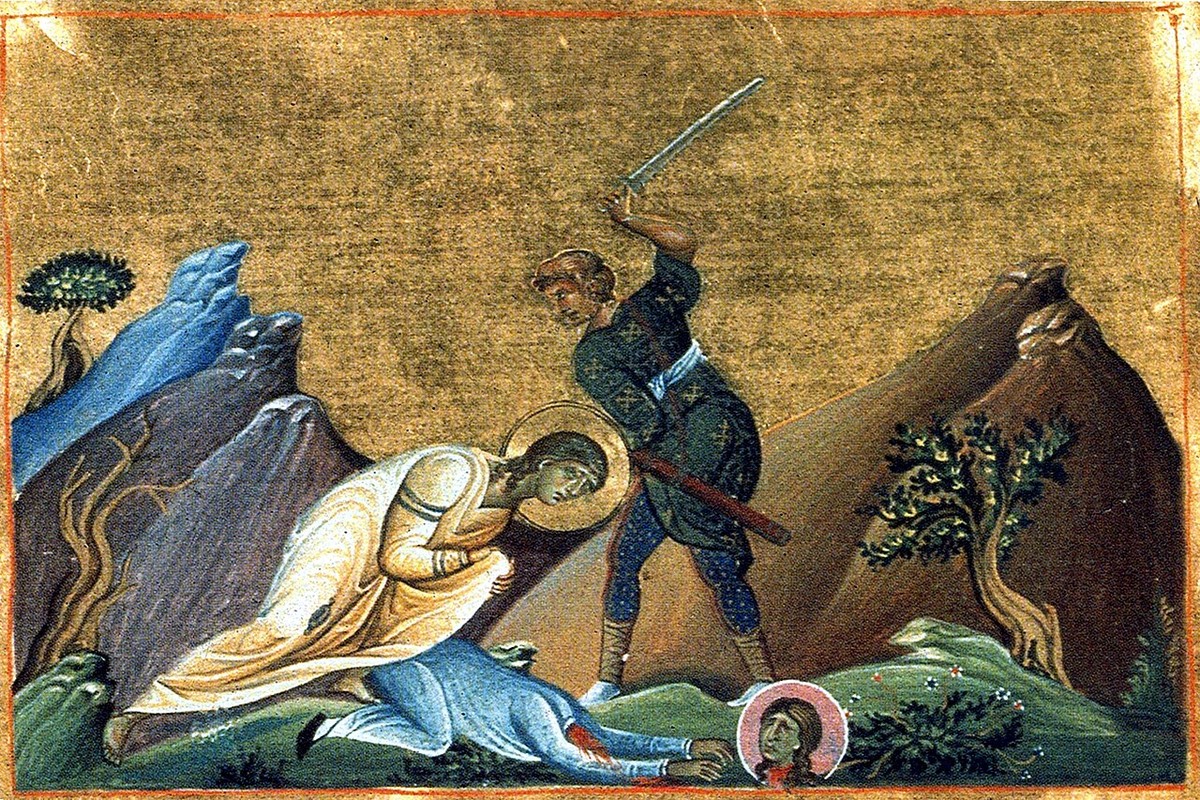
Anastasia is depicted as a woman martyr in the maphorion, holding the cross of martyrdom, and very often a small vessel or flask — the pharmakon, the phial of medicine or of healing balm, her distinctive attribute as Pharmakolytria and the sign of her ministry to the sick and imprisoned. In Russian iconography as Uzoreshitelnitsa she may hold a scroll or the healing vessel and is invoked by prisoners and the sick. The stored image is her miniature from the Menologion of Basil II (Constantinople, c. 1000, Vatican Library), where she is inscribed as the holy great-martyr Anastasia the Deliverer-from-Bonds.
Disputed questions
- Sirmium, Rome, and the shape of the legend. The historical martyr behind the veneration is generally taken to be a woman martyred at Sirmium in Pannonia in the persecution of Diocletian, whose relics were later carried to Constantinople; the elaborate Byzantine passio that makes her a Roman senator's daughter, disciple of Chrysogonus and minister to the prisons, is a later hagiographic development that gathered several distinct martyrs (Chrysogonus of Aquileia, the sisters of Thessalonica, Theodota) into one cycle. The Church receives the whole tradition liturgically; historians distinguish the Sirmium martyr from the legend built around her. Some accounts accordingly treat "Anastasia of Sirmium" and "Anastasia Pharmakolytria" as the same saint under two names, others keep them apart; the identification is recorded here, not resolved (the live Wikidata entity Q232975 equates them).
- Not to be confused with the venerable-martyr Anastasia the Roman (October 29), an orphan virgin-nun raised by the abbess Sophia and beheaded in the third century — a wholly distinct saint, sometimes styled "the Elder" against this great-martyr's "the Younger." A martyr "Anastasia the Virgin" listed by some Greek books on October 12 is a further, unsettled case noted at that entry. Nor is she to be confused with the male monk-martyr Anastasius the Persian (January 22), the seventh-century Persian convert whose near-identical name — and popular association with loosing from captivity — invites the mix-up; nor with the venerable Anastasia the Patrician (March 10), the sixth-century noblewoman of Constantinople who died a hidden ascetic in the Egyptian desert.
- Manner of death. The Greek synaxarion and its verses have her burned alive; the fuller Life adds the detail of her being stretched between four stakes over the fire. Both belong to the received tradition.