
Andrew the First-Called
The Holy, Glorious, All-Praised and First-Called Apostle Andrew
Apostle · b. Bethsaida of Galilee, early 1st century — d. c. 60–70, crucified at Patras in Achaia
Commemorated 30 June — Synaxis of the Twelve Apostles, 30 November — Martyrdom by crucifixion at Patras
Andrew the First-Called (first century) was a fisherman of Bethsaida, the brother of Simon Peter, and — as a disciple of John the Baptist who heard him name Christ "the Lamb of God" — the first of the apostles to follow the Lord, whence his ancient title Prōtoklētos, "the First-Called." Having found the Messiah, he at once brought his brother Peter to Christ. After Pentecost the tradition sends him to preach around the Black Sea — through Asia Minor, Thrace, Scythia, and the lands of the Rus', where he is said to have blessed the hills of Kiev — and above all to Byzantium, where he ordained Stachys its first bishop, so that the Church of Constantinople venerates him as its founder. He was crucified on an X-shaped cross at Patras in Achaia and is commemorated on November 30, and among the Twelve on June 30.

Origins and the calling
Andrew (Ἀνδρέας, a Greek name from andreia, "manliness, courage") was born at Bethsaida on the Sea of Galilee, the son of Jonah (or John) and the younger brother — the tradition is not wholly consistent on the seniority — of Simon, whom the Lord would name Peter. With Peter he kept a fishing partnership on the lake that also joined them to the sons of Zebedee, James and John (Luke 5:10). The Gospels remember him as one of the small circle of Galileans around Jesus who came originally from the same town, "the city of Andrew and Peter" (John 1:44).
Before he was a disciple of Christ, Andrew was a disciple of John the Forerunner, drawn out to the Jordan by the preaching of repentance. The fourth Gospel gives the scene that fixed his title: John the Baptist, standing with two of his own disciples, looked upon Jesus walking and said, "Behold the Lamb of God"; and the two disciples heard him and followed Jesus. One of them was Andrew; the other, unnamed, the tradition takes to be John the Evangelist. Jesus turned and asked what they sought, and they stayed with him that day. "Andrew, Simon Peter's brother," the evangelist continues, "first findeth his own brother Simon, and saith unto him, We have found the Messias, which is, being interpreted, the Christ. And he brought him to Jesus" (John 1:35–42). On this passage rests the whole meaning of Andrew's name in the Church: he was the first called, prōtoklētos, and his first act as a disciple was to become himself a caller, bringing to Christ the very brother who would become the chief of the apostles. The cry he carried — "we have found the One we sought" — became the refrain of his kontakion.
That first following by the Jordan was not yet the permanent call. The Synoptic Gospels record the second and decisive summons by the lakeside, when Jesus, "walking by the sea of Galilee, saw two brethren, Simon called Peter, and Andrew his brother, casting a net into the sea; for they were fishers. And he saith unto them, Follow me, and I will make you fishers of men. And they straightway left their nets, and followed him" (Matthew 4:18–20; Mark 1:16–18). From that day Andrew belonged to the Twelve, and he stands in every Gospel list of the apostles — always among the first four, though never in the innermost three of Peter, James, and John.
In the Gospels
Andrew appears by name at several turning-points of the Gospel where his instinct is the same as at his calling: to bring people to Christ. At the feeding of the five thousand it is Andrew who notices the boy with the five barley loaves and two small fishes and brings the matter to the Lord — "there is a lad here… but what are they among so many?" — the small thing offered that the Lord multiplies (John 6:8–9). In Holy Week, when certain Greeks who had come up to the feast approached Philip saying "Sir, we would see Jesus," Philip told Andrew, and Andrew and Philip together told Jesus (John 12:20–22) — an episode the Church treasures as a first sign of the calling of the nations, and fitting to the apostle whose later missions the tradition sets among the Greek-speaking cities of the Black Sea. And on the Mount of Olives Andrew is named with Peter, James, and John among the four who asked the Lord privately about the destruction of the Temple and the end of the age, drawing out the great eschatological discourse (Mark 13:3–4). After the Resurrection he is numbered among the apostles gathered in the upper room who received the Holy Spirit at Pentecost (Acts 1:13).
The missions
Of Andrew's apostolate after Pentecost the New Testament says nothing; the traditions are drawn from the second- and third-century apocryphal Acts of Andrew, from the catalogues and synaxaria, and — for the northern journeys — from later Byzantine and Slavic sources. They are recorded here as tradition, with their layers distinguished, for they carry immense weight in the self-understanding of two of the great Churches.
The oldest and most widely attested tradition, already known to Origen (as Eusebius reports), assigns Andrew to Scythia — the lands north and east of the Black Sea — and this is why the Eastern Slavs came to claim him as their own apostle. From a base in Asia Minor the Acts and the synaxaria carry him through Cappadocia, Galatia, and Bithynia, along the Pontic coast to Sinope (where, they say, the pagans stoned and savaged him, and he was healed and went on), to Trebizond and the Caucasus, into the Crimea and the Greek cities of the northern shore, and among the Scythian and Sarmatian peoples of the interior. Everywhere the pattern is the same: preaching, miracles, the raising of churches, the ordaining of bishops and clergy, and persecution endured.
To this Pontic mission the Rus' tradition attached its own most cherished episode. The Primary Chronicle of Kiev relates that Andrew, journeying up the Dnieper, halted for the night beneath the hills where Kiev would later stand, and rising in the morning said to his companions: "See these hills? Upon these hills shall shine forth the grace of God; here shall be a great city, and God shall raise up many churches." He climbed the hills, blessed them, and set up a cross; and (the chronicle continues) he went on north to the place of Novgorod and thence, by way of the Varangian lands, to Rome. Historians regard the Kievan journey as a patriotic elaboration of later centuries rather than sober history — the geography is impossible for a first- century apostle — but its theological purpose is plain and was decisive: it gave the Church of Rus' an apostolic founder, tying the daughter directly to the apostolic age and, through Andrew's other great foundation, to the mother Church of Constantinople.
For it is Byzantium that stands at the centre of Andrew's cultus. The tradition, transmitted in the catalogues of the Seventy and firmly held at Constantinople, is that Andrew came to the small Greek town of Byzantium on the Bosphorus, preached there, and before departing ordained Stachys — one of the Seventy, greeted by Paul in Romans 16:9 — as its first bishop, setting him over a church at Argyropolis (see Stachys and his companions, kept October 31). On this apostolic ordination rests the claim of the Ecumenical Patriarchate to Andrew as the founder of its see: the bishops of Byzantium-Constantinople reckon their succession from Stachys and so from Andrew himself. The claim carried, and still carries, real ecclesiological freight. Against the Roman see's foundation by Peter, chief of the apostles, Constantinople set the foundation by Andrew — Peter's own elder brother, and, crucially, the one called before Peter, the First-Called who had brought Peter to Christ. The Andrew–Peter parallel became a standing feature of the dialogue and the rivalry between the two sees: New Rome answered Old Rome not by denying Peter's primacy of honour but by claiming his brother, and his senior in the following of Christ. To this day the Patriarch of Constantinople keeps November 30 as his patronal feast, and by long custom the Churches of Rome and Constantinople exchange delegations on each other's apostolic feasts — Rome to the Phanar for St Andrew, Constantinople to Rome for Sts Peter and Paul.
Martyrdom at Patras
The last and best-attested stage of the tradition brings Andrew to Achaia, in the Peloponnese, and to the city of Patras, where he was to receive his crown. The Acts and the synaxaria tell that his preaching and miracles won over almost the whole city: the sick were healed and the blind given sight; the notable citizen Sosios was raised from mortal illness, and Maximilla, the wife of the proconsul, and Stratokles, the proconsul's brother, were healed and believed. The proconsul himself, Aegeates (Aegeatos), remained a hardened pagan, and — enraged the more when his own wife embraced continence and the faith — ordered the apostle scourged and crucified.
By the tradition, Andrew was not nailed but bound to the cross, hand and foot, that his dying might be the longer; and the cross was set not upright in the Roman manner but in the form of the Greek letter chi (Χ), an X — the crux decussata, which from this martyrdom the Christian world has called St Andrew's Cross (the saltire). Seeing the instrument of his death, the apostle is said to have greeted it with joy, saluting "the good cross" on which his Lord had hung. For two days, still living, he preached to the crowds gathered about him; and when the people, moved to pity, pressed Aegeates to release him and the proconsul relented for fear of a riot, Andrew prayed that he might not be taken down but be counted worthy to die as his Master had died. A radiance of divine light, the accounts say, encompassed the cross; and when it faded the apostle had given up his soul, with the words, "Lord Jesus Christ, receive my spirit." Maximilla took down the body and buried it with honour. The Church keeps the day of this martyrdom, November 30, as his principal feast.
Relics and translations
Andrew was buried at Patras. In the fourth century — under Constantius, son of Constantine the Great, about the year 357 — the greater part of his relics was translated to Constantinople and laid in the Church of the Holy Apostles, beside those of the Evangelist Luke and of Timothy the disciple of Paul, in the mausoleum of the emperors: a translation whose theological point was of a piece with the Byzantine claim to the apostle. There they rested through the Byzantine centuries.
The head of the apostle remained at Patras, and around his relics the city kept his cultus. In 1204, at the sack of Constantinople by the Fourth Crusade, the cardinal Peter of Capua carried the body of Andrew west to his own city of Amalfi in southern Italy, where it lies in the crypt of the cathedral of Sant'Andrea to this day, and where the faithful record a periodic exudation of a fragrant liquid, the "manna of St Andrew." The head, when Patras fell under Ottoman threat in 1460, was brought by the despot Thomas Palaiologos to Rome and given to Pope Pius II, who enshrined it in St Peter's; there it stayed for five centuries. In 1964, in a gesture of reconciliation, Pope Paul VI returned the head of the Apostle Andrew to Patras, where it is venerated in the great modern basilica of St Andrew — the head home at last in the city of his martyrdom, and a portion of the relics returned from Amalfi and Rome in later exchanges.
By a much later and independent tradition of the medieval West, a monk named Regulus (Rule) is said to have carried certain relics of the apostle from Patras to the eastern coast of Scotland, to the place that became the town and see of St Andrews; the apostle was taken as the patron of the Scottish nation, and his X-shaped cross, the white saltire on a blue field, became — and remains — the flag of Scotland.
Veneration and later cultus
Andrew is honoured across the whole Christian world, East and West, but with a particular intensity in the Churches that claim him as founder or patron: Constantinople, where he is the apostle of the see and the Patriarch's feast; Russia and the other Eastern Slavs, whose apostolic charter the Kievan blessing supplied, and whose highest chivalric honour, the Imperial Order of St Andrew the First-Called, founded by Peter the Great, took its blue saltire from his cross and its motto from his title; Greece, where Patras keeps him as its patron and the return of his head in 1964 renewed his cultus; Georgia, whose tradition also numbers Andrew among the apostles who first brought the Gospel into the Caucasus, keeping on this day the "Entrance of the Apostle Andrew into Georgia"; and Scotland and the many nations, cities, and orders of the West that bear his name. The correspondence between his title, the First-Called, and Peter's, the Chief, gave the two brothers a paired place in the Church's imagination that runs from the Gospel of the calling to the diplomacy of the sundered sees.
Feast and commemoration
November 30 (church date; Old Calendar civil December 13) is Andrew's principal feast, the day of his martyrdom, kept universally across the Byzantine-rite calendars — Antiochian, Greek, Slavic, and OCA — with a full festal service, and observed at Constantinople as the patronal feast of the Ecumenical Patriarchate. It falls within the Nativity Fast; on this rank of apostolic feast the fasting discipline is typically relaxed to permit fish, wine, and oil, though local practice varies. On June 30 Andrew is commemorated with his brethren in the Synaxis of the Twelve Apostles. The Latin Church keeps St Andrew on the same day, November 30, where it opens the Western liturgical year (the First Sunday of Advent falls on or nearest his feast). On November 30 the calendars also join to Andrew several Georgian commemorations bound to his mission — the Entrance of the Apostle Andrew into Georgia, and the Catholicoi and kings associated with the Georgian Church — and, in the American Churches, the recently glorified Sebastian Dabovich.
Hymns
Troparion — Tone 4
As the First-called of the Apostles and brother of their chief, O Andrew, entreat the Master of all to grant peace to the world and to our souls great mercy.
Original translation from the Greek
Kontakion — Tone 2
Let us praise Andrew, the God-speaking namesake of courage and the First-called of the Savior's disciples, the own brother of Peter; for as of old he cried to his brother, so now he cries to us: "Come, we have found the One whom we have longed for!"
Original translation from the Greek
Appointed readings
Epistle — 1 Corinthians 4:9–16
9For I think that God hath set forth us the apostles last, as it were appointed to death: for we are made a spectacle unto the world, and to angels, and to men. 10We are fools for Christ’s sake, but ye are wise in Christ; we are weak, but ye are strong; ye are honourable, but we are despised. 11Even unto this present hour we both hunger, and thirst, and are naked, and are buffeted, and have no certain dwellingplace; 12And labour, working with our own hands: being reviled, we bless; being persecuted, we suffer it: 13Being defamed, we intreat: we are made as the filth of the world, and are the offscouring of all things unto this day. 14I write not these things to shame you, but as my beloved sons I warn you. 15For though ye have ten thousand instructers in Christ, yet have ye not many fathers: for in Christ Jesus I have begotten you through the gospel. 16Wherefore I beseech you, be ye followers of me.
Gospel — John 1:35–51
35Again the next day after John stood, and two of his disciples; 36And looking upon Jesus as he walked, he saith, Behold the Lamb of God! 37And the two disciples heard him speak, and they followed Jesus. 38Then Jesus turned, and saw them following, and saith unto them, What seek ye? They said unto him, Rabbi, (which is to say, being interpreted, Master,) where dwellest thou? 39He saith unto them, Come and see. They came and saw where he dwelt, and abode with him that day: for it was about the tenth hour. 40One of the two which heard John speak, and followed him, was Andrew, Simon Peter’s brother. 41He first findeth his own brother Simon, and saith unto him, We have found the Messias, which is, being interpreted, the Christ. 42And he brought him to Jesus. And when Jesus beheld him, he said, Thou art Simon the son of Jona: thou shalt be called Cephas, which is by interpretation, A stone. 43The day following Jesus would go forth into Galilee, and findeth Philip, and saith unto him, Follow me. 44Now Philip was of Bethsaida, the city of Andrew and Peter. 45Philip findeth Nathanael, and saith unto him, We have found him, of whom Moses in the law, and the prophets, did write, Jesus of Nazareth, the son of Joseph. 46And Nathanael said unto him, Can there any good thing come out of Nazareth? Philip saith unto him, Come and see. 47Jesus saw Nathanael coming to him, and saith of him, Behold an Israelite indeed, in whom is no guile! 48Nathanael saith unto him, Whence knowest thou me? Jesus answered and said unto him, Before that Philip called thee, when thou wast under the fig tree, I saw thee. 49Nathanael answered and saith unto him, Rabbi, thou art the Son of God; thou art the King of Israel. 50Jesus answered and said unto him, Because I said unto thee, I saw thee under the fig tree, believest thou? thou shalt see greater things than these. 51And he saith unto him, Verily, verily, I say unto you, Hereafter ye shall see heaven open, and the angels of God ascending and descending upon the Son of man.
Iconography
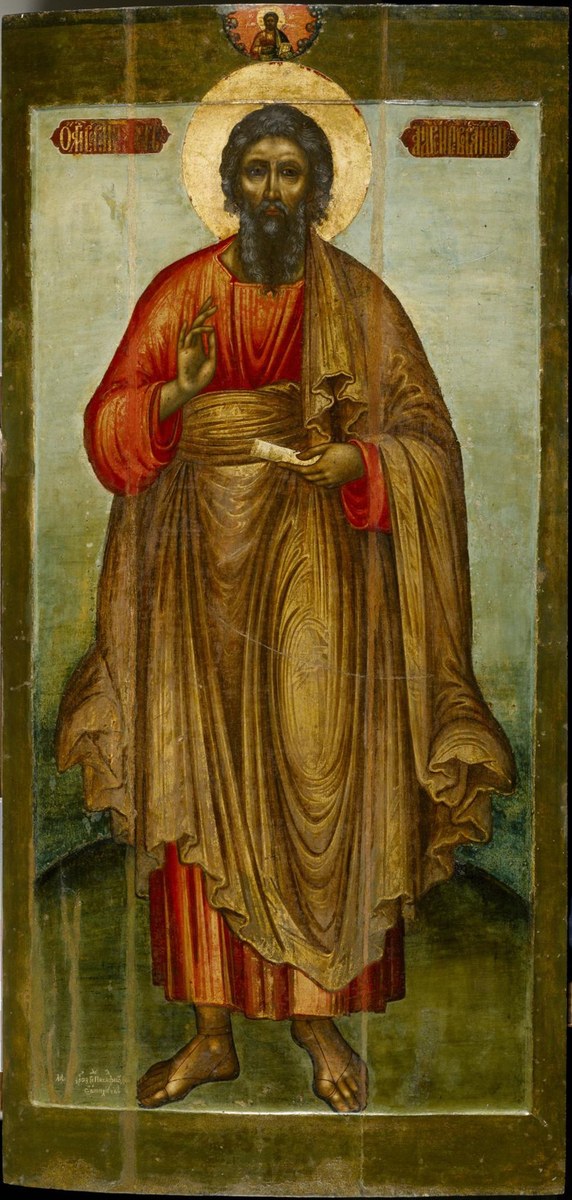
Andrew is among the most recognisable of the apostles in Orthodox iconography, identified less by an attribute than by his physiognomy: an old man with a high forehead and, above all, a shock of grey hair standing up in disordered locks and a full grey beard — the "wild-haired" apostle of the Byzantine painter's manuals, so that he can be picked out at a glance in any apostolic row. As one of the Twelve he stands in the Deesis tier of the iconostasis, in festal icons of Pentecost and the Ascension, in the Communion of the Apostles, and in the Synaxis of the Twelve. He holds a scroll, and by his first calling often bears a special dignity of place. Two subjects are proper to him. The martyrdom type shows him bound to the great X-shaped cross, the crux decussata that bears his name, often preaching from it to the crowd of Patras. The calling — Andrew by the Jordan turning to follow the Lamb of God, or bringing Peter to Christ — appears in Gospel illustration and in narrative cycles of his life. From the later Middle Ages his X-cross became a fixed Western attribute; in the East the disordered grey hair remains his surest mark.
The stored icon is a full-length Russian panel of 1669 by Fyodor Zubov, from the Chudov Monastery in the Moscow Kremlin: the apostle standing in red chiton and ochre himation, his right hand raised in blessing and a scroll in his left, with the characteristic upstanding grey hair, his identity fixed by the inscription flanking the halo ("Ο ΑΓΙΟΣ ΑΝΔΡΕΑΣ / the holy Andrew").