
Stachys, Amplias, Urban, Narcissus, Apelles and Aristobulus of the Seventy
The Holy Apostles of the Seventy Stachys, Amplias, Urban, Narcissus, Apelles and Aristobulus
Apostle of the Seventy · Apostle · Hieromartyr · Bishop · d. 1st century
Commemorated 4 January — Synaxis of the Seventy Apostles, 31 October — Joint memory of six apostles of the Seventy
Stachys, Amplias, Urban, Narcissus, Apelles and Aristobulus (1st century) are six of the Seventy Apostles, all greeted by name in the sixteenth chapter of the Epistle to the Romans and commemorated together on October 31. Stachys was ordained first bishop of Byzantium by the Apostle Andrew and shepherded his flock at Argyropolis for sixteen years before reposing in peace; Amplias (bishop of Diospolis) and Urban (bishop of Macedonia), also consecrated by Andrew, and Narcissus (bishop of Athens) died as martyrs for destroying idols; Apelles governed a church in Asia Minor; and Aristobulus, brother of the Apostle Barnabas, carried the Gospel to Britain, where he reposed in peace. The Church keeps their joint memory and numbers them again among the Seventy on January 4.
.jpg)
The six are known from the greetings of the Apostle Paul in Romans 16 and from the Byzantine catalogues of the Seventy ascribed to Hippolytus of Rome and to Dorotheus of Tyre, which assign each of them a see and a field of labour. No full passions survive; the synaxarion transmits a short notice on each, and it is from these that the tradition of the day is drawn.
Stachys, bishop of Byzantium
Stachys (Στάχυς, "ear of grain") is the disciple whom Paul salutes as "my beloved" in Romans 16:9. The tradition makes him the first bishop of the city of Byzantium — the future Constantinople — consecrated for that see by the Apostle Andrew the First-called, who is honoured as the founder of the Church of Byzantium and whose successors the patriarchs of Constantinople reckon themselves. Stachys built a church at Argyropolis on the Bosphorus, where great crowds gathered to hear him, and governed his flock with apostolic zeal for some sixteen years before reposing in peace. Because Andrew is counted at the head of the Byzantine succession, some lists number Stachys the second bishop of Byzantium and the first he himself appointed; the Church honours him as the first pastor set over the see that became the imperial city's.
Amplias, Urban and Narcissus
Amplias (Ἀμπλίας; the Ἀμπλιᾶτος, Ampliatus, of Romans 16:8, "my beloved in the Lord") and Urban (Οὐρβανός, the "fellow worker in Christ" of Romans 16:9) were both consecrated bishops by the Apostle Andrew. Amplias was set over Diospolis (Lydda), Urban over the churches of Macedonia. Both preached against the worship of idols, threw down the images of the pagan gods, and were put to death by the idolaters — martyr-bishops of the first generation.
Narcissus (Νάρκισσος), greeted with his household in Romans 16:11, was appointed bishop of Athens by the Apostle Philip. Like Amplias and Urban he was tortured and killed by the idol-worshippers for the boldness of his preaching.
Apelles
Apelles (Ἀπελλῆς), whom Paul salutes in Romans 16:10 as "approved in Christ," governed a church as bishop and brought many to the faith. The lists of the Seventy commonly place this Apelles at Smyrna, distinguishing him from the like-named Apelles of Heraclea kept on September 10 (see Disputed questions). He completed his course as a preacher of the Gospel; no martyrdom is recorded of him.
Aristobulus, apostle to Britain
Aristobulus (Ἀριστόβουλος), named in Romans 16:10 ("greet those who are of the household of Aristobulus"), is remembered in the tradition as the brother of the Apostle Barnabas of Cyprus. He is said to have been ordained bishop and sent to preach in Britain — the earliest apostle the Eastern tradition associates with the British Isles — where he endured many hardships among a fierce and unbelieving people, made converts, built up the Church, and at last reposed in peace. He is commemorated in his own right on March 16 (March 15 in Greek usage) as well as with this company on October 31, and his cultus as a founder of the British Church has an independent life in the West.
Feast and commemoration
October 31 (church date; Old Calendar civil November 13), the joint memory of the six apostles, closing the month of October. All six are numbered again in the Synaxis of the Seventy Apostles on January 4, and Aristobulus keeps a separate feast on March 16 (March 15 in the Greek calendars). The company is commemorated across the Byzantine-rite calendars (Antiochian, Greek, Slavic); the Greek Menaion gives the day's proper singing to the synaxarion notice, without individual hymns for the apostles.
Hymns
Troparion — Tone 3
Holy Apostles, intercede with the merciful God, that he grant to our souls the forgiveness of offences.
Original translation from the Greek
Iconography
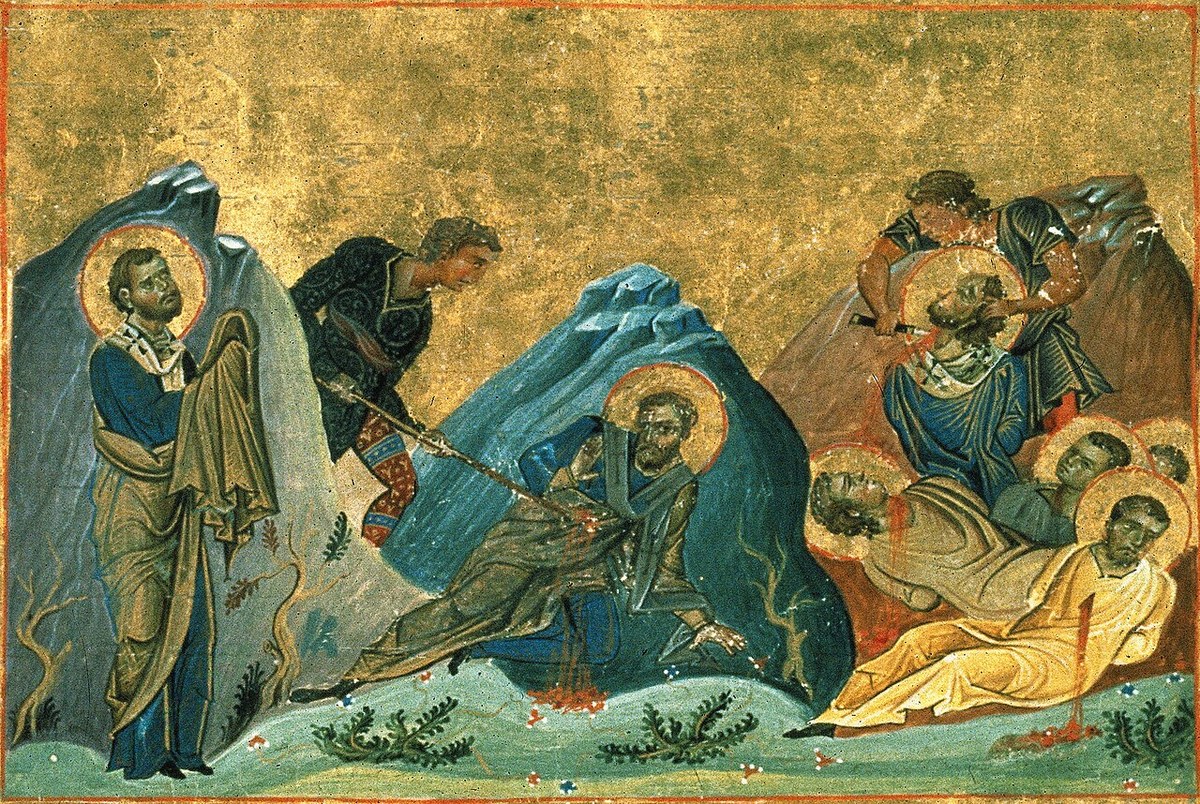
The six are painted as apostles of the first generation — as bishops in phelonion and omophorion holding the Gospel book, or in chiton and himation with scrolls — and appear in rows within synaxis icons of the Seventy. The stored image is a miniature from the Menologion of Basil II (Constantinople, c. 985; Vatican Library), which depicts three of the company — Stachys, Amplias and Urban — standing together; a fuller image showing all six, or the two martyr-bishops and Aristobulus, is still wanted.
Disputed questions
- Which Apelles? A second apostle named Apelles is commemorated on September 10 — Apelles of Heraclea, joined there with Lucius and Clement. The manuscript catalogues of the Seventy repeatedly confuse the two (and both with Apollos of Alexandria), and the boundary between them is a genuine tangle rather than a settled fact. This repository, following the more common Greek resolution, keeps the September 10 Apelles as bishop of Heraclea and the October 31 Apelles as bishop of Smyrna — two distinct members of the Seventy. The OCA synaxarion for October 31, by contrast, styles this Apelles "bishop of Herakleia," collapsing the distinction; the divergence is recorded, not resolved.
- Aristobulus' independent feast. Because Aristobulus has his own commemoration (Greek March 15 / Slavic and OCA March 16) and a distinct cultus as apostle to Britain, he is given his own entry — Aristobulus of Britain, authored at his March 15 feast — while remaining numbered here with the company of October 31, where the calendars name him.
- Stachys' place in the Byzantine succession. See above: first pastor of the see, or second after Andrew, depending on how Andrew's founding role is counted.