
Anicetus and Photius
The Holy Martyrs Anicetus and Photius of Nicomedia, and those who suffered with them
Martyr · d. c. 305, at Nicomedia
Commemorated 12 August — Martyrdom in the furnace at Nicomedia under Diocletian
Anicetus and his nephew Photius were martyred at Nicomedia about the year 305, in the last and fiercest of the imperial persecutions, under Diocletian. Anicetus, an officer of rank in the city, stepped forward when the emperor had an instrument of execution set up in the public square to terrify the Christians, and denounced both the machine and the gods it was meant to defend; Photius, seeing his uncle tortured and preserved, embraced him before the tribunal and confessed the same faith. The passion that has come down to us is a long chain of failed executions — a lion that fawned, a wheel that stopped, a fire that went out, molten tin that cooled, horses that would not tear them — ended at last by a great furnace into which the two went with a crowd of the faithful. Their memory is kept on August 12 throughout the Orthodox world, and their names are invoked, with the other holy martyrs, in the prayers of the Lesser Blessing of Waters.
.jpg)
Nicomedia under Diocletian
Nicomedia in Bithynia was Diocletian's eastern capital, and it was there, in February of 303, that the persecution opened with the demolition of the city's great church and the posting of the first edict. For the next decade the city was the theatre of the persecution's worst cruelties: the burning of the palace and the reprisals that followed, the execution of the bishop Anthimus, and the mass martyrdoms — the twenty thousand burned in the church at Nativity — that fill the Bithynian pages of the synaxaria. The passion of Anicetus and Photius belongs to this setting, and its details, exaggerated as some of them are in transmission, reflect a real and remembered concentration of judicial violence in one city.
Anicetus is described as a man of standing in Nicomedia: the Greek notices make him a soldier or officer — the later Slavonic tradition gives him the rank of a commander — and in any case a man of enough consequence that his defection was a public embarrassment rather than a private crime. Photius (called Photinus in the Latin martyrologies) was his nephew, younger, and appears in the account not as a companion arrested with him but as a bystander who chose to join him.
The confession before the emperor
The immediate occasion, as the passion tells it, was a piece of theatre. Diocletian had a machine of execution — the accounts speak of an instrument set up with a beast or a wheel — erected in the middle of the city, with a proclamation that any who would not sacrifice should be brought to it. The intention was to break the Christians by fear before ever bringing them to trial.
Anicetus came forward publicly and refused the terms. He told the emperor that the fear of torments does not touch a soul that has already reckoned with death, and that the gods whose honour the machine defended were themselves nothing: wood and stone, the work of hands, unable to save those who served them. It is the classic speech of the martyr-acts, and the passion gives it at length; what matters historically is only that a man of rank made a public renunciation at the height of the persecution and was dealt with accordingly.
The torments
The emperor ordered him beaten and his tongue cut out; the account has him continue to speak, and this is the first of the wonders. He was then thrown to a lion, which — the oldest and most persistent element of the story — did not attack, but came to him and lay down; and at that moment an earthquake shook the city and brought down the temple of Herakles, killing a number of the pagans present.
It was here that Photius ran forward, embraced his uncle, and cried out that he too was a Christian and that the gods were powerless. Sentence of beheading was passed on him at once; but the sword, the passion says, turned in the executioner's hand and struck the executioner.
The two were then imprisoned — for three years, according to the Slavonic recension — and brought out repeatedly for further attempts. A wheel to which they were bound stopped of itself. A fire kindled beneath them went out. Molten tin poured over them cooled without burning. They were tied to wild horses to be dragged, and the horses would not tear them. A bath-house heated for their destruction fell in about them without harming them. Diocletian, by the account, tried at last the other instrument of persecution and offered them honours and office if they would sacrifice, which they refused with contempt.
The furnace
Finally a great furnace was heated — for three days, the passion says — and the two were cast in. What gives the episode its character is what followed: a number of the Christians of Nicomedia, seeing the miracles and no longer willing to hide, ran into the fire with them, confessing Christ. These are the "those with them" of the calendar heading. The crowd perished; but the bodies of Anicetus and Photius were found untouched, the account insists, down to the hair of their heads, and they had given up their souls in prayer rather than in the flame. The year given is 305, the last of Diocletian's reign.
The Christians recovered the two bodies and buried them. Their tomb at Nicomedia is not described in the sources that survive, and no translation of their relics is recorded in the Greek books.
Veneration
The commemoration is early and universal. It stands in the Synaxarion of Constantinople under August 12 with a full notice and the customary distichs; it passed into the Slavonic Prologue and the Russian Menaion, and into the Latin books as well — the Roman Martyrology enters "at Nicomedia, the holy martyrs Anicetus and Photinus" on the same day, which is one of the relatively few cases where the Greek and Latin calendars agree on both the day and the pair.
The Prologue of Ohrid records a usage worth noting: that these two martyrs are named in the prayers of the Mystery of Holy Unction and of the Blessing of Waters. The martyrs invoked by name in the Lesser Blessing of Waters vary between editions of the Euchologion, and the claim should be read as a report of Slavic practice rather than as a rubric of the Greek books; but it indicates the standing these two had in the devotional life of the Slavic Churches, well beyond the bare synaxarion notice.
Feast and commemoration
August 12 (church date; Old Calendar civil August 25). The day falls within the afterfeast of the Transfiguration (August 6–13) and within the Dormition Fast (August 1–14), so the martyrs' office is sung with the hymns of Tabor and under the fast. They are the day's principal commemoration in the Greek Menaion, in the Slavonic books and in the OCA calendar alike, and the only commemoration of August 12 for which a full proper office is appointed. The Roman Martyrology keeps them the same day under the name Anicetus and Photinus.
Hymns
Apolytikion — Tone 4 (common of martyrs)
Thy martyrs, O Lord, in their contest received incorruptible crowns from Thee our God; for possessing Thy strength they cast down the tyrants and shattered the feeble insolence of the demons. By their prayers, O Christ God, save our souls.
Kontakion — Tone 2 (common of martyrs)
Let us the faithful praise with hymns the victorious athletes of Christ, and honour them worthily as bright lamps of the faith; for having despised the tyrants and the fire, they stand now before the throne of the King of glory, praying without ceasing for us all.
Original translation from the Greek
Iconography
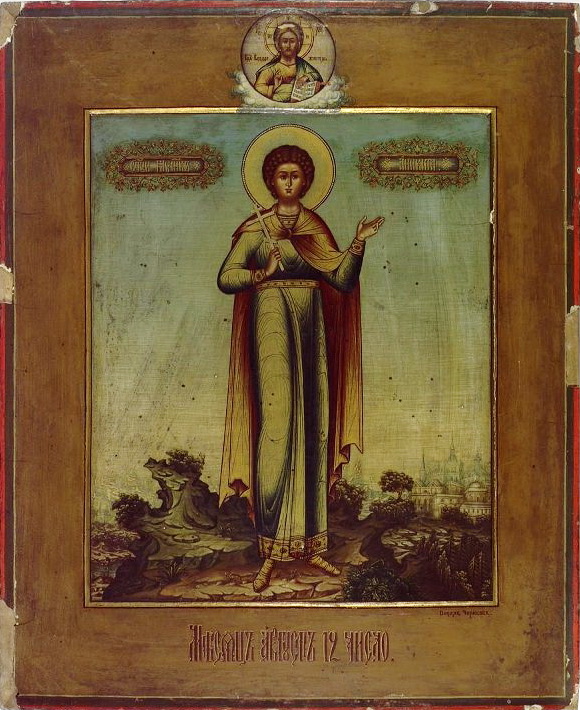
Anicetus is painted as a martyr of middle years — the Russian menaion type shows him beardless or lightly bearded and young — standing full-length in tunic and cloak, holding the cross of martyrdom in the right hand and the left raised open in prayer or confession. Photius, when the two are shown together, is the younger of the pair and stands at his uncle's side with the same cross. The distinguishing scene, where a passion cycle is painted, is the lion couched at the martyr's feet, and behind it the furnace into which the crowd of Nicomedian Christians followed them.
The stored image is a Russian menaion panel of 1893–94 by the Moscow icon-painter Osip Semenovich Chirikov (d. 1903), one of the month-icons painted for the church of the Marble Palace at St Petersburg and now in the State Museum of the History of Religion. The saint stands on a rocky ground before a distant city, blessed from above by Christ in a cloud; the inscription along the lower border reads Мѣсяцъ Августъ 12 число — "Month of August, the 12th day" — which fixes the identification to this commemoration. The panel shows Anicetus alone, as the month-icons commonly reduce a pair to its senior member; no pre-1900 image of the two together has been located.
Disputed questions
- Photius or Photinus. The Greek is Φώτιος; the Latin martyrologies and some Greek manuscripts give Φωτεινός / Photinus. Both are used of the same saint, and the variation is scribal, not a sign of two persons.
- The relationship. The Greek notices call the two συγγενεῖς, kinsmen; the Slavonic tradition and the OCA specify nephew. Nothing turns on it, but the specific relation is a later precision.
- Anicetus's rank. "Officer," "commander," "senator" and simply "one of the notables" all appear across the recensions. That he was a man of position is the constant; the particular office is not fixed.
- The scale of the wonders. The chain of nullified executions is the most conventional feature of the passion and the least likely to be historical in its details: the same sequence — beast, wheel, fire, molten metal, horses — recurs across the Bithynian and Syrian passions of the same period. The historical residue is a soldier of Nicomedia who refused under Diocletian, a young kinsman who joined him voluntarily, a long imprisonment, and a death by fire together with others.
- Year. 305 is the figure given in the Greek and Slavonic notices; some Russian calendars print 305–306. Diocletian abdicated on 1 May 305, which strains the account's attribution of the final sentence to him personally; either the date is a little early, or — more likely — the emperor's name has attached itself, as it habitually does, to executions carried out by his officers under his edicts.
- Not to be confused with Photius the Great, patriarch of Constantinople (February 6), nor with Photius the Monk (June 6), nor with Anicetus, bishop of Rome in the second century, who is not commemorated on this day in the Byzantine books.