
Photius the Great
Our Father among the Saints Photius the Great, Patriarch of Constantinople, Pillar of Orthodoxy and Ecumenical Teacher
Bishop · b. c. 810–820, at Constantinople — d. February 6, 891 (or 893), at the monastery of the Armenians (Bordi/Eremia)
Commemorated 6 February — Repose, within the afterfeast of the Meeting
Photius the Great (c. 810–891) was Patriarch of Constantinople, twice on the throne (858–867 and 877–886), and the foremost scholar-hierarch of the Byzantine middle age — "the Church's far-gleaming beacon." Sprung from a noble icon-venerating family that had suffered for the holy images, he was the most learned man of his century: first imperial secretary, ambassador, and teacher, whose Bibliotheca (Myriobiblos) preserves the memory of hundreds of ancient books now lost. Raised in six days from layman to patriarch, he became the Church's great defender against the innovations pressed from the Frankish and Roman West — above all the addition of the Filioque to the Creed, which he refuted in the classic Mystagogy of the Holy Spirit. He sent the mission to the Slavs under Cyril and Methodius, baptised the Bulgarians, and presided over the great reconciling council of 879–880, reckoned by many Orthodox the Eighth Ecumenical Council. Deposed at last by his former pupil the emperor Leo VI, he reposed in monastic exile on February 6, and is honoured as a pillar of Orthodoxy and an ecumenical teacher.
.jpg)
Origins and the household of confessors
Photius was born at Constantinople, about the year 810–820, into one of the great families of the capital — of senatorial and, by tradition, of imperial connection: his great-uncle was the holy Patriarch Tarasius, who had presided over the Seventh Ecumenical Council (787) and the restoration of the icons. The household into which Photius was born was of the same confessing stock. In the second, "Byzantine," iconoclasm his father Sergius (commemorated May 13) and his mother Irene held fast to the veneration of the holy images, were anathematised by the iconoclast synod, and suffered the loss of their goods and exile for it; the tradition of the Church honours Sergius as a confessor who "died as a martyr in defence of the holy icons." Photius thus grew up in a house that had paid for Orthodoxy, and the memory shaped him: the champion of the images' restoration was his own kinsman, and confession of the faith was his inheritance before it was his vocation.
Of that inheritance the most conspicuous fruit was learning. Photius became, by the common consent of friends and enemies alike, the most erudite man of his age — versed in grammar, rhetoric, philosophy, theology, law, natural science, and medicine, and possessed of a library and a memory that his contemporaries found almost incredible. His enemies whispered that so much knowledge could only have come by a compact with a Jewish magician; his admirers called him a man in whom all the wisdom of the ancients had gathered. He taught publicly at Constantinople — the schools of the capital counted him among their ornaments — and among his pupils, the tradition holds, was the young Constantine (Cyril), the future apostle of the Slavs.
The scholar in the world's service
Before he was ever a churchman Photius was a servant of the Christian empire. He rose through the imperial chancery to the highest lay dignities — prōtoasēkrētis (first imperial secretary) and prōtospatharios, a member of the Senate — and was entrusted with a great embassy to the Arabs, "to the Assyrians," at Baghdad or Samarra. It is to this journey that we owe his most astonishing book. Before setting out, at his brother Tarasius's request, Photius composed the Bibliotheca — the Myriobiblos, "the myriad books" — a collection of some 280 reviews of works of pagan and Christian antiquity he had read: histories, theology, philosophy, romances, medical and grammatical writers, orators and councils, each summarised, excerpted, and judged. A great part of the literature he handled has since perished, and for very many lost authors the Bibliotheca is our only window: it is at once the first great work of literary criticism to survive from the Christian East and one of the priceless salvage-vessels of ancient learning. To the same scholarly labour belong his Lexicon, his homilies, and the later Amphilochia, three hundred questions of Scripture and doctrine answered for Amphilochius, metropolitan of Cyzicus.
The first patriarchate (858–867)
The path to the patriarchal throne ran through one of the bitterest ecclesiastical quarrels of the age. In 858 the Patriarch Ignatius — son of the emperor Michael I, a man of rigorist and monastic temper — fell out with the kaisar Bardas, regent for the boy-emperor Michael III, and was deposed (whether he truly resigned, or was forced out, would be disputed ever after). The court and a synod turned to Photius, still a layman, as a man of unequalled learning and undoubted piety who might heal the breach. In the space of six days he was tonsured and passed through all the clerical grades — reader, subdeacon, deacon, presbyter — and on the feast of the Nativity, 858, was consecrated bishop and enthroned as patriarch by Gregory Asbestas of Syracuse.
The elevation, canonically hurried and made over a living predecessor, was challenged from the first by the strict party of Ignatius. Both sides appealed to Rome. Photius wrote to Pope Nicholas I in courteous and irenic terms, announcing his accession; a council met at Constantinople in 861 — the so-called Prōtodeutera, the "First-and-Second" council, whose disciplinary canons the Church still keeps — in the presence of Roman legates, and confirmed Photius and the deposition of Ignatius. But the legates had exceeded, or Nicholas judged that they had exceeded, their mandate; and the pope, pursuing at the same time the restoration of the papacy's jurisdiction over Illyricum, southern Italy, and Sicily — provinces recently transferred to Constantinople's obedience — reversed their act. In a Roman synod of 863 Nicholas declared Photius deposed and Ignatius the lawful patriarch, and pronounced anathema. The breach was now open, and it was as much a collision of two conceptions of the Church's order — the Roman claim to a universal appellate primacy against the Eastern conciliar and imperial polity — as a quarrel over two men.
Bulgaria, the mission to the Slavs, and the Filioque
Into this tension fell the conversion of the Slavs, and with it the question that would give the whole dispute its lasting theological weight. About 863 Photius sent the brothers Constantine (Cyril) and Methodius, equipped with the newly devised Slavonic letters and the Scriptures and services in the Slavs' own tongue, to Great Moravia — the seed of the whole Slavic Orthodox world. In 864 the Bulgarian prince Boris received baptism and brought his people into the Church, and Constantinople sent him clergy.
But Boris, playing East against West, soon admitted Frankish and Latin missionaries as well; and these, Photius learned, were teaching his new Christians practices and doctrines at variance with the faith they had received — imposing a second anointing, forbidding married priests, altering the fast, and, gravest of all, reciting the Creed with the added word Filioque, that the Holy Spirit proceeds "from the Father and the Son." In 867 Photius answered with an encyclical to the Eastern patriarchs, denouncing these novelties, and singling out the Filioque as an addition to the Creed of the Councils and an error in the doctrine of the Trinity itself: the Father alone is the source and cause within the Godhead, and to make the Son a second principle of the Spirit's procession is to confound the Persons. A council at Constantinople the same year condemned the innovations and, in the heat of the crisis, pronounced against Pope Nicholas himself. This is the first full Orthodox articulation of the objection to the Filioque — the theological heart of the Eastern refusal, and the beginning of the argument Photius would complete, years later and in calmer ink, in the Mystagogy.
Fall, imprisonment, and the council of 869–870
In 867 the throne changed hands by murder. Basil the Macedonian, having made himself co-emperor, had Michael III assassinated and seized the empire. Photius — who, the tradition says, refused the regicide the Holy Gifts — was at once deposed and confined in a monastery, and Ignatius restored. To settle the schism with Rome and to condemn Photius, Basil and the new pope Hadrian II convened a council at Constantinople in 869–870, which the Roman Church counts as the Fourth Council of Constantinople and the eighth ecumenical. It anathematised Photius; his supporters were required to sign, and the Roman legates pressed on the Eastern bishops a libellus asserting the papal primacy. The council's authority was thin — few Eastern bishops attended, and many resisted the Roman demands — and Photius met his judges, the sources say, with a dignified silence, asking at last by what right they set themselves up as his judges. He was held in a hard captivity for some seven years, cut off from his books.
Reconciliation and the second patriarchate (877–886)
The reconciliation, when it came, was as complete as the rupture had been sharp. Photius and Ignatius were brought together before the end; Basil recalled Photius from confinement and made him tutor to his sons — among them the future Leo VI. On the death of Ignatius in 877, Photius, by now reconciled with the Ignatian party, ascended the patriarchal throne a second time with general assent. And in 879–880 a great council met in Hagia Sophia, larger than any since the seventh ecumenical — some three hundred and eighty bishops — in the presence of the legates of Pope John VIII, who knew Photius and esteemed him. This council of 879–880:
- annulled the acts of the anti-Photian council of 869–870 and restored Photius in full communion, East and West together;
- solemnly reaffirmed the Creed of Nicaea and Constantinople, and forbade any addition or subtraction to it — a canon the Orthodox read as a conciliar condemnation of the Filioque;
- reasserted the ancient balance of the sees, honouring the primacy of Rome within the communion of equal and self-governing churches, without the universal jurisdiction the recent popes had claimed.
Pope John VIII's legates subscribed, and the pope ratified the reunion; for a season East and West were one again, and the "Photian schism" was healed by the very patriarch whose name it bears. Many Orthodox reckon this Council of 879–880 the Eighth Ecumenical Council, the true sequel to the seven, over against the Roman numbering of 869–870.
Repose
Under his old pupil Leo VI, who came to the throne in 886 with grievances of his own, Photius was accused afresh and deposed a second time (886), and retired — or was sent — to the monastery of the Armenians (the Bordi, or Eremia, monastery). There, in prayer and study to the end, he reposed on February 6, in the year 891 (some reckon 893). The Church, which had seen him twice cast down by emperors, kept his memory as that of a confessor of Orthodoxy and a teacher of the whole inhabited earth; and in the centuries after the final estrangement of East and West his stature only grew, until he stood in the Orthodox mind as the great forerunner and champion of the Church against the claims and the doctrine of the Latin West.
Writings
Photius is one of the great authors of the Orthodox tradition, and his works are of three kinds.
- The Mystagogy of the Holy Spirit (Περὶ τῆς τοῦ Ἁγίου Πνεύματος Μυσταγωγίας) — his mature treatise against the Filioque, the classical Orthodox refutation of the doctrine of the double procession. Its argument is Trinitarian before it is polemical: that the Father is the one source and cause (aitia) within the Godhead; that the Spirit proceeds from the Father alone, as the Lord himself taught (John 15:26); that to derive the Spirit also from the Son either introduces two principles into the Trinity or collapses the distinction of the divine Persons; and that the addition to the Creed, made without and against an ecumenical council, is on that ground alone unlawful. Every later Orthodox treatment of the question — down to Mark of Ephesus and beyond — is written in the light of the Mystagogy.
- The Bibliotheca (Myriobiblos) and the Amphilochia and Lexicon — the great monuments of his learning, described above.
- Homilies, letters, and canonical works. His homilies include two famous sermons preached in Hagia Sophia during the Rus' attack on Constantinople of 860, and a homily on the dedication of the new apse-mosaic of the Theotokos — landmarks of Byzantine preaching and of the history of the icon after iconoclasm. His hundreds of letters range over doctrine, church order, and pastoral counsel. To his authority is attached the great canonical collection, the Nomocanon in Fourteen Titles, whose definitive form and preface are his, the foundation of later Orthodox canon law.
Feast and commemoration
Photius is commemorated on February 6 (church date; Old Calendar civil February 19), the day of his repose, which falls within the afterfeast of the Meeting of the Lord — so that his office is sung together with the hymns of the Meeting. The day is kept across the Orthodox world, and with especial solemnity in the Church of Constantinople and the Greek churches, where he is titled "the Great" and numbered among the teachers of Orthodoxy; the Slavic calendars keep him on the same day. He shares February 6 with the holy hierarch Bucolus of Smyrna, the Gaza elders Barsanuphius and John, and the martyrs Julian of Emesa and Dorothea of Caesarea.
Hymns
Troparion — Tone 4
As one conformed to the ways of the Apostles and a teacher of the whole inhabited earth, intercede, O Photius, with the Master of all, that peace may be granted to the world, and to our souls the great mercy.
Original translation from the Greek
Kontakion — Tone 1
Thou who by Thy nativity didst sanctify the virgin womb, and as was meet didst bless the hands of Symeon, hast gone before and even now hast saved us, O Christ our God. Give peace amid wars to Thy commonwealth, and strengthen those in authority whom Thou hast loved, O Thou who alone lovest mankind.
Original translation from the Greek
Appointed readings
Epistle — Hebrews 7:26–28; 8:1–2
26For such an high priest became us, who is holy, harmless, undefiled, separate from sinners, and made higher than the heavens; 27Who needeth not daily, as those high priests, to offer up sacrifice, first for his own sins, and then for the people’s: for this he did once, when he offered up himself. 28For the law maketh men high priests which have infirmity; but the word of the oath, which was since the law, maketh the Son, who is consecrated for evermore. 1Now of the things which we have spoken this is the sum: We have such an high priest, who is set on the right hand of the throne of the Majesty in the heavens; 2A minister of the sanctuary, and of the true tabernacle, which the Lord pitched, and not man.
Gospel — John 10:9–16
9I am the door: by me if any man enter in, he shall be saved, and shall go in and out, and find pasture. 10The thief cometh not, but for to steal, and to kill, and to destroy: I am come that they might have life, and that they might have it more abundantly. 11I am the good shepherd: the good shepherd giveth his life for the sheep. 12But he that is an hireling, and not the shepherd, whose own the sheep are not, seeth the wolf coming, and leaveth the sheep, and fleeth: and the wolf catcheth them, and scattereth the sheep. 13The hireling fleeth, because he is an hireling, and careth not for the sheep. 14I am the good shepherd, and know my sheep, and am known of mine. 15As the Father knoweth me, even so know I the Father: and I lay down my life for the sheep. 16And other sheep I have, which are not of this fold: them also I must bring, and they shall hear my voice; and there shall be one fold, and one shepherd.
Iconography
Photius is depicted in the settled type of a Byzantine patriarch: an aged hierarch, high-browed and with a long grey beard, vested in the sakkos and the great cross-figured omophorion, or in the phelonion, and wearing at times the patriarchal mitre; he holds the Gospel-book, or a scroll on which his teaching of the Holy Spirit may be written, and blesses with his right hand. As a doctor of the Church he is often shown among the great hierarchs and teachers. The narrative cycles of the Skylitzes chronicle illustrate the scenes of his life — his enthronement, his baptising of the Bulgarians, his trial before the council.
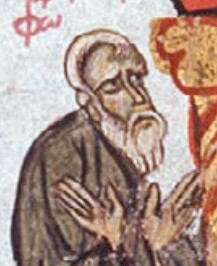
The stored image is a manuscript miniature from the Madrid Skylitzes (the twelfth-century illustrated chronicle of John Skylitzes, made in Norman Sicily), in which the patriarch is named Φώτιος — an early narrative portrait of the saint (source, public domain, pd-old-work).
Disputed questions
- "Schismatic" or saint — the two readings of Photius. For long centuries the Latin West remembered Photius as the arch-schismatic, the ambitious usurper of Ignatius's throne who first tore the Church in two; the East remembered a wronged and holy patriarch, canonically elected, unjustly deposed by emperors and popes, and vindicated by a great council. Sober history complicates both portraits. Photius's elevation over a living predecessor was irregular, and the Ignatian party's grievance was real; but the deposition of Ignatius was the emperor's act, not Photius's, and the two men were reconciled before Ignatius died. Rome's intervention was entangled from the first with its claim to Illyricum and to a universal jurisdiction the East did not concede. And the "schism" was in fact healed in Photius's own lifetime, by the council of 879–880 that Pope John VIII confirmed: the permanent estrangement of the churches came only in and after 1054, a century and a half later, and cannot fairly be laid at Photius's door. What is beyond dispute is that he was the first to state, fully and theologically, the Orthodox case against the Filioque — and it is as the doctor of that case, far more than as a party to a quarrel of sees, that the Church venerates him.
- The year of his repose. The sources give 891 or 893; the day, February 6, is fixed.
- When did his cultus become universal? Photius was honoured in the East from soon after his death, but his feast was not everywhere kept; his veneration spread widely, and his figure took on its full stature as the champion of Orthodoxy against Rome, above all from the later centuries and markedly in the modern Greek Church, which glories in him as Photios ho Megas, Photius the Great.
- Not to be confused with the several other bearers of the name in the calendars — in particular the Martyr Photius, who with Aniketos suffered at Nicomedia (kept August 12), a wholly different saint of an earlier age; nor with Photius the Monk, the venerable of unknown date kept on June 6, of whom the Greek synaxarion transmits only that he "reposed in peace" — the likelier confusion in a list, since both feasts fall on the sixth of a month, but the June Photius is a monastic with no writings and no biography, and this one a hierarch; nor with his own antagonist Ignatius, Patriarch of Constantinople (kept October 23), with whom his life is so bound up. "The Great" belongs to this Photius alone.
- Not to be confused, above all in English writing, with Photius, Metropolitan of Kiev, Moscow and All Rus' (c. 1370s–1431, kept July 2) — the other great hierarch of the name, also a Greek, also a man of letters, who was sent from Constantinople in 1408 to govern the Russian Church and reposed at Moscow. Five centuries and the whole of the Russian north separate them; the patriarch belongs to Byzantium and to February 6, the metropolitan to Rus' and to July 2.