
Anthony of Siya
Our Venerable Father Anthony, Abbot of Siya
Venerable · b. c. 1477 — d. 1556
Commemorated 7 December — Repose at the Siya monastery (1556)
Anthony of Siya (c. 1477–1556) was a monastic founder of the Russian far north, the abbot who established the monastery of the Holy Trinity on the River Siya (Sija), in the wilderness of the North Dvina, and made it a centre of prayer, learning and iconography in the Archangelsk borderlands. Trained in his youth as an icon-painter and himself remembered as an iconographer, he sought solitude even as his foundation grew famous, twice withdrawing to remoter hermitages before the brethren recalled him. He guided the Siya monastery until his death at the age of seventy-nine, and is venerated among the wonderworkers of the Russian North. His feast is December 7.
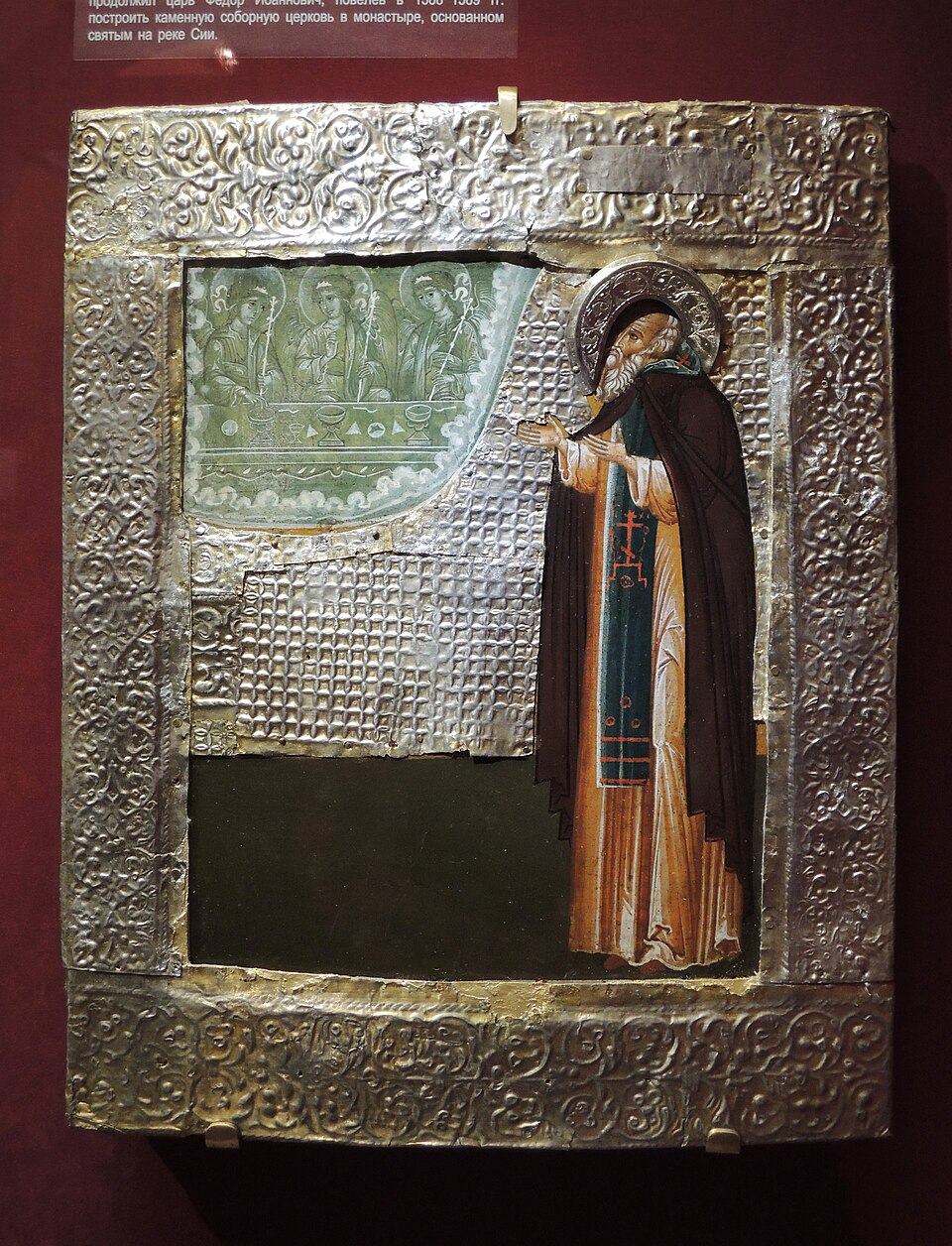
_01_by_shakko.jpg)
Origins and early life
The saint was born about 1477, with the name Andrew, into a family of prosperous farmers in the village of Kekhta near the North Dvina river. He received a good education for his station, was a keen reader, and learned the art of icon-painting — a skill that would mark both his own devotion and the later character of his monastery. After the death of his parents he went to Novgorod, where for some five years he served in the household of a boyar. He married, but his wife died within a year, and the young widower, freed of worldly ties, resolved to give himself to the monastic life.
Monastic struggle and foundation
Distributing his goods to the poor, Andrew came as a wanderer to the hermitage of St Pachomius on the River Kena, where Pachomius tonsured him with the name Anthony. He was soon ordained hieromonk and, with his abbot's blessing, served the divine offices, going out with the brethren to the monastery's labours. But the love of solitude drew him further into the wilderness. Taking two companions, he settled on Mikhailov Island, ringed on one side by the River Siya and on the other by lakes, and there in 1520 he raised a chapel, clearing the dense forest with heavy toil. When his companions began to grumble at the hardship, an unknown man appeared and supplied them with means and money — a providential relief the Life records as a sign of God's favour on the new foundation.
The monastery of the Holy Trinity on the Siya grew and became widely known, and pilgrims came from the surrounding villages. Ever seeking greater stillness, Anthony again withdrew, taking a single disciple, to a still more remote place on Lake Padun (Palun), where he lived three years in a solitary cell. When the abbot Theoctistus would no longer lead the community, the brethren persuaded Anthony to return; he consented, resumed the abbacy, and guided the monastery with piety until his death in 1556, at the age of seventy-nine.
Repose and veneration
Anthony died on 7 December 1556. His Siya monastery endured as one of the great spiritual and cultural centres of the Russian North, notable for its library and its school of icon-painting, and produced the celebrated illuminated Siya Iconographic Original (an artists' pattern-book). He was glorified as a saint, and his relics rested at the monastery he had founded; he is counted among the wonderworkers of the northern lands, and a Life and service were composed in his honour — the Life, notably, by the tsarevich John, son of Ivan the Terrible.
Feast and commemoration
December 7 (church date; Old Calendar civil December 20), the day of his repose, within the Nativity Fast. His veneration is Russian; he is not among the saints of the general Byzantine Menaion. He shares the day with Ambrose of Milan and Nilus of Stolobny. He is not to be confused with Anthony the Great of Egypt (†356, kept January 17), the father of monasticism whose name and discipline he followed.
Hymns
Troparion — Tone 1
Kindled with spiritual longing and casting off the tumults of the world, thou didst cleave with love to the one God; and seeking Him with thy whole soul, thou didst depart into the inner wilderness, settling by the waters, where abiding long years in tears and labours thou didst pass an angelic life in great patience, taught by the divine Wisdom, and didst gather a multitude of monks, O wise one. Cease not to visit them, O Anthony our venerable father, praying to the Most Holy Trinity to deliver us from every evil and to save our souls.
Original translation from the Slavonic
Kontakion — Tone 8
From thy youth, O venerable one, thou didst waste thy flesh with fasting and prayers, and taking up thy cross thou didst follow Christ; wherefore thou didst joyfully accomplish thy course to the heights, where thou standest with all the saints before the Holy Trinity. And now, visiting thy flock, remember those who honour thy most holy memory, that we all may cry to thee with thanksgiving: Rejoice, O God-wise Anthony, instructor of the wilderness.
Original translation from the Slavonic
Iconography
Anthony is depicted as an aged abbot in the monastic schema, with a long grey beard, holding a scroll and blessing, or with a representation of his Trinity monastery on the Siya; that he was himself an icon-painter gives his memory a special place in the northern iconographic tradition. The stored image is a seventeenth-century Russian panel icon from the Moscow Kremlin collection.