
Anthony the Great
Our Venerable and God-bearing Father Anthony the Great
Venerable · b. c. 251, at Coma (Koma) in Middle Egypt — d. January 17, 356, on the Inner Mountain (Mount Colzim), aged about 105
Commemorated 17 January — Repose on the Inner Mountain by the Red Sea
Anthony the Great (c. 251 – 356) is honoured by the whole Church as the father of monasticism and the archetype of the Christian ascetic. A well-born Egyptian of the village of Coma, orphaned in his youth, he heard read in church the Gospel word "If thou wilt be perfect, go and sell that thou hast, and give to the poor… and come, follow me," and took it as spoken to himself: he gave away his inheritance, placed his sister with consecrated virgins, and gave himself to the ascetic life. After apprenticeship to a local solitary, years of naked combat with the demons among the tombs, and twenty years walled up in a deserted fort at Pispir, he emerged — the tradition marvels — neither broken nor wild but whole in body and serene in soul, and became the teacher of a multitude, so that "the desert was made a city of monks." Twice he came down to Alexandria, once to strengthen the martyrs under persecution and once, in old age, to confound the Arians beside his friend Athanasius, whose Life of Anthony would shape all later hagiography and carry monasticism through the whole Church. He reposed on his Inner Mountain by the Red Sea on January 17, 356, aged about a hundred and five, and had himself buried in a place he commanded his two disciples to keep secret.

The life of Anthony is known, before all else, from the Life of Anthony (Vita Antonii) written within a few years of his death by Athanasius the Great, archbishop of Alexandria, who had known the saint and gathered his testimony from those who served him. To this the tradition adds the sayings of Abba Anthony preserved in the Apophthegmata Patrum (the Sayings of the Desert Fathers), the small body of Letters that passes under his name, and the notices of the Church historians. What follows synthesises these; where they are silent, the entry is silent.
Origins and renunciation
Anthony was born about the year 251 in the village of Coma (Koma) in Middle Egypt, of Christian parents who were people of substance — landowners of the fertile valley — and of native Egyptian, that is Coptic, stock. He was a retiring child who would not learn letters (Athanasius says he could not endure the schoolroom and remained unlettered in Greek), shunned the company of other boys, and loved only to be at home and in church, where he listened to the Scriptures so attentively that he kept them in his heart in place of books. When he was about eighteen or twenty his parents died, leaving him the master of a considerable estate and the guardian of a much younger sister.
Not six months later, as he walked to church turning over in his mind how the Apostles had left all to follow Christ, and how the first believers had sold their possessions and laid the price at the Apostles' feet, he entered just as the Gospel was being read, and heard the Lord's word to the rich young man as though it were addressed to him: "If thou wilt be perfect, go and sell that thou hast, and give to the poor, and thou shalt have treasure in heaven; and come, follow me" (Matthew 19:21). He went out at once and gave to the people of his village the three hundred arourae of rich and well-favoured land that were his patrimony, that they and his sister might never be troubled with it; the rest of his goods he sold and gave to the poor, keeping back a little for his sister. But hearing again in church, "Take no thought for the morrow" (Matthew 6:34), he gave away even that remnant, entrusted his sister to a household of known and faithful virgins to be raised — one of the earliest glimpses in the record of an organised community of consecrated women — and gave himself wholly to the discipline of the ascetic life. He was then about twenty years old.
Apprenticeship and the ascetic beginnings
Anthony did not invent the solitary life; he perfected it. In these first years he did not yet withdraw into the deep desert but practised his discipline in the neighbourhood of his own village, where — as Athanasius is careful to record — there were already devout men who lived apart in the outskirts. He attached himself as a disciple to a venerable old ascetic who had followed the solitary life from his youth, and set himself to imitate him; and he went about to the other spiritual men of the district, and from each took the mark of his particular virtue — from one his graciousness, from another his constancy in prayer, from a third his freedom from anger, his vigils, his study of Scripture, his fasting, his sleeping on the ground — gathering, Athanasius says, like a prudent bee the honey of every man's excellence and carrying it back to his own cell. He supported himself by the labour of his hands, weaving, and gave what he did not need to the poor; he prayed without ceasing; and he grew so beloved that all called him "the friend of God."
The tombs and the combat with the demons
As Anthony advanced, the tradition holds, the enemy of souls rose against him, and the Life recounts the long combat with the demons that is at the heart of Anthony's memory and of the whole monastic understanding of the spiritual warfare. First came the assaults of remembrance — of his forsaken wealth, the care of his sister, the honour of his family, the sweetness of food, the pleasures of the world — and then the open temptations of the flesh: the demon, Athanasius writes, troubled him by night in the form of a woman, and by day with unclean thoughts, until Anthony quenched the fire by fasting, watching and prayer; and at last the spirit of fornication appeared to him openly as a black boy, owning himself beaten, and Anthony gave thanks to God, being then about thirty-five.
Seeking a harder arena, he withdrew to the tombs at some distance from the village, had an acquaintance shut him within one of them and bring him bread at intervals, and there the demons fell upon him with a fury the Life describes without flinching: they beat him through the night until he lay speechless and half-dead upon the ground, so that his friend, coming with the bread, carried him as a corpse to the village church, where the people mourned him. Reviving in the night, Anthony had himself carried back to the tomb, and lying there, unable to stand for his wounds, he called out to the demons to do their worst. They came again, filling the place with the din and the shapes of wild beasts — lions, bears, leopards, bulls, serpents, asps, scorpions and wolves — each raging after its kind; and Anthony, torn and in pain, mocked their weakness: had they any power, one of them would have sufficed; their swarming only showed their impotence. Then, the Life says, the roof seemed to open and a beam of light came down; the demons vanished, his pains ceased, and Anthony, understanding that the Lord had been present, cried out: "Where wast thou? Why didst thou not appear at the beginning, to stay my sufferings?" And a voice answered: "Anthony, I was here; but I waited to watch thy struggle. And now, because thou hast held out and wast not overcome, I will ever be thy helper, and will make thy name known in every place."
The twenty years in the fort at Pispir
Strengthened, and now about thirty-five, Anthony resolved on a yet deeper withdrawal. He crossed to the far bank of the Nile and came to a deserted fort — a ruined fortress in the mountain at Pispir (the place the tradition calls the Outer Mountain), its cisterns dry, its rooms full of creeping things. He carried in six months' bread (the flat Theban loaves keep long), sealed up the entrance, and would see no one; twice a year bread was let down to him through the roof. There he remained, alone and unseen, for nearly twenty years (about 285 to 305), wrestling with the passions and the demons — those who came would hear from within the fort the clamour of tumultuous voices and Anthony unshaken among them — and being trained in that inner stillness which is the whole aim of the discipline.
Emergence: the desert made a city
At last friends and would-be disciples, drawn by his fame, broke down the door of the fort, and Anthony came out. Then, Athanasius writes, the wonder was seen: after twenty years of solitude and severest fasting, he was neither grown fat from want of exercise nor withered from fasting and struggle with the demons, but his body was in perfect condition, and his soul pure, undisturbed, "as one guided by reason and abiding in that which is according to nature" — the very image of a nature restored. From that emergence, about the year 305, dates his public work. He healed the sick and cast out demons by prayer; he consoled the sorrowful and reconciled the estranged; above all he taught, and men left the world to imitate him, until — in the phrase that has echoed ever since — "the desert was made a city of monks," and the mountains about Pispir were dotted with the cells of those who had chosen the solitary life under his guidance. He did not found a communal monastery with a written rule, as his younger contemporary Pachomius did in the Thebaid; his was the anchoritic way — solitaries living apart, each in his own cell and discipline, gathered loosely about a father — and of this pattern, which he did not invent but perfected and made known to the world, he is honoured as the father. Athanasius sets in Anthony's mouth at this point the great discourse to the monks — a long instruction on the ascetic life and on discernment of the demons and their wiles — which became a foundation of Orthodox ascetical teaching.
The two journeys to Alexandria
Twice in his long life Anthony left the desert for the city, and each descent answered a crisis of the Church.
The first was about the year 311, in the persecution under Maximin Daia, when the confessors of Egypt were being sent to the mines and the scaffold. Anthony went down to Alexandria longing himself to be a martyr, and openly ministered to those condemned — attending them in the mines and the prisons, encouraging them before the tribunals, standing in the sight of the judge, yet, the Life says, God preserved him for the good of many, and he did not seize martyrdom but waited on the will of God. When the persecution abated he returned to his cell, and there was a daily martyr in his conscience, ever contending in the faith.
The second was in his last years, about 337 or 338, when the bishops entreated him to come down and lend the weight of his sanctity against the Arians, who claimed him falsely for their party. He came, and though old and unlettered he publicly condemned the Arian heresy as the last and worst of errors, declaring the Son of God not a creature but of one being with the Father, eternally begotten; and the whole city, Christians and pagans and philosophers alike, thronged to see "the man of God." He healed and taught for a few days, converted many, and returned to the desert, Athanasius himself walking with him to the gate. The friendship of the aged hermit and the embattled archbishop is one of the fixed points of the age: Anthony was Athanasius's support in the Arian struggle, and Athanasius, in turn, became Anthony's biographer and the guardian of his memory.
The Inner Mountain, Paul of Thebes, and the emperors
The crowds that his fame drew to Pispir at length drove Anthony to seek a deeper solitude. Falling in, the Life says, with a caravan of Saracens (the Bedouin of the desert), he travelled three days into the wilderness and came to a high mountain by the Red Sea — the Inner Mountain, later called Mount Colzim, where the Monastery of Saint Anthony (Deir Mar Antonios) stands to this day — with a spring of sweet water and a few palms. There he made his true home for the rest of his life, tending a little plot of grain and vegetables to spare his visitors the labour of bringing food, and coming down only at intervals to the brethren of the Outer Mountain. It was in these years, the Western tradition holds, that he was led by a revelation to seek out and bury the still older solitary Paul of Thebes, the first hermit — the meeting Jerome records, at which Anthony learned that another had gone before him into the desert.
His renown reached the imperial court. The emperor Constantine and his sons Constantius and Constans wrote to Anthony as to a father, asking his prayers; and when the brethren wondered at it, Anthony bade them not marvel that an emperor had written to a man, but marvel rather that God had written his law for men and had spoken to the world through his own Son. He answered the letters with counsel to remember the judgment to come and that Christ alone is the true and eternal King.
Repose and the hidden grave
Foreseeing his end, Anthony made a last visit to the monks of the Outer Mountain, took leave of them, and returned to the Inner Mountain, where he fell ill. To the two disciples who had served him in his old age — the tradition names them Macarius and Amathas — he gave his final charge, which is itself a last lesson in humility. He forbade the Egyptian custom of embalming the bodies of holy men and keeping them in houses, and commanded that his own body be buried in the earth in a place known to no one but themselves, lest it become an object of display. His few possessions he divided: one sheepskin and the worn cloak on which he lay to Athanasius the bishop, the other sheepskin to Serapion bishop of Thmuis, and to his two disciples his hair-shirt. Then, Athanasius writes, "he stretched out his feet, and looking on his friends as though they were dear to him, he was gathered to his fathers." He reposed on January 17, 356, having lived about a hundred and five years, the greater part of them in the desert; and his disciples buried him secretly, as he had charged them, so that to this day no man knows the place of his first grave.
Relics and translations
The hidden grave did not remain the end of the story. The tradition holds that under the emperor Justinian, about the year 561, the relics of Anthony were discovered by revelation and translated to Alexandria; from there, after the Arab conquest of Egypt, they were carried to Constantinople. In the later tenth or eleventh century they were brought to the West — to La-Motte in the Dauphiné of France, and thence to the abbey that became Saint-Antoine-l'Abbaye near Vienne, which grew into a great centre of pilgrimage. About this shrine arose the Hospital Order of Saint Anthony (the Antonines), founded to care for those afflicted with the burning gangrenous sickness that the Middle Ages called "Saint Anthony's Fire" (the ergotism caused by poisoned rye), whose sufferers sought the intercession of the desert father. The several stages of this journey are recorded with the variance to be expected of relics translated across a thousand years; the constant is the veneration of Anthony's remains in East and West alike.
Hymnographic and literary legacy
No single book so shaped the Christian imagination of holiness as the Life of Anthony. Written by Athanasius about 356–362 and rendered into Latin soon after by Evagrius of Antioch, it became the model of all hagiography, the pattern on which the Lives of the saints were built for a thousand years, and the great missionary of monasticism to the Latin world: it was on hearing the story of Anthony read aloud that two courtiers at Trier were converted on the spot, and the account of that scene — and of Anthony's own summons by the Gospel word — struck the young Augustine to the heart at the hour of his conversion (Confessions VIII). Through the Vita the ascetic ideal of Egypt passed to Cappadocia, to Palestine, to Gaul and Ireland, and to the whole later tradition of the monastic Church.
Anthony's own teaching survives in two forms. The Apophthegmata Patrum preserve a body of terse sayings of Abba Anthony, the first and most-cited voice among the Desert Fathers — on humility, on the fear of God, on temptation ("Whoever has not been tempted cannot enter the Kingdom of Heaven"; "I saw all the snares of the enemy spread out over the earth, and I groaned and said, Who can pass through these? And I heard a voice saying, Humility"), and on the discernment of spirits. Under his name also passes a collection of seven Letters, surviving in Coptic, Georgian, Latin, Syriac and Arabic, whose spiritual theology — of self-knowledge, of the kinship of the rational soul with God, of the whole ascetic labour as a return to the nature God made — is widely held to be substantially genuine, and shows that the "unlettered" Anthony was, in the deeper sense, a teacher of great subtlety.
Feast and commemoration
Anthony is kept universally on January 17 (church date; Old Calendar civil January 30), the day of his repose, and the Antiochian, Greek and Slavic calendars agree upon it. His feast falls in the weeks after the Theophany, and his office in the Menaion is among the most fully developed of any monastic saint; in the Greek tradition the day gathers with him his two namesakes, Anthony the New of Berroia and the desert father Achillas the anchorite, while the Slavic books add the Russian Anthony of Dymsk and the holy emperor Theodosius the Great. In the West, where the Vita carried his memory early, Anthony (Anthony the Abbot) is likewise honoured on January 17, and is among the most popular of all the saints, invoked against fire and pestilence and reckoned the patron of the sick and of domestic animals.
Hymns
Troparion — Tone 4
Imitating the zealous Elijah in thy ways, and following the Baptist along his straight paths, O Father Anthony, thou becamest a dweller of the wilderness, and by thy prayers didst establish the world. Wherefore intercede with Christ our God, that our souls may be saved.
Original translation from the Greek
Kontakion — Tone 2
Having thrust away the tumults of the world, thou didst finish thy course in stillness, imitating the Baptist in every way, O most holy one; therefore together with him we honour thee, O Anthony, father of fathers.
Original translation from the Greek
Appointed readings
Epistle — Hebrews 13:17–21
17Obey them that have the rule over you, and submit yourselves: for they watch for your souls, as they that must give account, that they may do it with joy, and not with grief: for that is unprofitable for you. 18Pray for us: for we trust we have a good conscience, in all things willing to live honestly. 19But I beseech you the rather to do this, that I may be restored to you the sooner. 20Now the God of peace, that brought again from the dead our Lord Jesus, that great shepherd of the sheep, through the blood of the everlasting covenant, 21Make you perfect in every good work to do his will, working in you that which is wellpleasing in his sight, through Jesus Christ; to whom be glory for ever and ever. Amen.
Gospel — Luke 6:17–23
17And he came down with them, and stood in the plain, and the company of his disciples, and a great multitude of people out of all Judæa and Jerusalem, and from the sea coast of Tyre and Sidon, which came to hear him, and to be healed of their diseases; 18And they that were vexed with unclean spirits: and they were healed. 19And the whole multitude sought to touch him: for there went virtue out of him, and healed them all. 20And he lifted up his eyes on his disciples, and said, Blessed be ye poor: for yours is the kingdom of God. 21Blessed are ye that hunger now: for ye shall be filled. Blessed are ye that weep now: for ye shall laugh. 22Blessed are ye, when men shall hate you, and when they shall separate you from their company, and shall reproach you, and cast out your name as evil, for the Son of man’s sake. 23Rejoice ye in that day, and leap for joy: for, behold, your reward is great in heaven: for in the like manner did their fathers unto the prophets.
Iconography
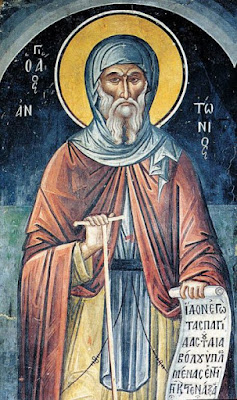
Anthony is depicted as a very old man — the archetype of the desert elder — with a long white beard flowing to his breast, clothed in the monastic analavos and mantle and often the hood (koukoulion), holding a scroll and raising his hand in blessing or teaching; the scroll frequently bears a word of his ascetic counsel. His face is the settled type of the wise and gentle ascetic, and his image stands at the head of the ranks of the venerable in the iconography of the Church, the first of the monastic saints. Narrative scenes drawn from the Vita — his temptation by the demons in the shapes of beasts, his meeting with Paul of Thebes and the sharing of the raven's bread, his burial of Paul by the lions — are beloved of both Byzantine and Western art (the temptation of Anthony became a favourite subject of the Western masters).
The stored primary image is a Greek Athonite icon of the 14th–15th century: the saint in the monastic habit, white-bearded, holding a scroll and blessing — the classic portrait type of the father of monks (source, public domain, pd-old-work).
A second stored image is the miniature for January 17 from the Menologion of Basil II (Constantinople, c. 985; Vatican, Vat. gr. 1613) depicting the repose of Anthony the Great: the aged saint laid within his desert cave and mourned by his disciples — the visual form of the closing scene of the Life (source, public domain, pd-old-work).
Disputed questions
- Authorship and historicity of the Vita Antonii. The Life is ascribed to Athanasius and was accepted as his from antiquity; the ascription is held by the great majority of scholars, and the Life is a primary source of the fourth century, written by one who knew the man. A minority in the modern period has questioned Athanasian authorship or the relation of the Greek text to a possible Coptic original; the mainstream holds the Greek Vita the genuine work of Athanasius, however much it is also a work of conscious theological art, framing Anthony as the model of the Christian restored to the image of God.
- The "unlettered" Anthony and the Letters. Athanasius stresses that Anthony knew no Greek letters, yet the Letters attributed to him breathe an educated, Alexandrian (indeed partly Origenist) spirituality. The tension is usually resolved by observing that a man may be unschooled in the rhetor's Greek and yet a profound spiritual teacher, dictating or teaching in Coptic; the Letters are generally received as authentic in substance.
- "The first monk." Anthony is styled the father of monasticism, but the tradition itself is careful: Paul of Thebes had gone into the desert before him (as Jerome wrote precisely to show), and Anthony's own Life records the solitaries from whom he learned. He is the father of the monastic movement not as its absolute first practitioner but as the one who, under God, perfected the anchoritic life, drew the multitudes after him, and — through Athanasius — made it known to the whole Church.
- Not to be confused with the several later saints who bear his name and often his discipline: Anthony of Dymsk (†1224), the Russian monk who is commemorated on this same January 17 as his namesake's spiritual son; Anthony the New of Berroia (11th c.), the Greek wonderworker called "the New" precisely in homage to this Anthony, and likewise kept on January 17; Anthony of the Kiev Caves (Feodosy's fellow-founder, †1073), the father of Russian monasticism, who brought the Athonite (and so ultimately the Antonian) tradition to Rus'; Anthony the Roman of Novgorod (†1147); Anthony of Siya (†1556); and, in the West, Anthony of Padua. The epithet "the Great" belongs to this Anthony of Egypt alone.