
Anysia of Thessalonica
The Holy Virgin-Martyr Anysia of Thessalonica
Martyr · Virgin · d. c. 304, at Thessalonica
Commemorated 30 December — Martyrdom at Thessalonica
Anysia (†c. 304) was a young Christian of Thessalonica, the daughter of pious and wealthy parents, who on their death gave away her inheritance to the poor and gave herself to a strict life of fasting, vigil, and prayer, resolved to keep her virginity for Christ alone. During the persecution of Maximian, as she was going to the assembly of the faithful, a pagan soldier seized her and tried to force her to sacrifice to the idols at a heathen festival; when she confessed Christ and spat in the face of the demon he served, he ran her through with his sword. She is honoured as a virgin-martyr of the same city and the same persecution as the Great-Martyr Demetrius, and is kept on December 30, within the afterfeast of the Nativity.
.jpg)
Origins and ascetic life
Anysia belonged to the Christian community of Thessalonica, the great Macedonian city that in the age of the persecutions gave the Church the Great-Martyr Demetrius and a host of lesser witnesses. The tradition makes her the only child of parents at once wealthy and devout, who raised her in the faith and in the fear of God and died while she was still young, leaving her a considerable fortune. Free of their tutelage and of any wish to marry, Anysia resolved to belong to Christ alone. She sold her property and distributed the proceeds to the poor, and took up a hidden ascetic life in the world — fasting, keeping vigil, and giving herself to prayer and to works of mercy — cherishing her virginity as a betrothal to the heavenly Bridegroom. Hers is thus, in the Greek reckoning, the life of an ascetic as much as of a virgin, and the Greek books style her accordingly (see Feast and commemoration).
Martyrdom
Her death is set in the persecution under the Caesar and later Augustus Maximian (Galerius Maximian, co-emperor with Diocletian), whose edicts fell with particular severity on Thessalonica. An imperial decree, the account runs, had licensed the soldiery to strike down any Christian met with in the open without trial, and had summoned the city to a public sacrifice at a heathen festival — in some tellings the feast of the sun. One morning, as Anysia was making her way to the synaxis of the faithful for the Holy Mysteries, a pagan soldier hurrying to the sacrifice fell in with her, seized her, and demanded to know where she was going; then, meaning to drag her to the festival and compel her to offer incense to the idols, he laid hold of her.
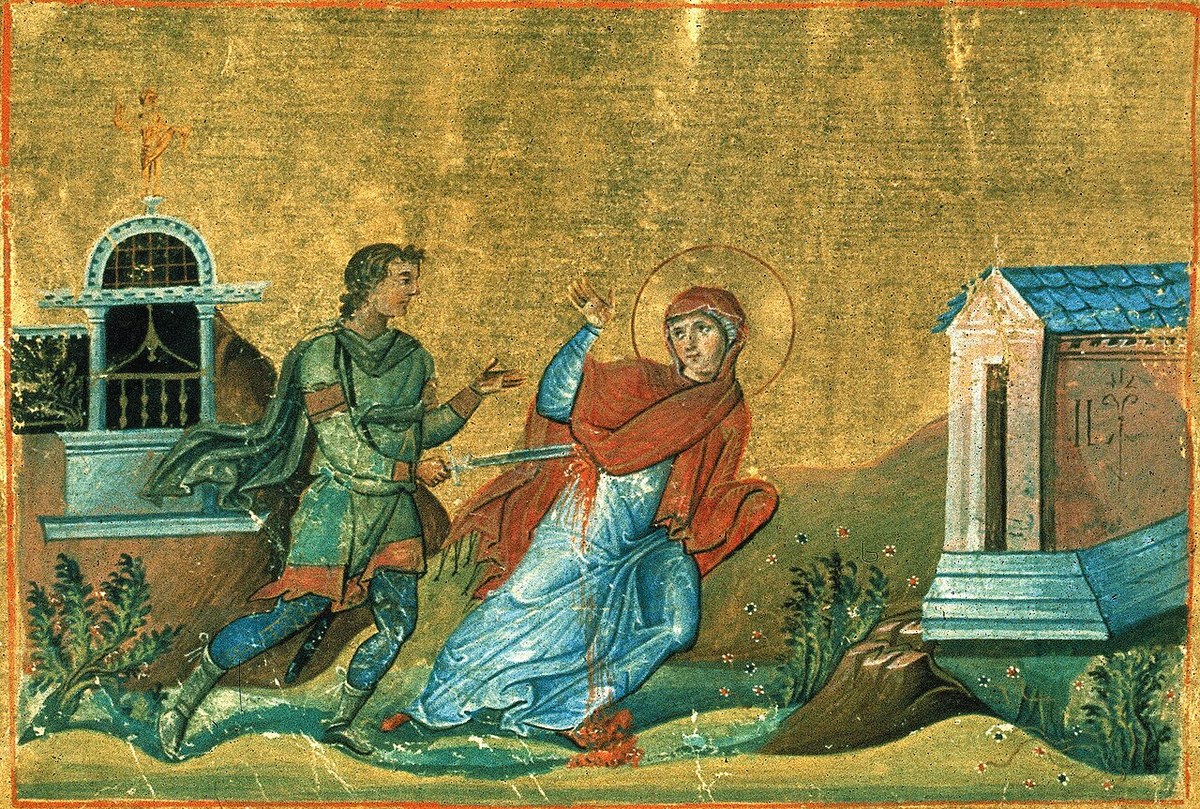
Anysia would not be moved. Signing herself with the Cross and confessing that she was the servant of the one true God, Jesus Christ, she refused the sacrifice; and when the soldier answered with blasphemy and tore at her veil, she spat in his face, rebuking the demon he served. Enraged, he drove his sword through her side, and she fell, giving up her soul to God and receiving, in the tradition's phrase, the unfading crown of martyrdom. The Christians of the city, the synaxarion adds, gathered her body and buried it with honour near the gate where she fell, and a small shrine or memorial marked the place. Her death is placed about the year 304, in the same wave of persecution and the same city as the martyrdom of Demetrius.
Feast and commemoration
Anysia is kept on December 30 (church date; Old Calendar civil January 12), within the afterfeast of the Nativity of Christ — the calendars of Antioch, Greece, and the Slavs agree on the day. There is, however, a difference of classification worth recording. The Slavonic and OCA books style her a virgin-martyr (мученица; "Virgin Martyr at Thessalonica"), leading with her consecrated virginity and her death by the sword. The Greek synaxaristes, weighing her years of fasting and withdrawal, more often style her Ὁσιομάρτυς — venerable-martyr, a monastic-ascetic martyr — even though she was not a tonsured nun but an ascetic living in the world. The two titles describe one life under two aspects; this entry follows the leading Antiochian and OCA usage (virgin-martyr) while noting the Greek emphasis. Her proper apolytikion, moreover, is shared with Melania the Younger of the following day, December 31, the two feasts being sung as a pair in the Greek Menaion (Melania is authored at her own feast, December 31).
Hymns
Troparion — Tone 4
Thy lamb, O Jesus, cries out with a loud voice: Thee, my Bridegroom, do I long for, and seeking Thee I contend; I am crucified and buried together with Thee in Thy baptism, and I suffer for Thy sake, that I may reign with Thee; I die for Thee, that I may live in Thee. Receive me as a spotless sacrifice, offered to Thee in love. By her intercessions, O merciful One, save our souls.
Original translation from the Greek
Proper
Having holily accomplished the road of the virtues, thou wast betrothed unto the Word, O modest Anysia, and didst contend rejoicing; while thou, O Melania, made radiant with the splendour of dispassion, didst flash upon the world the lightning of the virtues. And now do ye both make Christ the Lord merciful unto us.
Appointed readings
Epistle — 2 Corinthians 6:1–10
1We then, as workers together with him, beseech you also that ye receive not the grace of God in vain. 2(For he saith, I have heard thee in a time accepted, and in the day of salvation have I succoured thee: behold, now is the accepted time; behold, now is the day of salvation.) 3Giving no offence in any thing, that the ministry be not blamed: 4But in all things approving ourselves as the ministers of God, in much patience, in afflictions, in necessities, in distresses, 5In stripes, in imprisonments, in tumults, in labours, in watchings, in fastings; 6By pureness, by knowledge, by longsuffering, by kindness, by the Holy Ghost, by love unfeigned, 7By the word of truth, by the power of God, by the armour of righteousness on the right hand and on the left, 8By honour and dishonour, by evil report and good report: as deceivers, and yet true; 9As unknown, and yet well known; as dying, and, behold, we live; as chastened, and not killed; 10As sorrowful, yet alway rejoicing; as poor, yet making many rich; as having nothing, and yet possessing all things.
Gospel — Luke 21:12–19
12But before all these, they shall lay their hands on you, and persecute you, delivering you up to the synagogues, and into prisons, being brought before kings and rulers for my name’s sake. 13And it shall turn to you for a testimony. 14Settle it therefore in your hearts, not to meditate before what ye shall answer: 15For I will give you a mouth and wisdom, which all your adversaries shall not be able to gainsay nor resist. 16And ye shall be betrayed both by parents, and brethren, and kinsfolks, and friends; and some of you shall they cause to be put to death. 17And ye shall be hated of all men for my name’s sake. 18But there shall not an hair of your head perish. 19In your patience possess ye your souls.
Iconography
Anysia is depicted as a young woman, veiled and in the maphorion of a female saint, bearing the cross of martyrdom in her right hand — the settled type of a virgin-martyr. Her narrative image is the martyrdom: the maiden struck down by the soldier's sword before the idols, or falling at the city gate. The stored image is the miniature appointed to her commemoration in the Menologion of Basil II (Constantinople, c. 985; Vatican, Vat. gr. 1613): Anysia set upon by the soldier who runs her through with his blade, the martyr's death of the holy virgin of Thessalonica (source, public domain, pd-old-work).