
Apollinaria
Our Venerable Mother Apollinaria
Venerable · b. 5th century, Rome — d. c. 470, Sketis (Egypt)
Commemorated 5 January — Repose at Sketis — kept on the Eve of the Theophany
Apollinaria (fifth century, †c. 470) is one of the women of the Egyptian desert who lived out their monastic life disguised as men. Daughter of the Roman patrician Anthemius, renowned for beauty and learning, she asked her parents' leave for a pilgrimage, gave away her wealth at Jerusalem, and made her way to the desert of Sketis, where — under the name Dorotheus — she was received as a eunuch monk and lived for years in a cell, unrecognised, in great asceticism. When her own younger sister, tormented by a demon, was brought to the holy monks and healed by the prayers of "Dorotheus," and then found to be with child, the blame fell on the monk; rather than defend herself she bore the disgrace, until, brought before her own father, she revealed her identity to her parents alone and returned to her cell. Only at her death was it discovered that the monk Dorotheus was a woman. She is kept on January 5, the Eve of the Theophany, and in the Western tradition is sometimes surnamed "Syncletica."
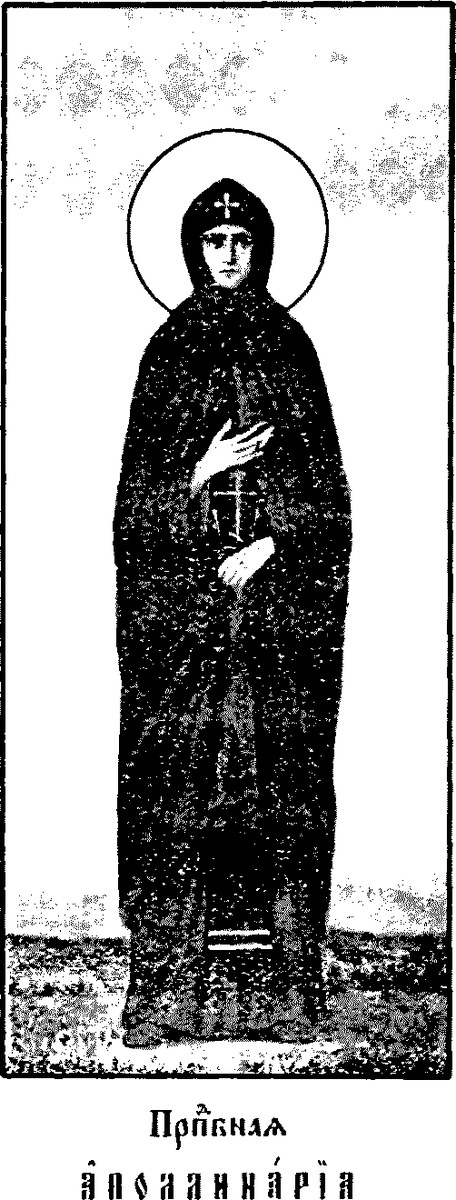

Origins and flight to the desert
The tradition makes Apollinaria the elder daughter of Anthemius, a Roman of the highest rank — the accounts variously make him a former proconsul or one who governed as regent in the minority of a young emperor — and sets her life in the fifth century, in the reign, the OCA notice says, of Leo the Great (457–474). She was famed for beauty and wisdom, and, like Syncletica before her, refused marriage for the love of Christ and consecrated herself to virginity. Obtaining her parents' consent to make a pilgrimage to the holy places, she came to Jerusalem, worshipped at the shrines, and there distributed her possessions to the poor, keeping only what she needed to disappear from the world.
Guided (the Life says) by an angel, she came into Egypt and to the great lavra of Sketis, the desert of Abba Macarius. To live among the monks she laid aside her name and her sex: cutting her hair and putting on a man's habit, she presented herself as a eunuch named Dorotheus, and was received into the community, where "Brother Dorotheus" lived in a solitary cell, labouring in fasting, vigil, and prayer, and advancing so far that the gift of healing was attributed to the unknown monk.
The ordeal and the hidden identity
The testing of Apollinaria came through her own family. Her younger sister, left at home, was seized by a demon, and her despairing parents — knowing the fame of the monks of Sketis — sent the afflicted girl to the desert to be healed. She was entrusted, in the way of Providence, to Dorotheus, whose prayers delivered her; but after the sister's return home it was found that she was with child, and she accused the monk who had healed her. The scandal fell upon "Dorotheus," and Apollinaria — who could have ended it with a word — chose instead to bear the false accusation in silence, as her Lord had borne false witness.
Summoned at last to answer, and brought before her own father and mother, she made herself known to them alone, revealing that the accused monk was their lost daughter Apollinaria, and that the charge was therefore impossible; the demon, and not the monk, had wrought the sister's affliction, and the girl was healed and cleared. Binding her parents to secrecy, Apollinaria returned to her cell at Sketis and took up again the hidden life of Dorotheus. She reposed about the year 470, and only when the brethren came to prepare the body of their fellow-monk for burial was it discovered that Dorotheus had been a woman — the secret of her whole ascetic life disclosed at the grave.
Feast and commemoration
Apollinaria is commemorated on January 5 (church date; Old Calendar civil January 18), the Eve of the Theophany, her memory kept with the Forefeast within the strict-fast vigil. She belongs to the small and striking company of monastic women who lived as men — with Matrona of Constantinople, Theodora of Alexandria, Eugenia, Euphrosyne, Pelagia, and Mary/Marinos — a motif the Egyptian and Byzantine synaxaria preserved as a figure of the total renunciation of the world and its judgments.
Hymns
Troparion — Tone 8
In thee, O Mother, was the divine image preserved with exactness; for taking up thy cross, thou didst follow Christ, and by thy deeds thou didst teach us to despise the flesh, for it passeth away, but to care for the soul, a thing immortal; wherefore thy spirit, O venerable Apollinaria, rejoiceth with the angels.
Original translation from the Greek
Iconography
Apollinaria is depicted as a desert ascetic — commonly as an emaciated, long-haired hermit in a garment of palm-leaves or a monastic tunic, in the manner of the anchorites of Egypt, her identity as a woman disclosed only by the inscription; narrative images show the disclosure of her sex at her burial. The stored image is the captioned plate of the illustrated Zhitiya Svyatykh (1903–1911).
Disputed questions
- "Apollinaria Syncletica." In the Latin martyrologies and some Western sources she is styled Apollinaris Syncletica — "Syncletica" being taken as a surname (from synklētikos, "of the senatorial order," her father's rank). This has made her a standing occasion of confusion with Syncletica of Alexandria, the Desert Mother commemorated on this same day: two fifth- and fourth-century women ascetics of Egypt, both associated with Alexandria and the desert, both linked to the word "Syncletica." They are distinct persons with distinct Lives, and are kept as such here.
- The setting and the father. The sources differ over Apollinaria's date: the OCA places her under Leo I (457–474), while other recensions set her father Anthemius as regent in the minority of Theodosius II (early fifth century), which would move her a generation earlier. The identification of "Anthemius" with a specific historical figure (the emperor Anthemius, or the praetorian prefect) is not secure; the entry follows the received hagiography and gives the repose as "c. 470."